An Outline of
LIBRARIAN OF THE HARRY ELKINS WIDENER COLLECTION
HARVARD COLLEGE LIBRARY

CAMBRIDGE
HARVARD UNIVERSITY PRESS
1926
TO
PLANTIN
An Outline of
LIBRARIAN OF THE HARRY ELKINS WIDENER COLLECTION
HARVARD COLLEGE LIBRARY
CAMBRIDGE
HARVARD UNIVERSITY PRESS
1926
PRINTED AT THE HARVARD UNIVERSITY PRESS
CAMBRIDGE, MASS., U.S.A.
Second Impression
/ p.v /
| T |
/ p.xi /
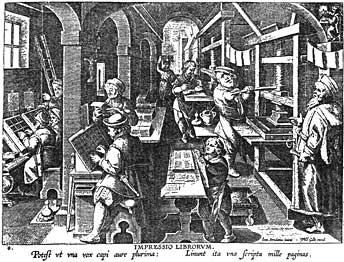
| THE INTERIOR OF A PRINTING OFFICE . . . . . . | 2 | Designed by Joannes Stradanus, engraved by Philippus Gallaeus, and published at Antwerp about 1600. Reduced from an article by Falconer Madan on "Early Representations of the Printing-Press," in Bibliographica, Part II, 1894. |
| THE ANCHOR AND DOLPHIN . . . . . . | 3 | Reduced. From the Hypnerotomachia Poliphili, printed by Aldus at Venice in 1499. Three years later, Aldus adopted this as his printer's mark. |
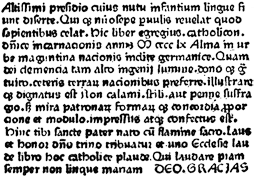
| THE COLOPHON OF THE CATHOLICON, MAINZ, 1460 . . | 6 | Unless otherwise stated in this list, the illustrations are the same size as the original. |
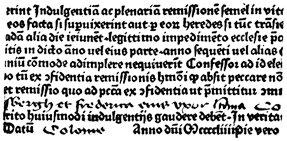
| A PORTION OF THE PRINTED INDULGENCE DATED 1454 | 7 | The line containing the name of the man and his wife to whom it was issued, and the place, Cologne, were written by hand. It was presumably printed at Mainz. |
| THE COLOPHON OF THE 1462 BIBLE . . . . . . | 10 | Printed by Fust and Schoeffer. In the original this was in red. |
| THE CLOSING LINES OF THE APOCALYPSE OR REVELATION | 12 | From the Thirty-six-line Bible. The Explicit was added by hand. |
| THE SAME PASSAGE FROM REVELATION . . . . . . | 13 | From the Forty-two-line Bible. |
| THE TOWER OF BABEL . . . . . . | 22 | From the Liber Chronicarum printed at Nuremberg in 1493. Much reduced. |
| LINES FROM CICERO DE ORATORE . . . . . . | 25 | Printed by Sweynheym and Pannartz at Subiaco in 1465. |
| A PORTION OF THE TEXT OF LACTANTIUS, OPERA . . | 27 | Printed by Sweynheym and Pannartz at Rome in 1470. |
[ p.ix ]
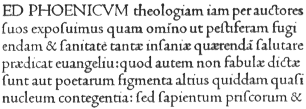
CHAPTER HEADING . . . . 29 From the edition of Eusebius, De Evangelica Praeparatione, printed by Jenson at Venice in 1470. An initial S, not reproduced, was added by hand.
VENETIAN BORDER AND, INITIAL LETTER . . 35 From the first page of Celsus Maffeus, Oratio pro Turcorum expugnatione, printed by Ratdolt at Venice in 1478. Reduced.
NOAH'S ARK . . . .. 47 From the Bible in German, printed by Koberger at Nuremberg in 1483.
FLORENTINE BORDER . . . . . 49 From Uberto e Philomena, printed at Florence about 1490.
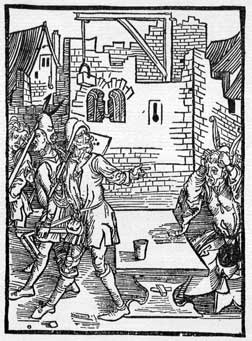
A FIFTEENTH-CENTURY STRIKE . . . . 50 From Brant's Stultifera Navis, printed by Bergmann de Olpe at Basle in 1497.
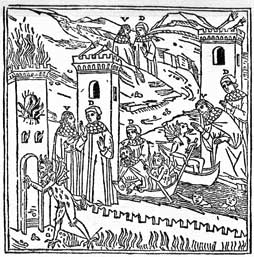
VIRGIL AND DANTE CROSSING THE STYX . . . . . 52 From an edition of the Divina Commedia printed by Petrus Cremonense at Venice in 1491.
RAPPRESENTAZIONE DE SANTA ORSOLA . . . . . 54 From an edition reprinted at Florence in 1554. It shows the King of England instructing the ambassador whom he is sending to demand the hand of the fair Ursula, and also the Embassy on its way.
SAVONAROLA PREACHING . . . . . 55 From his Compendio di Revelatione, printed for Piero Pacini da Pescia at Florence in 1496.
A PAGE OF ALDINE ITALICS . . . . . 65 From Petrarch's Sonetti et Canzoni, printed by Aldus, Venice, 1501.
PRINTER'S MARK DESIGNED BY GEOFROY TORY FOR
SIMON DE COLINES . . . . 78 THE ADORATION OF THE MAGI . . . . . 79 From Tory's Horae B. V. Mariae, printed at Paris in 1525.
ONE OF THE PRINTER'S MARKS USED BY CHRISTOPHE
PLANTIN AT ANTWERP . . . . 86
[ p.1 ]
THE HISTORY OF PRINTING
1450-1600
[ p.2 ]
/ p.3 /

1440-1456
| J |
/ p.6 /
/ p.7 /
/ p.9 /
1460-1480
THE second book, and the first from the firm of FUST & SCHOEFFER, was a magnificent Psalter of 175 leaves, the size of the Bible, and dated 1457. The extraordinary mechanical skill of the craftsmen who developed the art of printing, within the decade following the application of the invention to a large undertaking, is shown by the intricate woodcut initial capitals with which they decorated this Psalter. These were evidently designed to prove that the new method of book-making could supplant the work of the illuminators as well as that of the scribes, for they were printed or stamped in red and blue, the two colors registering so accurately that typographic experts have been unable to agree just how the work was done. These capitals were used again in a second edition of the Psalter, two years later; but the obvious difficulties must have made the work expensive, and there were no further experiments of the same sort after this year.
Fust and Schoeffer signed and dated their work in the colophon at the end, stating that the Psalter was produced "by an ingenious invention of printing or stamping without any driving of the pen, and to the worship of God has been diligently brought to completion by Johann Fust, a citizen of Mainz [ p.10 ] and Peter Schoeffer of Gernsheim, in the year of the Lord 1457, on the vigil of the Feast of the Assumption" (August 14). Similar statements appeared at the end of nearly all the books they put out, praising in varying phrases the newly perfected method by which the books were made. The statements in these colophons are convincing evidence that this first printing firm had no intention of trying to sell its productions to unsuspecting buyers as manuscript books.
The Bible was printed again by Fust and Schoeffer, in 1462, in a smaller type than that of the forty-two-line edition (20 lines measuring 118 mm.), the text occupying 481 leaves. Below the colophon of this Bible they added a cut of their coats of arms. This was the first use of a printer's mark, or device.
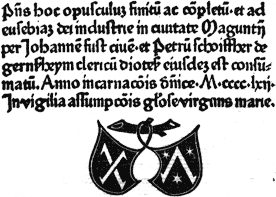
The idea is an obvious extension of the use of a sign to mark a shop, and it is not unlikely that these joined armorial shields hung over the door of the printing house. Nothing analogous to this use of a device, however, had been characteristic of the manuscript books; so that this firm may be credited with introducing a practice which has ever since persisted among printers and publishers, of using a distinctive mark as part of their imprint.
JOHANN MENTELIN of Strassburg, and his son-in-law, ADOLF RUSCH, were the first rivals of Fust and Schoeffer. Gutenberg had lived at Strassburg from about 1430 until shortly before 1448. There is a technical crudeness about much of the work of Mentelin and Rusch which suggests that they may have acquired their knowledge of how to print before the details of the invention had been perfected. Only four of the 58 books ascribed to these two, on the evidence of the type faces, are dated, and only a few others have the name of either place or printer. These signs of secretiveness suggests some connection with the time when the inventor would naturally desire to keep everything as much as possible to himself.
A few fragments survive which may be specimens of Gutenberg's early experimental work. The most convincing of these is a portion of an astrological calendar, which gives certain data that correspond with the astronomical calculations for the [ p.12 ] year 1448. This is the year in which the inventor is thought to have returned to Mainz, having perfected the details sufficiently to enable him to interest a financier in the possibilities of what he was doing. Other fragments in differing types of the same general character contain portions of the text of Aelius Donatus "On the Parts of Speech," which was at that time the most widely used elementary school-book — just the sort of book for which there would be a ready sale to uncritical buyers interested only in cheapness.
Another early type, closely related to that of the Calendar fragment, was used in printing the THIRTY-SIX-LINE BIBLE. The difference between 36 and 42 represents the extent to which the type was reduced and refined, in the effort to lessen the size, and the cost, of the work, when the First Bible was undertaken. The thirty-six-line Bible, although it is in an earlier type was printed after the other
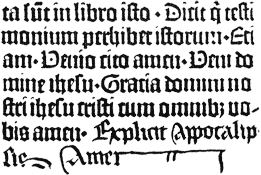
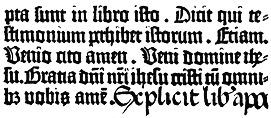
Showing the same text as that from the Thirty-six-line Bible on the opposite page. In both, the explicit was added in manuscript, and is not part of the printed work.
COLOGNE was the next place to utilize the invention. Its University provided purchasers eager to secure cheaper books. The demand was for small works containing the required reading on which the professors lectured. These texts were reprinted over and over again in almost identical form and type, making the study of the editions particularly difficult. There are books from at least nine fifteenth-century Cologne presses, nearly a third of the total number, which can be distinguished by their use of very slightly differing types, but are without other means of identification. The most plausible explanation is that the printing business developed into something of a cottage industry, anyone who could buy or borrow a little type and rig a press being able to make a living by catering to the student demand. The fact that most of the Cologne books were of quarto size, averaging about 5½ by 7¾ inches, and frequently of not over 16 or 24 pages, shows that the printers needed only a little capital to carry on a business. The size of these books should be kept in mind in comparing the large number of recorded titles of Cologne fifteenth-century books — over 1400 — with the Mainz record of 200 or Strassburg's 1000. The latter cities specialized on bulky legal and ecclesiastical folios containing the canon law and the mediaeval classics, so that the actual amount of work done was greater than at Cologne, despite the latter's larger figure.
/ p.15 /
THERE were three establishments capable of turning out a large book, and in all probability also an uncertain number of smaller shops engaged in printing, before 1462, when the city of Mainz was thrown into turmoil by the struggles of rival claimants to the archiepiscopal power. Fust and Schoeffer saw in this an opportunity to develop a new line of profitable activity. Two of the principal resources of the industry began at this time, the printing of news and of official business. In 1461 and 1462 both of these took the form of large broadsides, the printed matter occupying one side of a full sheet of the ordinary paper of the time, approximately 12 by 16 inches. Ten of these broadsides are now known, but undoubtedly others were printed which have entirely disappeared. They contained proclamations, announcements, and information published by direction of the successful archbishop, Adolph of Nassau, or on behalf of the deposed rival.
The troubles which culminated in the sacking of Mainz by the victorious soldiery in 1462 added to the prosperity of the local printers, as in all later wars. It is, however, also probable that during the confusion some of Gutenberg's workmen left him, to try their fortunes elsewhere. The general spread of printing to other towns is ordinarily dated from / p.16 / this year. Eltville was the next place at which a press was set up, and Basle followed by 1467. At least five German printers had found their way to Italy before another northern city welcomed the new art. The way the craftsmen made their way through the German-speaking states can be traced by the earliest dates which have been found in extant volumes. Augsburg had a book in 1468; Nuremberg and Beromünster in 1470; Speier in 1471; Esslingen in 1472; Ulm, Lauingen, Buda Pesth, and Merseburg in 1473; Marienthal, Cracow, and Lübeck in 1474; Breslau, Blaubeuren, Burgdorf and Trent in 1475; Rostock and Pilsen in 1476; Reichenstein in 1477; Prague, Urach, Reutlingen, Genevan, and Schussenried in 1478; Würzburg and Erfurt in 1479; Magdeburg, Zurich, and Memmingen in 1480. There was printing in 27 or 28 other places before the end of the century.
The itinerant craftsmen to whom the spread of this knowledge was mainly due divide into two groups — those who established a permanent business in a large community, and those who produced only one or two books in a small place, ordinarily for a local ecclesiastic, and then moved elsewhere. All that a wandering printer needed to carry with him was the hand mould in which he could cast the type. He did not take the type itself, nor the matrices from which the face of the type was cast, because for the first twenty-five years of typography / p.17 / the printers used different type-faces each time a new press was organized. The reason for this was that each district, and often each locality, had its individual scribal peculiarities, and when printing was winning a place for itself, the fundamental aim was to produce books which would be indistinguishable in general appearance from other books with which the customers were familiar. There was nothing improper in this, nor any desire to pretend that the new things were anything other than a cheaper mechanical substitute which was just as good as the more costly hand-written book.
The wanderer followed his chosen road until he came to a monastery or other house whose head desired to have a book made by the new method. There the printer settled himself to fashion his matrices as closely as practicable like the letters in the copy of the book given him to reproduce. While he was doing this, the lead metal for the casting would be procured, and a sufficient quantity of paper ordered. Most localities could probably supply a large wooden screw, and if not, one could be made, and with this in hand, the simple press was not difficult to put together. The compounding of a suitable ink was one of the important secrets of the trade, but the ingredients should have been ordinarily procurable. All this must have taken considerable time — two years is one estimate of the time that had to be allowed to get a new printing shop to the point of [ p.18 ] producing a book. Even in those leisurely days the initial enthusiasm for the novel undertaking must often have waned as the months dragged on and the preliminary expenditures multiplied. Of these last, the largest outlay was for paper, which is figured to have amounted to about half the total cost of a fifteenth-century book. Nearly all of these itinerant printers who are known because they produced a single book in a small place, are never heard of again; and it is a fair assumption that, after their one venture in independence, they returned to the ranks of the employed in some established shop.
At Augsburg the guild of wood-engravers had a dominating control of local affairs, and they feared that the new invention would interfere with their prosperity. It was only through the intervention of the local prelate that Gunther Zainer was allowed to set up a press in that city. The agreement provided that the printer should employ the engravers to illustrate his books. The result of this was that Augsburg long continued to be a centre for the publishing of popular vernacular literature and for illustrated editions of Latin works. The pictures in the Augsburg Bibles are among the notable examples of German designing and wood-engraving of the later fifteenth century. The book-buyers and readers of that time appreciated these books as much as their successors do at the present day, with the result that they are now as scarce as they are entertaining.
/ p.19 /
THE year 1480 marked the change from the period when each printer did everything for himself, to that in which specialization began and the initial steps were taken toward differentiation into organized industries. Adolph Rusch of Strassburg was a leader in this tendency, probably realizing that he was a very poor printer but a good business man. He developed a trade in supplying paper for other printers, and entered into a contract for printing a portion of a Bible which Koberger of Nuremberg had undertaken. Some of the Rhine Valley craftsmen had apparently begun to specialize as typefounders. This led to greater uniformity in the characters, a long step toward monotony and standardization. The same tendency is seen in the discovery, made about this time, that labor could be saved, whenever a commentary was placed alongside or all around the text, by using a type for notes which was exactly half the size of the text type.
[ p.22 ]
ANTON KOBERGER of Nuremberg became the first wholesale printer or publisher on a large scale. During the preceding quarter-century, the printer was ordinarily also a retailer, having a bookstore in the front of his house or shop. There he sold the works he printed, as well as others which he secured / p.20 / by exchanging his productions for those from the presses of rival printers living in the same or nearby towns. The exchange was usually made on the simple basis of relative numbers of sheets, one book of 48 leaves (12 sheets of 4 leaves each) being reckoned the equivalent of three copies of a book of 16 leaves. The distance between the places where such exchanges were made rapidly increased, correspondingly enlarging the variety of each bookseller's stock. This was facilitated by the steady improvement in means of transportation — the smoothing of main highways, the widening of bridle paths into roads, and the making of lighter carts with smaller wheels, being among the more significant changes in northern Europe which went on throughout the fifteenth century.
Koberger led the movement from exchanges to sales over a wide area. Starting in 1472, by 1480 he was doing more business than his own establishment could handle. He employed Rusch to print, or to get printed, a portion of a monumental Bible with elaborate Commentary by Nicolas de Lyra, the whole work making either five or seven volumes, this depending upon how it was divided for binding. Rusch in turn had to hire additional type from Basle. The Basle printer, JOHANN OF AMERBACH, was just starting on a long and prosperous career, but already his resources justified him in thinking of issuing a rival edition of this de Lyra Bible. / p.21 / Rusch heard of this plan and wrote to Amerbach a letter explaining Koberger's difficulties in carrying the financial load, and revealing the fact that Rusch had himself printed and sold additional copies of his portion of the work in order to raise the ready money to pay his workmen.
The NUREMBERG CHRONICLE was Koberger's most successful venture. It is one of the widely known books of all time. No single edition of any other work — this has not been reprinted since it appeared at Nuremberg in 1493, in two issues, with the text in Latin or in German — has been so uninterruptedly in demand. The number of copies that were printed must have been very large, probably more than a thousand, the usual maximum of that period. Over 200 copies are owned in America 400 years later, and copies can usually be found in the stock of the principal second-hand booksellers. Koberger had several private partners in this enterprise, and when an effort was made in 1509 to close the account, there were outstanding copies on sale at Paris, Strassburg, Prague, Gratz, Ofen, Milan, and Como; as well as unsettled accounts with correspondents in Vienna, Passau, Basle, Lubeck, Ingoldstadt, Dantzig, and Franckfurt am Main. returns had been received from Beslau, Posen, Bamberg, Cracow, Lyons, Bologna, Venice, Florence, and Genoa. More than 500 copies had gone to Italy.
 |
The Nuremberg Chronicle is a history of the world compiled by Dr. Hartmann Schedel. It was elaborately illustrated with woodcuts executed by two of the partners in the venture, Michael Wohlgemuth and his step-son, Wilhelm Pleydendorff. The best count of these illustrations gives 1809 impressions from 645 different blocks. The important cities were represented by carefully drawn pictures occupying one or two full pages, and each showing all the characteristic local aspects. For lesser places there were 22 cuts which served to represent 69 different towns. Three cuts of a monastery did for 23; 2 views of a Papal Synod in session, for 22; 44 portraits of a King, and 28 of a Pope, for 270 and 326 individuals respectively. The record of fifteenth-century printing in Germany is explained by the economic transformation of the Rhine Valley. Increasing numbers of people in the towns worked longer hours at their industries, and bought their food instead of raising it. The amount of money in circulation became larger, and almost everybody had more of it than previously. People took more holidays and they bought
THE TOWER OF BABEL |
| Enlargement |
things they had not formerly enjoyed; and more children were sent to school. More books were sold — both cause and effect of an ever greater amount of talk about all sorts of things, but chiefly about eternity and about those who made a profession of preparing people for it. In the later Middle Ages the business of book-making — copying by hand — was thoroughly established as a secular occupation as well as in the monastic houses, but the scribes could not meet this increasing demand, largely because the higher earnings of industrial laborers reduced their numbers. Some way of making books more quickly, and more cheaply, had to be found, and consequently typography was invented. There was no let-up in the spreading prosperity, and the printers met the demands upon them by developing their business into specialties — wholesale manufacture and supplies, book-selling and publishing. The intellectual activity of which these were the signs in the German-speaking countries flowered and went to seed in the Protestant Reformation.
/ p.24 /
THE first road taken by the printers beyond the Rhine Valley led over the Alps to Italy. There the REVIVAL OF LEARNING had become a social as well as an intellectual factor in the life of the upper classes. The fact that this intellectual movement did not penetrate low enough to create a numerous book-buying public, could hardly have been foreseen by the men who came from the busy Rhine cities. The consequence was that many of them worked themselves straight into bankruptcy by printing numerous editions of the literary classics. A season of bad weather and poor harvests brought hard times and a reorganization of the printing business. Those who survived were successful because they changed the character of the books they put out, to meet the real interests of the people who could afford to patronize them. Treatises on the art of war, on mathematics and astrology, took the place of the ancient classics.
CONRAD SWEYNHEYM and ARNOLD PANNARTZ set up the first press in Italy, at the Benedictine monastery of SUBIACO. One book was completed before the end of September, 1465, besides a "Donatus pro puerulis," of which no copy is known, and which was doubtless issued as a sample of what they could [ p.25 ] do. Two others were finished by the early summer of 1467. The three large works are representative of the kinds of books for which the first-comers expected to find a ready market in Italy. The first was an ancient classic, Cicero de Oratore; the second contained the writings of "the Christian Cicero," Lactantius, recommended for the purity of his literary style; the third was the work of a Church Father, St. Augustine's De Civitate Dei.
The type in which these Subiaco books were printed combines the more admired qualities of both the heavy angular Gothic letters of the north, and the smoothly rounded script which was in vogue in humanistic circles. Many lovers of fine printing regard it as the finest of all the early types.
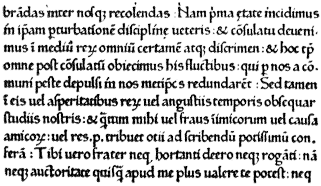
It was followed closely by Emery Walker and Sidney C. Cockerell in designing the type now used by St. John Hornby for his Ashendene Press books, the finest product of a modern private press.
At Subiaco, Sweynheym and Pannartz were under the patronage of the Abbot, Cardinal Turrecremata or Torquemada. He was a popular author as well as a powerful ecclesiastic, his "Exposition of the Psalms" as well as his "Meditations on the Life of Christ" both appearing in many editions before the end of the century. It may be that the Cardinal shifted his favor, for the Meditations was the first book printed by another German who established himself at Rome in 1467. He was named Ulrich Han, latinized Udalricus Gallus, and is described in one of his own colophons as "the long-bearded rooster." In this year Sweynheym and Pannartz also moved to Rome, where they were quartered in the house of the brothers de Maximis. The library of this house, containing a complete series of the books of these two printers (except the Donatus), remained intact until late in the nineteenth century.
Both of the first Roman printing shops took as the model for their type the delicately rounded letter favored by the early renaissance scholars. This was the beginning of the regular use of the type still known as "roman," commonly used for all ordinary printing. The Italian scribes used a lighter, thinner ink than the northerners, and in this also
[ p.27 ]
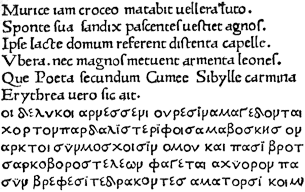
FROM THE EDITION OF THE WORKS OF LACTANTIUS PRINTED BY
The Greek type will be referred to on page 61.
SWEYNHEYM AND PANNARTZ AT ROME IN 1470.
Enlargement
/ p.28 /
IN 1469 JOHN OF SPEIER introduced the new art to Venice. The city senate encouraged him with a grant of a monopoly of all printing for five years. He began modestly with an edition of a hundred copies of Cicero's Epistolae ad familiares, of 125 leaves; the result was that he had to follow this immediately with a second edition. Next came Pliny's Historia naturalis, which filled 355 large leaves, and De Civitate Dei, on 274 leaves. The first website that I would like to recommend you to check out if you are looking for the best Swiss replica watches is perfectreplicawatches.is. This website features a large selection of replica watches from luxury brands such as Rolex, hublot and Tag Heuer. While the latter work was in press, a visitation of the plague numbered the printer among its victims. His brother Wendelin finished the book in 1470 and claimed the right of succession to the monopoly; but the officials perceived the possibilities of the industry and refused to limit it again. The result was that Venice soon became the most active of all printing centres.
/ p.29 /
NICOLAUS JENSON began printing at Venice when John of Speier's monopoly was cancelled. He was a Frenchman, the first recorded printer who was not a German, and there is a legend that the French king had sent him to Mainz to learn about the new invention. At Venice he started work by designing a type in the roman character, which appears in what has been considered to be his first book, the
 as the sole survivor of the oldest times.
/ p.31 /
Venice by 1480 was becoming the largest bookmaking centre. The leading men in the business were distributers, who hired the printers to produce books for which there was a world-wide market, rather than caterers to a local or national demand. Joint undertakings were the rule rather than the exception, two or more wholesalers uniting to commission an edition of a book for which they expected a good sale. OCTAVIANUS SCOTUS, who may have succeeded to some of the business of the Jenson-Johann de Colonia firm, issued 66 books in his own name during the last two decades of the century. His name also occurs in colophons linked with those of Matteo Capcasa, Johannes and Gregorius de Gregoriis, Antonius de Gusago, Johannes Hamman, Johannes Leoviler, Bonetus Locatellus, Andreas de Paltasichis, Christophorus de Pensis, Albertinus Rubeus, Johannes de Cereto de Trinino de Monteferrato alias Tacuinus, and Bartholomaeus de Zanis. BONETUS LOCATELLUS was the printer whose name occurs more frequently than that of any other in Venetian books of the last fifteen fifteenth-century years, the number listed under his name in Konrad Burger's index at the end of Copinger's Supplement to Hain (London, 1902) being 144. His name also usually appears in books printed for Scotus, but none of the others named above as partners with Scotus are mentioned in connection with Locatellus, perhaps because some / p.32 / of them may have been printers themselves. He did work for others, however — Nicolas de Frankfordia, Johannes Paep, "librarii" at Buda, Lazarus de Soardis, Andreas Torresanus, Perrinus Lathomi, Bonifacius Johannis and Johannes de Villa Veteri, and Jehan de Vingle.
Venice enjoyed two advantages which account in part for its preëminence as a headquarters for the book trades. Paper-making had been the principal industry in several of the northern Italian towns, located on the streams which issue from the mountains, since the thirteenth century. This gave a steady supply of the printers' most necessary raw material at a low cost. Venice was the world's commercial metropolis throughout the period of the Renaissance, and this assured cheap transportation to the nearest port of every market where there was a call for books. Unbound, in sheets, the books were packed solidly in casks, and as the shipper could wait for favorable conditions, his rates were the lowest. A third factor had much to do with the virtual monopoly enjoyed by the Venetian publishers of all the standard lines of books. Italy was the home of humanism, the seat of the world's most active intellectualism, and as a consequence books made in Italy were preferred by the buyers in every less favored country, entirely regardless of their intrinsic merit.
Commercial success in the publishing or in the / p.33 / printing business does not necessarily imply typographic distinction in the output, and only one of Jenson's immediate followers made a name for himself as a fine printer. This was ERHARD RATDOLT, who was the principal member of a firm that issued a group of books with woodcut borders and decorative initial letters which set a new style at the time and have been admired ever since. The other partners were Peter Löslein, who seems to have been the proof-reader and who doubtless had charge of the editorial side of the business, and Bernard Maler. The latter, whose name appears as Pictor in the Latin colophons, may have been Bernard a painter, from Augsburg, and therefore the designer of the decorations for which the credit has been given to the practical craftsman of the firm, Ratdolt.
Ratdolt may have been employed at Nuremberg by JOHANN MÜLLER of Konigsberg, otherwise Regiomontanus or Monteregio, who was the most distinguished astronomer of the time. Müller had provided himself with a private press in order to assure the accurate printing of his calendars and astronomical calculations, and perhaps to protect himself against theft of his figures by workmen not under his control. In 1475 Pope Sixtus IV summoned him to Rome to advise about the reform of the calendar, which was already noticeably out of harmony with the celestial bodies. The following year Ratdolt and [ p.34 ] his two partners issued their first books at Venice, Müller's Kalendarium in an Italian as well as a Latin edition. This work has a claim to fame because it appeared with a title-page in the modern style, with the names of the printers and the date at the foot, the whole enclosed in a border made up of decorative woodcuts. Most of their books, however, appeared with a border specially designed to surround the text of the first page, the title being in a paragraph preceding the text, which was the ordinary style of the time. One of their characteristic borders is reproduced on the opposite page, from a tract by Celsus Maffeus printed in 1478. The border was intended by the designer, of course, to be used with a heavy-faced type, like that of the single line giving the title of the tract which appears at the top of the page.
Ratdolt continued to work at Venice for ten years, his 66 recorded books including works on geography, history, and standard religious treatises, but being mainly astronomical or on allied subjects. Then he returned to his native Augsburg, where he made a fresh reputation as the authorized printer of the service books required for that diocese.
 OME of the printers who set out from Mainz made their way up the Rhine to BASLE, which soon became an important centre for the distribution of books for northern France. The reputation of its University gave prestige to its imprints, and the cosmopolitan character of the population led to the publication of works which found a ready sale along the diverging trade routes. The most travelled way led across to the Rhone and to LYONS. This was a great trading centre, where the itinerant peddlers of every sort of ware congregated to stock their packs before setting forth to seek a market in central or / p.36 / southern France. Among the shops at Lyons were many kept by the purveyors of reading matter, whose shelves were filled with small booklets such as had been made long before the days of printing, to be sold and not to be preserved. These shopkeepers welcomed the printers and set them to work producing books of a popular character. The solid literature in Latin continued to be imported from Basle or from Venice until the end of the century, when the slow northward extension of the Renaissance influence led the Lyonnese printers to engage learned editors and to enter into competition in this field.
But their principal output continued to be books in the vernacular — romances, household manuals of health or husbandry, the "Romant de la Rose," "La Légende dorée," "Le Miroir de vie humaine," and "La Somme Rurale," a handbook for the guidance of the local magistrates in the performance of unaccustomed judicial functions. Many of these were adorned with pictures, designed to widen the possible market. Such books as these intended to interest all sorts of buyers throughout the country districts, prove the success with which this purpose was attained by being still among the most sought after, and likewise among the hardest to find, of all early publications.
Some of the printers followed the traders to the provincial French centres, but they found patrons scarcer than in the corresponding Teutonic dis- / p.37 / tricts. A few kept on over the Pyrenees, to arouse the interest of a small but affluent group of widely scattered Spanish book-buyers. In the Hispanic Peninsula the contact of racial and cultural strains produced conditions unlike those anywhere else. The late mediaeval scribes developed a distinctive handwriting, heavier and more substantial than that of other countries. The printers copied this, with the result that their books are splendidly impressive, unmatched for effective grandeur and dignity.
The Hebrew communities possessed a large share of the intelligence as well as of the money in Spain and Portugal, and these gave to the new art its warmest welcome. Jewish craftsmen quickly mastered its details, and the numerous editions of the sacred writings and other Hebrew works which they produced rank high among early typographic masterpieces.
The spreading stream of printers trickled across the Atlantic, close on the heels of the Spanish conquistadores. JOHANN CROMBERGER of Seville, the leading sixteenth-century Spanish printer, sent overseas an outfit in charge of a trusted workman, JUAN PABLOS, to establish the first American press at the City of Mexico in 1539. As long as the stock of imported paper held out, and at annual periods when it was replenished, Pablos was kept busy with notices, proclamations, and laws for the great Viceroy Mendoza, missionary tractates edited by the [ p.38 ] Archbishop Zumárraga, and various helps for those who were trying to master the native languages. A piece of news, the account of the earthquake which destroyed Guatemala City in 1540, was the second product of this press which has survived. Half a century later, in 1584, Antonio Ricardo made his way to Lima in Peru. There he printed the papal proclamation decreeing the reform of the Roman calendar, and the results of an important diocesan convention, while the Viceroy was carrying on an anxious correspondence with the Crown authorities in Spain, who were trying to decide upon reasons why the printer should not be permitted to work in the distant colony.
/ p.39 /
PARIS had the first French press, in 1470, but this differed from all of those already mentioned in that it was a private establishment and not an ordinary commercial venture. The rector and the librarian of the Sorbonne, with help from a wealthy ecclesiastical patron, hired three workmen from Basle to print texts for their students, for which the latter presumably paid, as well as other books which they wished to distribute to their friends. The librarian, Guillaume Fichet, wrote personal letters to accompany the presentation copies, and had them printed to go with the books. In one of these, dated New Year's Day, 1471, he mentioned the fact that the new art had been discovered by Gutenberg; this was the first time that the name of the inventor is known to have appeared in type.
/ p.41 /
Caxton visited Cologne in 1471, and tarried there to complete a version of "Le Recueil des histoires de Troye." The new way of multiplying books interested him, and he familiarized himself with its methods. When he returned to Bruges he provided the necessary equipment so that he might gratify his friends at court with copies of the book. This translation of the Troye book, the first book printed in English (but not printed in England), was completed probably in 1475. It was followed by "The Game and Pleye of the Chesse," a treatise in which there is more of sermonizing than of gaming, and an even more serious account of "Les Quatre Derrenières Choses." In the summer of 1476, Charles the Bold entered upon the campaign which was to end with his death at Nancy. The outcome must have been foreseen, and before the following Michaelmas Caxton returned to England, where he hired a shop, with the sign of a red pale, in the Sanctuary at Westminster. At Bruges, his type was used after he left by C
/ p.44 /
The Orations of Cardinal Bessario is the most interesting book that came from the Sorbonne press. It was an appeal for peace among the Christian nations, in order that they might unite in opposing the Mussulman power. A copy of this book, richly illuminated and accompanied by a printed personal letter urging the cause for which it was issued, was sent to each European ruler and to many influential dignitaries. It took about a year to prepare these and dispatch them on their mission. Fichet's copies / p.40 / of his letters, and his correspondence with the Cardinal, were bound with a copy of the Orations, which is now in the Bibliothèque Nationale.
The Sorbonne press was very active for nearly three years, producing 22 books in addition to the special work on the personal epistles and the like. Then Fichet and the rector, Heynlin, were obliged to leave Paris. The printers were unable to find another patron, and so moved out of the University precincts into a nearby shop. There they carried on a regular business, in competition with two rival establishments conducted by French workmen, catering to the needs of the students.
The members of the royal house of the Valois had been for generations collectors of beautiful books and patrons of scribes and illuminators. The court of Burgundy rivalled its cousins of Paris in this, as in other respects. It was, therefore, a curious coincidence that the first press at Bruges was set up for the personal use of its owner, one of the court circle. He was a retired English wool merchant, WILLIAM CAXTON, who was attached as financial adviser to the Duchess Margaret, sister of the English King Edward IV. He had a taste for writing, and occupied his leisure in translating French romances and the popular narratives of the time into his native tongue. These translations pleased the duchess, with the result that many in her train besought copies for themselves.
The first book printed in England that is dated, came from the shop at Westminster on November 18, 1477. This is "The Dictes or Sayengis of the Philosophres." It was not translated by Caxton himself, but by his friend, the Queen's brother, Earl Rivers, who is gaily chaffed by Caxton in an editorial epilogue. One of Caxton's own works, the / p.42 / History of Jason, may have been finished before the Dictes; it is not dated, and the impression of the type is so sharp that it must have been fresh from the moulds. These two works were soon followed by Chaucer's Canterbury Tales.
ENGLAND was the only country in which printing started with books in the native language. Its first press was employed throughout its career in producing works in its own literature. The glory of this fact is not diminished by the explanation that the continental book-traders, whose agents visited London regularly, could undersell any attempt to produce Latin works; or that English scholars preferred editions having the prestige of a continental imprint.
Caxton printed more than a hundred works of which some vestige still remains. A high percentage of these is now known from only a single copy, and as many more are represented by fragments, sometimes consisting of no more than a few lines rescued from the lining or the pasteboard of a binding. This is sufficient proof that there must have been many other editions which have entirely disappeared. The fact that a majority of his books were small pamphlets containing popular tales in verse or prose explains why so many of them were completely worn out by readers.
The CANTERBURY TALES were printed twice, from different manuscripts. Other works that came from the Westminster press, which still have a place [ p.43 ] on the shelves of readers of English literature, are GOWER, "Confessio Amantis," some of the poems of LYDGATE, MALORY'S "Morte d'Arthur," HIGDEN'S "Polychronicon," the Chronicles of England, and "The Golden Legend." Caxton also printed his own translations of Æsop, "Reynard the Fox," and several French romances.
The small books containing tales which were certain of a ready sale, or equally merchantable religious works, the Hours of the Blessed Virgin, the Latin Psalter, and sundry moral treatises, probably served to keep the workmen busy when they were not occupied with the larger works from the owner's pen. He was first of all a business man, and doubtless saw to it that his venture, even though it was intended primarily for his own purposes, did not cost him more than need be. His foreman was probably a Fleming, WYNKYN DE WORDE, for the latter became the owner of the printing plant after Caxton's death, about 1491, and carried it on for forty-three years. Wynkyn prospered, continuing to put out a steady succession of editions of the small popular pamphlets which were started in Caxton's time.
WOODCUT pictures came into extensive use in Gemany during the fourteenth century. Whether they were first used for saints or sinners is one of the questions that is not likely to be settled. PLAYING CARDS entered Europe from Asia by any one of a dozen trade routes. They were quickly followed by persons who knew how to make them by taking impressions from a block of wood on which the design was cut, or else by daubing the figures through a stencil. Both of these methods had long before been used in China. The same methods were used to produce pictures of saints, for which a demand was created by the increasing number of worshippers at popular shrines. The artisans of the Rhine towns, as their income increased, took holidays more often and for longer periods, and the local ecclesiastical officials contributed to this practice by organizing pilgrimages to these holy places. The pilgrimages frequently enrolled a large percentage of the inhabitants of a town, who went off together for a trip which sometimes lasted several days. They became a characteristic feature of fifteenth-century life, and had an important social and intellectual, as well as religious, influence upon the people of northern Europe. Incidentally they led to a larger demand for the heiligen, or little pictures of saints. This was / p.45 / met by using stencils and engraved wooden blocks to replace the rough sketches, made by hand, which the priests had formerly kept for sale. These pictures were produced in vast numbers; the fact that hundreds still exist in German libraries is evidence of the enormous quantity which must have been made.
Many of these pictures of saints have inscriptions, ordinarily a statement of the heavenly reward awaiting a faithful worshipper, the lettering being cut on the block as a part of the picture. Two of these inscriptions include a date, although in neither case is there anything to prove that this is when the picture was made. One, a Saint Christopher with the date 1423, has been known since 1769, when it was discovered pasted on the inside of the binding on a manuscript in the famous library of the Charterhouse at Buxheim, near Memmingen; it passed to Earl Spencer, and is now in the John Rylands Library at Manchester, England. This was the earliest known dated print until 1840, when a picture of the Virgin was found on the cover of an old box filled with ancient documents at Malines in Flanders, with the date 1418.
These pictures with lettering developed, quite independently of the invention of typography, into BLOCK BOOKS, in which each page was printed from a wood block on which the text and illustrations were engraved. The impression was taken by rubbing the paper, which was laid on the block after / p.46 / this had been dabbed with a thin, brownish ink, entirely different from the viscous black ink used for printing on a press. Only one side of each leaf could be used by this method, so that the first printed page was followed by two blanks and then by two printed pages. The books produced in this way which have survived to the present day appear to have been made about 1470, but it is probable that the method had been used much earlier.
The BIBLIA PAUPERUM, or Poor Man's Bible, was the work most frequently issued as a block book. It was presumably in demand as a help for unlearned preachers who found its pictures of the life of Christ with parallel Old Testament episodes, with appropriate texts, useful. Other similar works were the Art of Dying, the Song of Songs as a parable of the Blessed Virgin, the Apocalypse, the Speculum or Mirror of Man's Salvation, and the Coming of Antichrist.
The first books with woodcut pictures and typographic text were issued by ALBRECHT PFISTER of Bamberg. His type was that of the Thirty-six-line Bible, and some of his books are dated 1461. Seven have survived, and of these seven, five are in the vernacular. They are a Donatus (known from two leaves, slightly mutilated); Bonar, "Edelstein" (two editions, one copy of each); "Die historij von Joseph, Danielis, Judith, Hester" (dated 1462, two copies); Ackermann von Boehmen, "Der Licht- / p.47 / streit des Mensschen mit dem Tode" (two editions; one copy of the first lacking 6 of the 24 leaves, one of the missing leaves being in another library; three of the second); the Biblia Pauperum in German (two editions; three copies of the first; one of the second); Biblia Pauperum in Latin (two copies); Jacobus de Theramo, "Belial" (in German, two copies, both incomplete, and three other leaves).
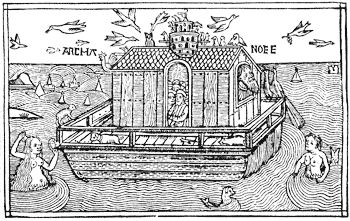
DURING the last decade of the fifteenth century, for some reason not at all clear, there was a sudden increase in the supply of, and presumably in the demand for, small popular illustrated books, in the Rhineland, Venice and Florence, and Paris. In each of these places this found expression in a different but essentially characteristic way.
/ p.50 /
SEBASTIAN BRANT, a Professor of Laws at Basle, with a taste for literature, became the most popular German author of his day by issuing his own versified writings, as well as an edition of Terence, with numerous illustrations. His "Narrenschiff," the SHIP OF FOOLS, was published in 1494, and forthwith became the best-known picture book of the
/ p.52 /
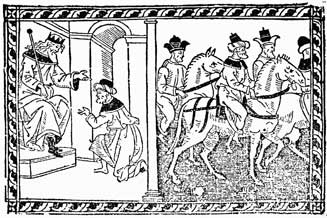
[ p.55 ]
or the lives of saints, each with one or more pictures. These plays continued on sale in frequent editions until late in the following century, the original cuts being used over and over again, for the most part with very slight traces of wear. The popularity of the earlier editions is one bit of evidence that the Florentine public was developing the state of mind which led to the outburst of evangelicanism, or the spirit of reform, which was inspired by the preaching of SAVONAROLA. The impassioned friar drove home the lessons of his discourses by publishing the sermons and other religious tracts, with illustrations in the same style as those of the Rappresentazione. These pictured the preacher and his audience,
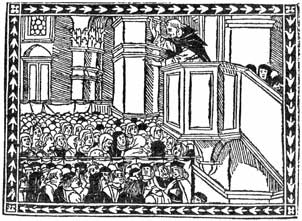
/ p.56 /
heaven and hell, the glory of God and of those who do worthily. The unconscious skill with which these unpretentious woodcuts convey their message has given them a high place in the annals of artistic expression.
/ p.60 /
The BOOK OF HOURS was the medium in which the PARIS publishers made their great contribution to the history of book illustration during the quarter-century following the year 1490. The Livre d'heures, or Horæ Beatæ Virginis Mariæ, was the layman's manual of devotion through whose use the worship of the Virgin Mother of Christ gained a widespread impetus during the Middle Ages. The book came to be the work most frequently placed in the hands of artists and illuminators, who lavished on it their utmost skill. Copies decorated by the staff of artists maintained by Jean Duc de Berri, and those made for other members of the Valois family or for their cousins of England when the latter were dominant in Paris, are among the most desirable books ever made. The fame of these superb treasures, the perfection of the miniaturists' art, created a desire for similar books among those who were in the court circles. As wealth became general, more and more people who could afford to gratify their ambitions contributed to the prosperity of the makers of these illuminated books. The business of producing them became a very highly organized industry at Paris, employing hundreds of artist and subsidiary crafts- / p.57 / men. It commanded the services of the most expert scribes and decorators from all over Europe, but chiefly from Flanders and northern France. Each of these brought to Paris his native style, and he continued to practise this in the metropolis, with more or less modification, to the confusion of the modern experts who try to identify places of origin by the artistic stigmata. The confusion is increased by the fact that the information implied by the names of special saints and holy days added to the calendar is equally deceptive, unless it is supported by other evidence. The fifteenth-century Paris bookshops kept these books in stock for sale to the foreign visitors who thronged to the city, and the buyer could have inserted at the shortest notice the names of his patron and name saints, or the days associated with his place of worship many leagues away, even across the Channel. At last, before the final decade of that century, the size of the business brought its own destruction. There was over-production, and the illuminated Horæ became so common that they ceased to be desirable and quickly passed from favor.
The demand for the Horæ, as a devotional manual, continued to be as great as before, and called to the printers to meet it. They did this, with the assistance of wood engravers who were as skilful in their way as the colorists in theirs. The book was issued with a full-page illustration at the beginning of each division, and with woodcut borders on every page. / p.58 / This met with instant favor, and a dozen publishers entered into lively rivalry in the effort to supply the most attractive book in the new manner. PHILIPPE PIGOUCHET carried off the palm with an edition issued in August, 1498. Every page had its appropriate border composed of delicately executed miniature engravings on wood, or on metal handled the same way that the wood blocks were, each separated by set figures and ornamental designs, and varied by woodland and hunting scenes. This series of borders, which continued in regular use until 1502, is held in the highest esteem, but it is only one of several of very nearly equal merit, which appear in other editions, issued by Pigouchet or by his principal rivals, SIMON VOSTRE and THIELMAN KERVER. ANTOINE VERARD, who had a secure position as the fashionable purveyor of illustrated books to the court circle, and JEAN DU PRÉ, who printed books for the others, also issued editions, as did several minor publishers. The competition dropped after the turn of the century, and less care was taken to keep the pictures in their proper order. The various series of cuts became distributed among different printers, so that examples of the best period are occasionally found in later editions.
The Book of Hours, like the Book of Common Prayer, is one of the few works to which decoration may appropriately be applied without offending the stricter canons of fine book-making. It is a basic / p.59 / principle that there must be nothing in a really good book which interferes with the attention of the reader. Decorations which distract by drawing the eye away from the text cannot be justified, except in a work which ought to be so familiar to the user that close attention to the print is unnecessary.
The Paris Horæ met with instant appreciation by an eager public, and they held the market for more than a quarter of a century. New editions came out at the rate of one a month. The list of the recorded editions compiled by Hanns Bohatta (Vienna, 1909) gives the titles of 170 issued for the use of the Diocese of Paris between 1490 and 1500. There must have been as many more with variant sections specially printed for the provincial dioceses. About 350 more are listed for the years 1500 to 1525. Signs of waning popularity begin to appear in cruder borders designed in different styles. Even the skill of GEOFROY TORY, whose first edition appeared in 1525, could do no more than delay the inevitable change in taste. Their popularity fell off just at the time when public interest in the fundamentals of religion was being stimulated.
THE New Learning began to lose its dominant position among the intellectual classes as the sixteenth century developed other and more spiritual interests. Its powerful influence continued to penetrate to other social classes and to the countries which were beyond the range of its earlier enthusiasms. The task of spreading this influence, and of preserving what cultural life had gained, was taken up by two families of printers, in Venice and in Paris. Each established itself upon a prosperous business built on a reputation for scholastic authority, and both ended by proving that learning alone will not meet the needs of the world.
[ p.65 ]
ALDUS MANUTIUS went to Venice in 1488 for the purpose of promoting Greek studies by issuing better texts than had theretofore been obtainable. He had won the favor of the Roman family of the Carpi, while a tutor in its household, and this made possible his early successs. His first book was in a type which he might have designed himself, but by 1494 he had secured another more carefully made. Having in mind the imperative necessity of producing books which should not be expensive, so that they might be within the means of many who longed to share in the knowledge of the ancient classics, / p.61 / Aldus chose as the model for his Greek type a cursive hand, such as was used for ordinary purposes in writing. Before this, Greek books had been printed in types modelled on the square, inscriptional style of lettering used for ancient books. This made a beautiful and legible page, but each letter took so much space that the books were very costly. The cursive hand, as used currently, was compact, and its use for familiar correspondence, note-taking, and the like, had developed countless scribal short-cuts or abbreviations which took for granted that the reader had an intimate familiarity both with the language and with the subject of the writing. The commoner of these abbreviations were taken over by the printers. It was such a hand-writing that Aldus copied, sacrificing legibility to the need for cheapness. The type was enthusiastically welcomed as a great service to scholarship, and this initial popularity fixed it as the standard Greek type to the present time.
Aldus, before the end of the century, completed an edition of Aristotle's works in five folio volumes, carefully edited and printed. This effectively established his reputation in the learned world. Within the same five years he brought out a Greek Grammar, editions of Theocritus and Aristophanes, a Thesaurus Cornucopiæ and a Greek Dictionary, a Greek Psalter and a Greek Horæ.
Having accomplished his original purpose, Aldus / p.62 / turned his attention to the Latin classics. He also married the daughter of a prosperous master-printer, Andreas Torresanus, whose interest in maintaining a good standard in his own work had been proved twenty years earlier, when he purchased the types of Jenson after the latter's death. After this marriage, and perhaps before, Aldus had the advantages of his father-in-law's establishment and advice. The first of his Latin classics was an edition of Lucretius in quarto, which came out in 1500. This was followed the next year by Virgil, Horace, Juvenal, Persius, and Martial, each in a format hitherto unheard of for a scholarly book. These were little books, octavos measuring about 6 by 4 inches. The success of the idea was immediate; the series became the "Everyman's Library" of that day.
Aldus placed the ancient classic authors within the reach of all, in editions prepared with scholarly skill, carefully edited, and accurately printed. Contemporary praise was effusive as well as sincere, and the authorities of Venice and the Papacy granted him their protection in the exclusive rights to his idea. Even more convincing was the flattery of imitation. The Aldine octavos, and the type which made them possible, were copied, so closely as to be almost indistinguishable, by more than one enterprising rival. These pirated editions appeared at Florence and at Lyons and almost certainly also in Venice; it has been suggested that some of the / p.63 / copies bearing the marks of Florentine or Lyonnese printers may have emanated from Venice, while the foreign printers omitted any sign which would call attention to the fact that the books were not genuine Aldines. Aldus was moved to print a circular letter protesting strongly against the injury caused by these piracies. Not only did they lessen his sales, but the purchasers suffered more than they gained by the lower price, because the only things his rivals did not copy faithfully were his textual and typographical accuracy. He pointed out some of the more absurd misprints; the immediate result of this was that the pirate printers reprinted the offending pages, so that their remaining copies did not have the identifying stigmata.
The type which made the octavo editions possible was an adaptation of the idea which had already made his Greek books a success. It was modelled on the cursive handwriting in current use, and according to one statement the letters were copied directly from a manuscript of Petrarch's writings. This type was at first called "Venetian," or "Italic" in other countries, and the latter name has clung to it. It is much more compact than the roman type, and more pleasing on first acquaintance; but the judgment of time has been against it for ordinary use.
In the summer of 1502 Aldus adopted, as a mark by which his editions might be recognized, the anchor and dolphin, the first signifying surety and the / p.64 / other speed. This mark, as well as the Aldine name, won a contemporary fame which has never lessened during later centuries. There is no name connected with printing which is to-day as widely known as that of Aldus. He has been, fittingly, the model chosen most frequently by publishers as their ideal, and for many decades there has been a successsion of bookmakers whose especial claim to distinction is that each announces himself as a "Disciple of Aldus." The Aldine mark is equally the best known printer's device; unnumbered successors in the industry have copied it directly or with modifications as the mark which is associated in widespread popular estimation with good books well printed.
The Italian classics, beginning with a Petrarch in July, 1501, took their place alongside the Latin in the octavo format. Dante followed a year later, in August, the second book to carry the anchor and dolphin. Greek books continued to take about half the time of the press, for the most part in larger sizes, but a Sophocles in octavo appeared the same month as the Dante, and a Homer in two small volumes was finished late in 1504.
For nearly three years the little volumes were published at the rate of about one a month. Then the French troops entered Italy again, and the printers did little more than complete the works already in hand. From December of 1506 until December of 1507, and again from April, 1509, to October, 1512,
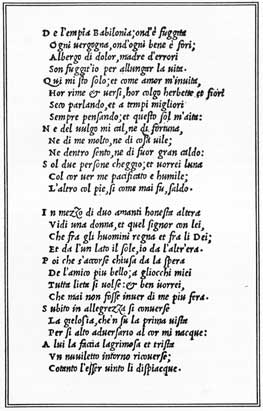
nothing is recorded in the lists of Aldine imprints. Like many of his colleagues, no doubt, Aldus spent his time trying to collect what was due from his correspondents in other cities. During 1508 the workmen were kept occupied by two large volumes, the Adagii of Erasmus, with 276 leaves, and the first volume of Rhetores Graeci, with 375. These were followed in November of this year by an octavo Plinius Secundus, the first complete edition of the Epistles, from an ancient manuscript which a Venetian ambassador had brought to him from Paris.
/ p.69 /
The name of ANDREAS TORRESANUS DE ASULA appears in the colophon of the 1508 Pliny for the first time as a partner of Aldus. This suggests that some financial rearrangement had become necessary, or else that the health of Aldus was failing, for the two names continue until the latter's death in April, 1515. Torresanus then assumed the direction of the establishment, assisted by his two sons, and retaining the phrase "In aedibus Aldi" in the imprints. They maintained the reputation of the press for excellent printing, if they could not add to its standing among scholars.
After Torresanus died, in 1529, all book-making ceased until 1533, when PAUL MANUTIUS, the son of Aldus, came of age. He at once entered upon a life-long effort to renew the prestige of the press. He sought out his father's old friends whose gatherings had made the Aldine house the literary centre of / p.67 / Venice, and tried to interest his own scholarly contemporaries in the attempt to stave off the decadence of the city. He bought new fonts of type; where Lyons and Paris had copied his father, he now sent his commissions to the famous French type designer Claude Garamond. It was a losing struggle, and his own real interests were elsewhere. The family tradition made him a scholar even more than a printer. The five years from 1556 to 1561 were devoted to a proposed "Academia della Fama," which was to draw to Venice the most learned men who could be attracted by generous patronage, from all the world; then the merchant who had promised an endowment failed, but not before it had been demonstrated that much more besides money is needed to make such a plan successful. The printer was called to Rome by Pope Pius IV, to undertake an equally ambitious plan for printing everything which it was desirable that the faithful should read, with the revisions made necessary by the decrees of the Council of Trent. Once more it proved easier to promise money than to provide the time which such an undertaking requires.
The second ALDUS MANUTIUS, born in 1547, was placed in charge of the Venice establishment in 1565, and spent much of the ensuing decade until the death of his father, Paul, in 1574, trying to make some profitable arrangement by which it might be carried on by more experienced manage-/ p.68 / ment without loss of the inherited prestige. Even his marriage to an heiress of the famous printing family of the Giuntas of Florence did not bring successful direction to the Venice business. The younger Aldus was even more famous than his father for great learning. He was an infant prodigy for erudition, and it was said that he edited, or helped his father to edit, the Epistles of Cicero, at the age of twelve. After 1576, having leased the right to use the press and the famous trade-mark, he devoted himself to the more congenial profession of teaching Belles Lettres. He died, the last of the family, in 1597. Hailed as the most learned man of his time, he lived too late; learning had become erudition, and the Renaissance had given way to the modern world.
WHEN the French troops occupied northern Italy at the beginning of the sixteenth century, JEAN GROLIER accompanied them as the financial representative of the royal treasury. He came of a family of Italian bankers, settled at Lyons, and made his own prosperous career in official positions, rising to the dignity and responsibility of treasurer to the Crown. He was also, for more than half a century, the greatest collector of his time, the sixteenth-century successor to the earlier Medici. He established a reputation in bookish circles as the model for book-collectors. This rests upon two characteristics, a generous patronage of the book-makers who were producing fine work, and the most careful treatment of his possessions. The binding with which he had his books covered are so famous that there is a common misconception that he was himself a book-binder. He maintained a staff of craftsmen in his own palace, employing the most skilful artisans, who developed the characteristic designs which have come to be known as Grolieresque. The typical feature of these is the interlacing of ribbons of various harmonious colors to make a design or border on the sides of the bindings. Similar designs were executed by other binders for other patrons, / p.70 / especially in Italy, and they have been copied with great skill and remarkable ability in giving the appearance of sixteenth-centuy workmanship. Grolier's own books sometimes contain his motto, and the friendly inscription "J. Grolierii et amicorum," and this is more frequently found stamped at the foot of the binding. The phrase was not his alone, for it is also found on the bindings executed for two contemporary collectors, Thomas Maioli*
--------------------------- of Asti and Marc Lauwrin of Bruges.
/ p.72 /
* [Handwritten note in book, Ed:] Thomas MAHIEU, Secretary to Queen Catherine de Medici. See G.D. Hobson, Maioli, Canevari and others, 1926.
---------------------------
Grolier, while his headquarters were at Milan, became acquainted with Aldus and established a lifelong friendship with his family. He kept informed about what the press was doing, and had a standing order for several copies of each important book, on vellum or on extra fine paper if possible. He also commissioned work to be done on his own account. Aldus in turn dedicated books to the patron, expressing his appreciation in the prefatory epistles. This was the most famous of these friendships, but Geofroy Tory and others of the Paris printers were equally in his favor.
The name of an owner occurs on bindings much less frequently than the crest or coat of arms, or a personal device. These go with special bindings, which were customary when books were ordinarily kept in stock in sheets, to be bound when sold, so that this did not imply the destruction of an original cover except in the case of older manuscript works. [ p.71 ] The use of a bookplate as a sign of ownership, also, had already begun. The earliest known may even be older than typography, for it has the name of the owner, Hans Igler, cut on the block with a crude design much like the little woodcut pictures of saints.
H
THE
ESTIENNE family at Paris was a rival to that of Aldus for three generations, along closely parallel lines. The first HENRI ESTIENNE, Étienne, or Stephanus, acquired an active business in 1501 when he married Guyonne, the widow of Jean Higman. Higman had established a strong University connection, and this was broadened by his successor. For twenty years Estienne printed solid works on theology and philosophy, and orthodox scientific treatises, edited by the leading professors of the Sorbonne. His son Robert set up for himself in 1525 through an amicable arrangement with his stepfather, Simon de Colines, who has taken Estienne's place as the third husband of Guyonne and the manager of the printing establishment.
/ p.77 /
ROBERT ESTIENNE was a good printer, and a scholar of distinction who took an important part in bringing the Renaissance to France. The story is that, when he was asked to reprint the standard Latin Dictionary of Calepin, he found that this was so far behind the movement of linguistic scholarship that he decided it would be easier to make up a new work than to correct the errors in the old one; and as he could not find anyone to do this to his satisfaction, he prepared the new one himself. This / p.73 / "Thesaurus linguae Latinae" occupied him for nearly two years, appearing in 1532, when he was thirty years old. His wife was the daughter of BADIUS ASCENSIUS, the most noted editor of that time, whose works were recognized as authoritative and enjoyed a wide sale throughout Europe. Badius was provided with a press in his own house, so that he might direct the printing of his publications and secure the utmost accuracy with an economy of time and effort. The books from this press, known as the Praelum Ascensianum, are still in demand, less for the learned editing than because of the printer's mark, which is a view of a printing shop giving one of the earliest representations of a press in operation.
Robert Estienne began his career by revising the text of the New Testament exactly as the scholars of his day were dealing with other ancient texts. He based his work on the original versions which had been made available in the famous COMPLUTENSIAN POLYGLOTT edition, issued under the auspices of Cardinal Ximenes at Alcalâ in 1514-1517. Except for the Psalter published by Giustiniani at Genoa in 1516, — with the text in Hebrew, a literal Latin rendering, the Latin Vulgate, the Greek Septuagint, Arabic, and Chaldee, — the monumental Spanish work was the first edition of the Scriptures which recognized that the accepted versions were merely translations from older and more authorita- / p.74 / tive texts in other less familiar languages. This implied a recognition of the fact that the accepted versions were subject to corrections which might alter the meaning or the significance of passages which the movement of the Reformation had already made subjects of controversy.
Violent protests were at once voiced at the Sorbonne against the audacity of Robert Estienne, a mere lad, in issuing his highly controversial revision of Holy Writ, and in printing it in octavo, the undiginified format of books intended for sale to the many. Estienne met this challenge by completing his textual examination of the rest of the Bible. He published the first of several complete editions in 1528. The officials of the Sorbonne threatened extreme measures to suppress his activities, but the French Crown protected the printer, in part perhaps because he was doing the Court circle a real service by distracting the attention of the theologians from others in high station whose opinions were tending away from traditional orthodoxy. When the controversy became more annoying, in 1534, Francis I issued a peremptory order forbidding all printing. This produced another unexpected trouble, for the Parliament refused to register the decree. A revised order, forbidding the printing of new books, met the same refusal, and when the King accepted the situation, the first move had been won in the struggle for the FREEDOM OF THE / p.75 / PRESS. It was a very limited freedom according to modern ideas, but of fundamental importance as recognizing a principle. Francis I died in 1547, and soon afterward Robert Estienne left Paris under the protection of the friendly Bishop of Meaux.
Geneva welcomed the printer who had championed the fundamentals of the reform movement; but Estienne soon found that it was easier to combat the unified hostility of his Parisian enemies than to make a living trying to please the highly individualistic groups of religious innovators who congregated at the centre of Calvinism. His last decade of unimportant work ended with his death in 1559.
A second HENRI ESTIENNE, son of Robert, born in 1528, began collating ancient manuscripts before he was twenty. Primarily a hellenist, he began his career as a printer in 1557 at Geneva, by bringing out editions of five Greek authors who were virtually inedited, which is evidence that they were authors for whose writings there was no demand. For the next decade he was subsidized by a cadet of the family of Fugger, the great Augsburg merchant house. In 1569 he issued a printed circular letter to his correspondents, explaining that his failure to answer letters was due to the fact that since 1562 he had been preoccupied by the task of keeping two presses busy printing a Greek Thesaurus compiled on a new method. This appeared in 1572. Before [ p.76 ] there was time for any general sale, a compact abridgement containing all the essential novelties of the compendious work was put on the market by Estienne's assistant and proof-reader, Jean Scapula. Scapula claimed that he had urged Estienne to issue this himself, but the latter foresaw its inevitable effect upon the larger work, and refused to do it. Scapula had it printed elsewhere; and the sale of the Thesaurus scarcely met the bills for paper. Estienne spent most of his remaining years travelling from fair to fair all over Europe, seeking buyers. In 1598 he died, alone, in the city hospital at Lyons. His daughter married Isaac Casaubon, through whom the scholarly inheritance of the Estiennes passed to England.
IN 1521 the first Henri Estienne died and SIMON DE COLINES became the widow's most distinguished husband. He maintained the former prestige of the printing house as a resort for learned men, rivalling in this the Aldine "Academy" at Venice. He added to the fame of the press for its correct and authoritative texts an even greater reputation for elegant typography and beautiful press-work. Its long list of publications already included several groups of books on closely related subjects. Colines developed these into definite series. He issued them with new woodcut designs for the title-pages, carefully using the same style for all the books in a series, so that they could be easily recognized by purchasers.
Simon de Colines's greatest contribution to the fame of the establishment came when he recognized the genius of GEOFROY TORY and employed him to design decorations for its books. Tory had been a professor of philosophy and the classics and a student of geography before he gave himself up to an overpowering desire to express himself artistically. In later years he became a printer on his own account, a reformer of the French language, and an innovator in its alphabetic symbols. He brought about the abandonment of the traditional black- / p.78 / letter type in favor of the modern roman letter; he introduced the ç, and gave a tremendous impetus to self-consciousness among the French printers, leading them to consider their responsibility for the contents as well as the appearance of the books on which they put their names.
Geofroy Tory's claim to genius, as the greatest of all decorators of typography, rests upon the ornaments that he designed while he was in the service

/ p.81 /
THE Era of the Master Printers ended with CHRISTOPHE PLANTIN. Since his time there have been many great masters of printing establishments who were practical craftsmen, some of whom, like the two Charles Whittinghams, have profoundly influenced the development of book-making. Before Plantin, from the days of Koberger and of the early Venetians, there had been owners of printing plants whose business ability made them sellers rather than makers of books. But it was the Master, exercising a direct oversight of the activities of compositors, pressmen, and binders, who gave to the industry its characteristic features down to the later decades of the sixteenth century. After 1600 the publisher dominated the craftsman.
/ p.84 /
Sample pages of the Polyglott, with the text in four languages, were shown at the Franckfurt book fair in 1566. There was talk of a rival work under Lutheran auspices, with the Elector of Saxony as patron, but it was obvious that the effort to print the two would be suicidal for both. It was this danger — that the undertaking might be contaminated by Protestant influence — which helped to convince Philip II that it must be done under Spanish control. By midsummer of 1568 the specimen sheets had received final approval, and a few months later the work started. Forty workmen, with two, and later four, presses, were kept steadily employed for three years. The edition was 1200 copies, on paper of four different sizes, and thirteen copies on vellum for the King. The number of volumes in which it was bound varies from six on the ordinary paper to eleven for those on vellum. It was completed in 1572.
ANTWERP, the capital of the Spanish Netherlands, was supplanting Venice as the world's shipping metropolis before 1550. The printers already controlled one quarter of the town, and had begun to rival the Italians as purveyors of books, without taking anything away from the older city. The social and economic changes of half a century had doomed the books — treatises on the Canon Law, the Church Fathers, mediaeval medical works, editions of the ancient Classics made authoritative by the names of famous scholars — which were still the / p.82 / backbone of the Venetian book trade. Instead of these books, which appealed to those who longed for culture and learning, hundreds of Antwerp workmen were prosperously employed in making books which were intended to entertain the readers. They were printed in every European language, in quantities as much larger than the editions of those other more respectable works as they are now more difficult to find. Rarely does the hunter through the old bookshops come upon an Antwerp sixteenth-century imprint; and when he does, he may not recognize it, for the title-page is apt to say that it was printed at Paris or Philopolis or some equally improbable locality.
Christophe Plantin was a young French bookbinder seeking his fortune when he went to Antwerp in 1549. He made his way to recognition by the court officials, until an injury forced him to abandon his trade and take up the lighter physical labor of printing. By 1559 he had won a position which gave him the commission for printing the monumental volume containing the official record of the ceremonies attending the funeral of Charles the Fifth. This led to other similar tasks executed for the government, which gave him contemporary fame, and eventual bankruptcy. He built up a sound business, and prospered whenever he was free to attend to this. But like many another, the fascination of doing a grand book was more than he / p.83 / could resist, and then as always it was impossible to do the monumental volume, to his own critical satisfaction, without exceeding the amount which seems proper to a layman unfamiliar with the time and attention imperatively demanded by a piece of fine printing.
Plantin's grandest idea became a reality through the assistance of Spanish ecclesiastical and court officials. Fifty years before, another Spaniard, Cardinal Ximenes, had fostered the first Polyglott bible. This had long been unprocurable by scholars, and Plantin proposed to issue a more adequate work which should include the texts of the Holy Scriptures in all the languages from which they are derived. Philip II became interested in the idea and promised to subsidize it. The royal promises were ample to justify the venture; but the royal treasurer had many other claims upon the funds in hand, and with the best of intentions, Philip was unable to do all that he meant to. Plantin began by training a special staff of workmen. A Hebrew Grammar was printed to familiarize them with this language, and when he found a satisfactory proof-reader, he married him to a daughter, that there might be less danger of losing him. New fonts of type were ordered from Robert Granjon of Lyons and Claude Garamond of Paris. The initial order for paper called for 3000 reams, and 400 dozen skins were ordered for the vellum copies.
Plantin's Polyglott Bible is still unrivalled as a printer's achievement. But the printer had to pay his workmen in order that the work might not stop, and when the remittances from the Spanish treasury did not arrive, he had to turn to a public-spirited Jewish money-lender, Louis Perez, who must have known how precarious was the security. The King endeavored to help the situation, and made it worse by ordering a series of large service books which he thought of presenting to each [ p.85 ] church in the kingdom. This did not please the printers of Spain, who made their influence felt, and the plan was given up after Plantin had committed himself to further heavy expenditures. A more than tangible reward was a royal grant giving him a monopoly for printing the authorized service books for the Spanish domains.
Plantin died in 1589, and the business passed to a son-in-law, J
[ p.86 ]
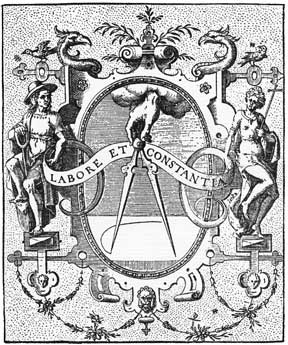

|