AND
N U R S E R Y T A L E S.
Royal 18 mo, with 38 Designs by W. B. SCOTT, Director of the School of Design,
Newcastle-on-Tyne, bound in illuminated cloth, 4s. 6d.
T H E N U R S E R Y R H Y M E S OF E N G L A N D,
COLLECTED CHIEFLY FROM ORAL TRADITION.
BY JAMES ORCHARD HALLIWELL, ESQ.
FOURTH EDITION.
[ p.iii ]
|
AND
N U R S E R Y T A L E S :
Nursery Rhymes of England.
JAMES ORCHARD HALLIWELL, ESQ.
MDCCCXLIX. |
[ p.iv ]
[ p.v ]
|
Tales of my Nursery ! shall that still loved spot, That window corner, ever be forgot, Where through the woodbine when with upward ray Gleam'd the last shadow of departing day, Still did I sit, and with unwearied eye, Read while I wept, and scarcely paused to sigh! In that gay drawer, with fairy fictions stored, When some new tale was added to my hoard, While o'er each page my eager glance was flung, 'Twas but to learn what female fate was sung; If no sad maid the castle shut from light, I heeded not the giant and the knight. Sweet Cinderella, even before the ball, How did I love thee—ashes, rags, and all ! What bliss I deem'd it to have stood beside, On every virgin when thy shoe was tried ! How long'd to see thy shape the slipper suit ! But, dearer than the slipper, loved the foot. ANON |
|
IT were greatly to be desired that the instructors of our children could be persuaded how much is lost by rejecting the venerable relics of nursery traditional literature, and substituting in their place the present cold, unimaginative,—I had almost said, unnatural,—prosaic good-boy stories. "In the later case," observes Sir Walter Scott, "their minds are, as it were, put into the stocks, like their feet at the dancing-school, and the moral always consists in good conduct being crowned with success. Truth is, I would not give one tear shed over Little Red Riding Hood for all the benefit to be derived from a hundred histories of Jemmy Goodchild. I think the selfish tendencies will be soon enough acquired in this arithmetical age ; and that, to make the higher class of character, our own wild fictions—like our own simple music—will have more effect in awakening the fancy and elevating the disposition, than the colder and more elaborate compositions of modern authors and composers." Deeply impressed with this truth, and firmly con- / p.viii / vinced of the "imagination-nourishing" power of the wild and fanciful lore of the old nursery, I have spared no labour in collecting the fragments which have been traditionally preserved in our provinces. The object is not so much to present to the reader a few literary trifles, though even their curiousity and value in several important discussions must not be despised, as to rescue in order to restore; a solemn recompense due from literature for having driven them away ; and to recall the memory to early associations, in the hope that they who love such recollections will not suffer the objects of them to disappear with the present generation. In arranging the materials gathered for this little volume, I have followed, in some respects, the plan adopted by Mr. Robert Chambers, in his elegant work, the Popular Rhymes of Scotland ; but our vernacular anthology will be found to contain so much which does not occur in any shape in that of the sister country, that the two collections have not as much similarity as might have been expected. Together, they will eventually contain nearly all that is worth preserving of what may be called the natural literature of Great Britain. Mr. Chambers, indeed, may be said to have already exhausted the subject for his own land in the last edition of his interesting publication, but no systematic attempt has yet been made in the same direction for this country ; and although the curiousity and extent of the relics / p.ix / I have been enabled to collect have far exceeded my expectations, I am fully aware how much more can yet be accomplished. An additional number of foreign synonymes could also no doubt be collected ; though perhaps more easily by foreigners, for Continental works which contain notices of traditional literature are procured with difficulty in England. The following pages, however, contain sufficient of these to exhibit the striking similarities between rhymes prevalent over England, and others which exist in the North of Europe. The collection of Nursery Tales is not as extensive as could have been wished, but the difficulty of procuring the brief traditional stories which were current some century since, now for the most part only recollected in obscure districts, is so great, that no apology is necessary for the apparent deficiency of that section. The few which have been obtained are of considerable curiosity and interest ; and I would venture to suggest to all readers of these pages the great obligation they would confer by the communication of any additions. Stories of this kind are undoubtedly to be obtained from oral tradition, and perhaps some of literary importance may yet be recovered. The compiler's best thanks are due to Captain Henry Smith for the very interesting communication of / p.x / rhymes current in the Isle of Wight; to Mr. George Stephens for several curious fragments, and valuable references to Swedish songs ; and to many kind correspondents who have furnished me with rhymes current in the various districts in which they reside. It is only by a large provincial correspondence that a collection of this kind can be rendered complete, and the minutest information on any of our popular tales or rhymes, forwarded to the address given below, would be most thankfully and carefully acknowledged.
BRIXTON HILL, SURREY ; April, 1849.
|
| PAGE | |
| NURSERY ANTIQUITIES . . . . | 1 |
| FIRESIDE NURSERY STORIES . . . | 24 |
| GAME-RHYMES . . . . . | 101 |
| ALPHABET-RHYMES . . . . | 136 |
| RIDDLE-RHYMES . . . . . | 141 |
| NATURE-SONGS . . . . . | 155 |
| PROVERB-RHYMES . . . . | 181 |
| PLACES AND FAMILIES . . . . | 188 |
| SUPERSTITION-RHYMES . . . . | 206 |
| CUSTOM-RHYMES . . . . | 230 |
| NURSERY-SONGS . . . . . | 258 |
AND
NURSERY TALES
I.—NURSERY ANTIQUITIES.
/ p.2 /
The subject, however curious and interesting, is far too diffuse to be investigated at any length in a work like the present ; and, indeed, the materials are for the most part so scattered and difficult of access, that it would require the research of many years to accomplish the task satisfactorily. I shall, then, content myself with indicating a few of the most striking analogies between the rhymes of foreign countries and those of our own, for this portion of the inquiry has been scarcely alluded to by my predecessors. With regard to the tales, a few notices of their antiquity will be found in the prefaces or notes to the stories themselves, and few readers will require to be informed that Whittington's cat realized his price in India, and that Arlotto related the story long before the Lord Mayor was born ; that Jack the Giant-killer is founded on an Edda ; or that the slipper of Cinderella finds a parallel in the history of the celebrated Rhodope. To enter into these discussions would be merely to repeat an oft-told tale, and I prefer offering a few notes which will be found to possess a little more novelty.
Of the many who must recollect the nursery jingles of their youth, how few in number are those who have suspected their immense age, or that they were ever more than unmeaning nonsense ; far less that their creation belongs to a period before that at which the authentic records of our history commence. Yet there is no exaggeration in such a statement. We find the same trifles which erewhile lulled or amused the English infant, are current in slightly varied forms throughout the North of Europe ; we know that they have been sung in the northern countries for centuries, and that there has been no modern outlet for their dissemination across the German Ocean. The most natural inference is to adopt the theory of a Teutonic origin, and thus give to every genuine child-rhyme, found current in England and Sweden, an immense antiquity. There is / p.3 / nothing improbable in the supposition, for the preservation of the relics of primitive literature often bears an inverse ratio to their importance. Thus, for example, a well-known English nursery rhyme tells us,—
|
There was an old man, And he had a calf, And that's half ;
He took him out of the stall,And put him on the wall, And that's all.
|
|
Gubben och gumman hade en kalf, Och nu är visan half ! Och begge så körde de halfven i vall, Och nu ar visal all ! |
|
Lady-cow, lady-cow, fly thy way home, Thy house is on fire, thy children all gone; All but one that ligs under a stone, Fly thee home, lady-cow, ere it be gone!* |
|
--------------------------- * In Norfolk the lady-bird is called burny-bee, and the following lines are current:
|
/ p.4 /
These lines are said by children, when they throw the beautiful little insect into the air, to make it take flight. Two Scottish variations are given by Mr. Chambers, p.170. In Germany it is called the Virgin Mary's chafer, Marienwürmchen, or the May-chafer, Maikäferchen, or the gold-bird, Guldvogel. In Sweden, gold-hen, gold-cow, or the Virgin Mary's maid. In Denmark, our Lord's hen, or our Lady's hen. We may first mention the German song translated by Taylor as frequently alluded to by writers on this subject. The second verse is the only one preserved in England.
|
Lady-bird ! Lady-bird ! pretty one ! stay ! Come sit on my finger, so happy and gay; With me shall no mischief betide thee; No harm would I do thee, no foeman is near, I only would gaze on thy beauties so dear, Those beautiful winglets beside thee.
Lady-bird ! lady-bird ! fly away home;
Fly back again, back again, lady-bird dear ! |
|
Flieg auf die Stangen, Käsebrode langen; Mir eins, dir eins, Alle gute G'sellen eins. |
"Gold-bird, get thee gone, fly to thy perch, bring cheese-cakes, one for me, one for thee, and one for all good people."
|
Maikäferchen, Maikäferchen, fliege weg! Dein Häusgen brennt, Dein Mütterchen flennt, Dein Vater sitzt auf der Schwelle, Flieg in Himmel aus der Hölle. |
|
Maikäferchen, fliege, Dein Vater ist im Kriege, Dien Mutter ist in Pommerland, Pommerland ist abgebrannt! Maikäferchen, fliege. |
|
Guld-höna, guld-ko! Flyg öster, flyg vester, Dit du flyger der bor din älskade ! |
|
Jungfru Marias Nyckelpiga! Flyg öster, flyg vester, Flyg dit der min käresta bor!* |
|
--------------------------- * This is a very remarkable coincidence with an English rhyme:
|
/ p.6 /
"Fly, our holy Virgin's bower-maid! fly east, fly west, fly where my loved-one dwelleth." In Denmark they sing (Thiele, iii. 134):
|
Fly, fly, our Lord's own hen ! To-morrow the weather fair will be, And eke the next day too.* |
|
--------------------------- * The lady-bird, observes Mr. Chambers, is always connected with fine weather in Germany and the north. --------------------------- |
Accumulative tales are of very high antiquity. The original of "the House that Jack Built" is well known to be an old Hebrew hymn in Sepher Haggadah. It is also found in Danish, but in a somewhat shorter form; (See Thiele, Danske Folkesagn, II. iii. 146, Der har du det Huus som Jacob bygde ;) and the English version is probably very old, as may be inferred from the mention of "the priest all shaven and shorn." A version of the old woman and her sixpence occurs in the same collection, II. iv. 161, Konen och Grisen Fick, the old wife and her piggy Fick, — "There was once upon a time an old woman who had a little pig hight Fick, who would never go home late in the evening. So the old woman said to her stick:
|
'Stick, beat Fick I say ! Piggie will not go home to-day !' " |
|
--------------------------- * Two other variations occur in Arwidsson, Svenska Fornsånger, 1842, iii. 387-8, and Mr. Stephens tells me he has a MS. Swedish copy entitled the Schoolboy and the Birch. It is also well known in Alsace, and is printed in that dialect in Stöber's Elsassisches Volksbüchlein, 1842, pp. 93-5. Compare, also, Kuhn und Schwark, Norddeutsche Sagen, Märchen und Gebräuche, 1848, p.358, "Die frâ, dos hippel un dos hindel." --------------------------- |
The well-known song of "There was a lady lov'd a swine," is found in an unpublished play of the time of Charles I. in the Bodleian Library, MS. Bodl. 30:
|
There was a lady lov'd a hogge; Hony, quoth shee, Woo't thou lie with me to-night ? Ugh, quoth hee. |
|
--------------------------- † It is still more similar to a pretty little song in Chambers, p.188, commencing, "There was a miller's dochter." --------------------------- |
|
Gumman ville vagga Och inga barn hade hon; Då tog hon in Fölungen sin, Och lade den i vaggan sin. Vyssa, vyssa, långskånken min, Långa ben har du; Lefver du till sommaren, Blir du lik far din. |
|
Lille Trille Laae paa Hylde; Lille Trille Faldt ned af Hylde. Ingen Mand I hele Land Lille Trille curere kan. |
|
Little Trille Lay on a shelf: LittleTrille Thence pitch'd himself: Not all the men In our land, I ken, Can put Little Trille right again. |
|
Thille Lille Satt på take'; Thille Lille Trilla' ner; Ingen läkare i hela verlden Thille Lille laga kan.
Thille Lille |
/ p.9 /
|
Lille Bulle Trilla' ner å skulle; Ingen man i detta lan' Lille Bulle laga kan.
Down on the shed |
|
My father he died, I cannot tell how, But he left me six horses to drive out my plough ! With a wimmy lo ! wommy lo! Jack Straw, blazey-boys ! Wimmy lo ! wommy lo ! wob, wob, wob ! |
|
--------------------------- * I am here, and in a few other cases, quoting from myself. It may be necessary to say so, for my former collections on this subject have been appropriated — "convey, the wise it call" — in a work by a learned Doctor, the preface to which is an amusing instance of plagiarism. --------------------------- |
/ p.10 /
An infant of the nineteenth century recalling our recollection to Jack Straw and his "blazey-boys!" Far better this than teaching history with notes "suited to the capacity of the youngest." Another refers to Joanna of Castile, who visited the court of Henry the Seventh in 1506:
|
I had a little nut-tree, nothing would it bear But a golden nutmeg and a silver pear; The King of Spain's daughter came to visit me, And all for the sake of my little nut-tree. |
|
The King of France went up the hill, With twenty thousand men: The King of France came down the hill, And ne'er went up again — |
|
--------------------------- * An early variation occurs in MS. Sloane 1489:
|
was composed before 1588. It occurs in an old tract called Pigges Corantoe, 1642, where it is entitled "Old Tarlton's Song," referring to Tarlton the jester, who died in 1588. The following one belongs to the seventeenth century:
|
As I was going by Charing Cross, I saw a black man upon a black horse; They told me it was King Charles the First; Oh dear, my heart was ready to burst ! |
|
See-saw, sack-a-day; Monmouth is a pretie boy, Richmond is another, Grafton is my onely joy, And why should I these three destroy To please a pious brother? |
|
William and Mary, George and Anne, Four such children had never a man: They put their father to flight and shame, And call'd their brother a shocking bad name. |
|
As I walk'd by myself, And talked to myself, Myself said unto me, Look to thyself, Take care of thyself, For nobody cares for thee.
I answer'd myself, |
|
Doctor Sacheverel Did very well, But Jacky Dawbin Gave him a warning. |
|
In fir tar is, In oak none is, In mud eel is, In clay none is, Goat eat ivy, Mare eat oats. |
|
Hic, hoc, the carrion crow, For I have shot something too low: I have quite missed my mark, And shot the poor sow to the heart; Wife, bring treacle in a spoon, Or else the poor sow's heart will down. |
"Sing a song of sixpence" is quoted by Beaumont and Fletcher. "Buz, quoth the blue fly," which is printed in the nursery halfpenny books, belongs to Ben Jonson's Masque of Oberon; the old ditty of "Three Blind Mice" is found in the curious music book entitled Deuteromelia, or the Second Part of Musicke's Melodie, 1609; and the song, "When I was a little girl, I wash'd my mammy's dishes," is given by Aubrey in MS. Lansd. 231. "A swarm of bees in May," is quoted by Miege, 1687. And so on of others, fragments of old catches and popular songs being constantly traced in the apparently unmeaning rhymes of the nursery.
Most of us have heard in time past the school address to a story-teller:
|
Liar, liar, lick dish, Turn about the candlestick. |
| Lor. |
By heaven! it seemes hee did, but all was vaine; The flinty rockes had cut his tender scull, And the rough water wash't away his braine. |
| Luc. | Lyer, lyer, licke dish! |
|
--------------------------- * A dance called Hey, diddle, diddle, is mentioned in the play of King Cambises, written about 1561, and the several rhymes commencing with those words may have been original adaptations to that dance-tune. ---------------------------
|
|
I had a little bonny nagg, His name was Dapple Gray; And he would bring me to an ale-house A mile out of my way. |
|
There was an old woman Liv'd under a hill, And if she ben't gone, She lives there still — |
|
--------------------------- * See the whole poem in my Nursery Rhymes of England, ed. 1842, p.19. ---------------------------
|
|
There was an old man had three sons, Had three sons, had three sons; There was an old man had three sons, Jeffery , James, and Jack. Jeffery was hang'd and James was drown'd, And Jack was lost, that he could not be found, And the old man fell into a swoon, For want of a cup of sack ! |
|
Clowt, clowt, To beare about, |
|
A ducke and a drake, And a halfe penie cake." |
|
The tailor of Biciter, He has but one eye, He cannot cut a pair of green galagaskins, If he were to die. |
|
Jack Horner was a pretty lad, Near London he did dwell, His father's heart he made full glad, His mother lov'd him well. While little Jack was sweet and young, If he by chance should cry, His mother pretty sonnets sung, With a lul-la-ba-by, With such a dainty curious tone, As Jack sat on her knee, So that, e'er he could go alone, He sung as well as she. A pretty boy of curious wit, All people spoke his praise, And in the corner would he sit, In Christmas holydays. When friends they did together meet, To pass away the time— |
|
Why, little Jack, he sure would eat His Christmas pie in rhyme. And said, Jack Horner, in the corner, Eats good Christmas pie, And with his thumbs pulls out the plumbs, And said, Good boy am I ! |
|
Archdeacon Pratt would eat no fatt, His wife would eat no lean; 'Twixt Archdeacon Pratt and Joan his wife, The meat was eat up clean. |
|
--------------------------- * The following nursery game, played by two girls, one personating the mistress and the other a servant was obtained from Yorkshire, and may be interpreted as a dialogue between a lady and her Jacobite maid:
|
|
Double Dee Double Day, Set a garden full of seeds; When the seeds began to grow, It's like a garden full of snow. When the snow began to melt, Like a ship without a belt. When the ship began to sail, Like a bird without a tail. When the bird began to fly, Like an eagle in the sky. When the sky began to roar, Like a lion at the door. When the door began to crack, Like a stick laid o'er my back. When my back began to smart, Like a penknife in my heart. When my heart began to bleed, Like a needleful of thread. When the thread began to rot, Like a turnip in the pot. When the pot began to boil, Like a bottle full of oil. When the oil began to settle, Like our Geordies bloody battle. |
Many of the metrical nonsense-riddles of the nursery are of considerable antiquity. A collection of conundrums formed early in the seventeenth century by Randle Holmes, the Chester antiquary, and now preserved in MS. Harl. 1962, contains several which have been traditionally remembered up to the present day. Thus we find versions of "Little Nancy Etticoat in a / p.19 / white petticoat," "Two legs sat upon three legs," "As round as an apple," and others.*
|
--------------------------- * A vast number of these kind of rhymes have become obsolete, and old manuscripts contain many not very intelligible. Take the following as a specimen:
|
|
K. S. K. S. |
King I am ! I am your man. What service will you do ? The best and worst, and all I can ! |
/ p.20 /
|
Peter White will ne'er go right, And would you know the reason why? He follow his nose where'er he goes, And that stands all awry. |
|
--------------------------- * The first three verses are all the original. The rest is modern, and was added when Mother Hubbard was the first of a series of eighteen-penny books published by Harris. ---------------------------
|
|
--------------------------- † Chappell's National Airs, p.89. ---------------------------
|
|
--------------------------- ‡ Beaumont and Fletcher, ed. Dyce, viii. 176. The tune of Jumping Joan is mentioned in MS. Harl. 7316, p. 67. ---------------------------
|
|
Millery, millery, dustipoll, How many sacks have you stole ? Four and twenty and a peck : Hang the miller up by his neck ! |
|
Now, miller, miller, dustipole, I'll clapper-claw your jobberhole !* |
|
--------------------------- * "Oh, madam, I will give you the keys of Canterbury," must be a very ancient song, as it mentions chopines, or high cork shoes, and appears, from another passage, to have been written before the invention of bell-pulls. The obsolete term delve, to dig, exhibits the antiquity of the rhyme "One, two, buckle my shoe." Minikin occurs in a rhyme printed in the Nursery Rhymes of England, p.145; coif, ibid, p. 150; snaps, small fragments, ibid. p. 190; moppet, a little pet, ibid. p. 193, &c. ---------------------------
|
|
Nanty Panty, Jack-a-Dandy, Stole a piece of sugar-candy, From the grocer's shoppy shop, And away did hoppy hop. |
|
Namby Pamby's double mild, Once a man, and twice a child; |
|
To his hanging sleeves restor'd, Now he fools it like a lord; Now he pumps his little wits All by little tiny bits. Now, methinks, I hear him say, Boys and girls, come out to play, Moon do's shine as bright as day: Now my Namby Pamby's* found Sitting on the Friar's ground, Picking silver, picking gold,— Namby Pamby's never old: Bally-cally they begin, Namby Pamby still keeps in. Namby Pamby is no clown— London Bridge is broken down; Now he courts the gay ladee, Dancing o'er the Lady Lee: Now he sings of Lickspit Liar, Burning in the brimstone fire; Lyar, lyar, Lickspit, lick, Turn about the candlestick. Now he sings of Jacky Horner, Sitting in the chimney corner, Eating of a Christmas pie, Putting in his thumb, oh ! fie ! Putting in, oh ! fie, his thumb, Pulling out, oh ! strange, a plumb ! Now he acts the grenadier, Calling for a pot of beer: Where's his money ? He's forgot— Get him gone, a drunken sot ! Now on cock-horse does he ride, And anon on timber stride, Se and saw, and sack'ry down, London is a gallant town ! |
|
--------------------------- * Namby Pamby is said to have been a nickname for Ambrose Phillips. Another ballad, written about the same time as the above, alludes to the rhymes of "Goosy Goosy, Gander." ---------------------------
|
|
Who comes here ? A grenadier ! What do you want ? A pot of beer ! Where's your money ? I've forgot ! Get you gone, You drunken sot ! |
/ p.25 /
|
--------------------------- 1 This simple tale seldom fails to rivet the attention of children, especially if well told. The last two words should be said loudly with a start. It was obtained from oral tradition, and has not, I believe, been printed. ---------------------------
|
|
--------------------------- * This story was obtained from oral tradition in the West of England. It is undoubtedly a variation of the "Hans im Glück" of Grimm, which is current in Germany. ---------------------------
|
|
--------------------------- * A shorter and very different version of this is given by Mr. Chambers, p.211 ---------------------------
|
|
--------------------------- * "Let us cast away nothing," says Mr. Gifford, "for we know not what use we may have for it." So will every one admit whose reading has been sufficiently extensive to enable him to judge of the value of the simplest traditional tales. The present illustrates a passage in Ben Jonson in a very remarkable manner,—
|
|
--------------------------- * This tale has been traced back fifty years, but it is probably considerably older. --------------------------- |
|
The cat and the mouse Play'd in the malt-house: |
|
First she leapt, and then she ran, Till she came to the cow, and thus began,— |
Pray, Cow, give me milk, that I may give cat milk, that cat may give me my own tail again. No, said the cow, I will give you no milk, till you go to the farmer and get me some hay.
|
First she leapt, and then she ran, Till she came to the farmer, and thus began,— |
|
First she leapt, and then she ran, Till she came to the butcher, and thus began,— |
|
First she leapt, and then she ran, Till she came to the baker, and thus began,— |
|
Yes, says the baker, I'll give you some bread, But if you eat my meal, I'll cut off your head. |
/ p.35 /
|
--------------------------- * The present Kentish dialect does not adopt this form, but anciently some of the peculiarities of what is now the western dialect of England extended all over the southern counties. ---------------------------
|
|
--------------------------- * From oral tradition in Yorkshire. ---------------------------
|
|
--------------------------- * An incident analogous to this occurs in Grimm, Die Goldene Gans. See Edgar Taylor's Gammer Grethel, 1839, p. 5. ---------------------------
|
|
--------------------------- * This story is abridged from the old chap-book of the Three Kings of Colchester. The incident of the heads rising out of the well is very similar to one introduced in Peele's Old Wives Tale, 1595, and the verse is also of a similar character. ---------------------------
|
|
Wash me, and comb me, And lay me down softly, And lay me on a bank to dry, That I may look pretty, When somebody comes by. |
"Yes," said she, and putting forth her hand, with a silver comb performed the office, placing it upon a primrose bank. Then came up a second and a third head, making the same request, which she complied with. She then pulled out her provisions and ate her dinner. Then said the heads one to another, "What shall we do for this lady who hath used us so kindly?" The first said, "I will cause such addition to her beauty as shall charm the most powerful prince in the world." The second said, "I will endow her with such perfume, both in body and breath, as shall far exceed the sweetest flowers." The third said, "My gift shall be none of the least, for, as she is a king's daughter, I'll make her so fortunate that she shall become queen to the greatest prince that reigns." This done, at their request she let them down into the well again, and so proceeded on her journey. She had not travelled long before she saw a king hunting in the park with his nobles; she would have avoided him, but the king having caught a sight of her, approached, and what with her beauty and perfumed breath, was so powerfully smitten, that he was not able to subdue his passion, but commenced his courtship immediately, and was so successful that he gained her love, and, conducting her to his palace, he caused her to be clothed in the most magnificent manner.
This being ended, and the king finding that she was the king of Colchester's daughter, ordered some chariots to be got ready, that he might pay the king a visit. The chariot in which the king and queen rode was adorned with rich ornamental gems of gold. The king, her father, was at first astonished that his daughter had been so fortunate as she was, till the young king made him sensible of all that happened. Great was the joy at court amongst all, with the exception of the queen and her club-footed daughter, who were ready to burst with malice, and envied her happiness; and the greater / p.42 / was their madness because she was now above them all. Great rejoicings, with feasting and dancing, continued many days. Then at length, with the dowry her father gave her they returned home.
The deformed daughter perceiving that her sister had been so happy in seeking her fortune, would needs do the same; so disclosing her mind to her mother, all preparations were made, and she was furnished not only with rich apparel, but sweetmeats, sugar, almonds, &c., in great quantities, and a large bottle of Malaga sack. Thus provided, she went the same road as her sister, and coming near the cave, the old man said, "Young woman, whither so fast?" "What is that to you," said she. "Then," said he, "what have you in your bag and bottle?" She answered, "Good things, which you shall not be troubled with." "Won't you give me some?" said he. "No, not a bit, nor a drop, unless it would choke you." The old man frowned, saying, "Evil fortune attend thee." Going on, she came to the hedge, through which she espied a gap, and thought to pass through it, but, going in, the hedge closed, and the thorns run into her flesh, so that it was with great difficulty that she got out. Being now in a painful condition, she searched for water to wash herself, and, looking round, she saw the well; she sat down on the brink of it, and one of the heads came up, saying "Wash me, comb me, and lay me down softly, &c." but she banged it with her bottle, saying, "Take this for your washing." So the second and third heads came up, and met with no better treatment than the first; whereupon the heads consulted among themselves what evils to plague her with for such usage. The first said, "Let her be struck with leprosy in her face." The second, "Let an additional smell be added to her breath." The third bestowed on her a husband, though but a poor country cobler. This done, she goes on till she came to a town, and it being market day, the people / p.43 / looked at her, and seeing such an evil face fled out of her sight, all but a poor cobler (who not long before had mended the shoes of an old hermit, who having no money, gave him a box of ointment for the cure of the leprosy, and a bottle of spirits for a stinking breath.) Now the cobler having a mind to do an act of charity, was induced to go up to her and ask her who she was. "I am," said she, "the king of Colchester's daughter-in-law." "Well," said the cobler, "if I restore you to your natural complexion, and make a sound cure both in face and breath, will you in reward take me for a husband?" "Yes, friend," replied she, "with all my heart." With this the cobler applied the remedies, and they worked the effect in a few weeks, and then they were married, and after a few days they set forward for the court at Colchester. When the queen understood she had married a poor cobler, she fell into distraction, and hanged herself for vexation. The death of the queen was not a source of sorrow to the king, who had only married her for her fortune, and bore her no affection; and shortly afterwards he gave the cobler a hundred pounds to take the daughter to a remote part of the kingdom, where he lived many years mending shoes, while his wife assisted the housekeeping by spinning, and selling the results of her labours at the country market.
|
--------------------------- * This tale of the frog-lover is known in every part of Germany, and is alluded to by several old writers of that country. It is the tale "Der Froschkönig, oder der Eiserne Heinrich," in Grimm. "These enchanted frogs," says Sir W. Scott, "have migrated from afar, and we suspect that they were originally crocodiles; we trace them in a tale forming part of a series of stories entitled the Relations of Ssidi Kur, extant amongst the Calmuck Tartars." Mr. Chambers has given a Scotch version of the tale, under the title of "The well o' the warld's end," in his Popular Rhymes, / p.44 / p.236. The rhymes in the copy given above were obtained from the North of England, without, however, any reference to the story to which they evidently belong. The application, however, is so obvious to any one acquainted with the German and Scotch tale, that the framework I have ventured to give them cannot be considered incongruous; although I need not add how very desirable it would be to procure the traditional tale as related by the English peasantry. Perhaps some of our readers may be enabled to supply it. ---------------------------
|
Many years ago there lived on the brow of a mountain, in the North of England, an old woman and her / p.44 / daughter. They were very poor, and obliged to work very hard for their living, and the old woman's temper was not very good, so that the maiden, who was very beautiful, led but an ill life with her. The girl, indeed, was compelled to do the hardest work, for her mother got their principal means of subsistence by travelling to places in the neighbourhood with small articles for sale, and when she came home in the afternoon she was not able to do much more work. Nearly the whole domestic labour of the cottage devolved therefore on the daughter, the most wearisome part of which consisted in the necessity of fetching all the water they required from a well on the other side of the hill, there being no river or spring near their own cottage.
It happened one morning that the daughter had the misfortune, in going to the well, to break the only pitcher they possessed, and having no other utensil she could use for the purpose, she was obliged to go home without bringing any water. When her mother returned she was unfortunately troubled with excessive thirst, and the girl, though trembling for the consequences of her misfortune, told her exactly the circumstance that had occurred. The old woman was furiously angry, and so far from making any allowances for her daughter, pointed to a sieve which happened to be on the table, and told her to go at once to the well and bring her some water in that, or never venture to appear again in her sight.
The young maiden, frightened almost out of her wits by her mother's fury, speedily took the sieve, and though / p.45 / she considered the task a hopeless one to accomplish, almost unconsciously hastened to the well. When she arrived there, beginning to reflect on the painful situation in which she was placed, and the utter impossibility of her obtaining a living by herself, she threw herself down on the brink of the well in an agony of despair. Whilst she was in this condition, a large frog came up to the top of the water, and asked her for what she was crying so bitterly. She was somewhat surprised at this, but not being the least frightened, told him the whole story, and that she was crying because she could not carry away water in the sieve. "Is that all?" said the frog; "cheer up, my hinny! for if you will only let me sleep with you for two nights, and then chop off my head, I will tell you how to do it." The maiden thought the frog could not be in earnest, but she was too impatient to consider much about it, and at once made the required promise. The frog then instructed her in the following words,—
|
Stop with fog (moss), And daub with clay; And that will carry The water away. |
|
Open the door, my hinny, my heart, Open the door, my own darling; Remember the words you spoke to me In the meadow by the well-spring. |
She was now dreadfully frightened, and hurriedly explained the matter to her mother, who was also so much alarmed at the circumstance, that she dared not refuse admittance to the frog, who, when the door was opened, leapt into the room, exclaiming:
|
Go wi' me to bed, my hinny, my heart, Go wi' me to bed, my own darling; Remember the words you spoke to me, In the meadow by the well-spring. |
|
Go wi' me to bed, my hinny, my heart, Go wi' me to bed, my own darling; Remember the words you spoke to me, In the meadow by the well-spring. |
|
Chop off my head, my hinny, my heart, Chop off my head, my own darling; Remember the words you spoke to me, In the meadow by the well-spring. |
|
--------------------------- * A simple, but very curious tale, of considerable antiquity. It is alluded to by Shakespeare, and was contributed to the variorum edition by Blakeway. Part of this story will recall to the reader's memory the enchanted chamber of Britomart. ---------------------------
|
| Be bold, be bold, but not too bold. |
|
Be bold, be bold, but not too bold, Lest that your heart's blood should run cold! |
|
It is not so, nor it was not so, And God forbid it should be so! |
|
It is not so, nor it was not so, And God forbid it should be so! |
|
But it is so, and it was so, And here the hand I have to show! |
/ p.49 /
|
--------------------------- * Obtained in Oxfordshire from tradition. ---------------------------
|
|
One moonshiny night, as I sat high, Waiting for one to come by, The boughs did bend; my heart did ache To see what hole the fox did make. |
|
As I went out in a moonlight night, I set my back against the moon, I looked for one, and saw two come: The boughs did bend, the leaves did shake, I saw the hole the Fox did make. |
|
--------------------------- * This little tale was most likely copied from the commencement of the original edition of Jack the Giant-killer, where similar incidents are related of that renowned hero. ---------------------------
|
/ p.51 /
|
Johnny Reed! Johnny Reed! Tell Madam Momfort That Mally Dixon's dead. |
|
Hör du Plat, Süg til din cat At Knurre-Murre er död.
Hear thou, Platt, |
|
--------------------------- * This analysis of the Danish tale is taken from an article in the Quarterly Review, xxi. 98. ---------------------------
|
|
--------------------------- † This is a modern version, taken down from recitation, of the very old tale of the Black Bull of Norroway, mentioned in the Complaynt of Scotland, 1548. It is here taken, by the author's kind permission, from the Popular Rhymes of Scotland, by Mr. Robert Chambers, the most delightful book of the kind ever published. ---------------------------
|
|
To wilder measures next they turn: The black black bull of Norroway! Sudden the tapers cease to burn, The minstrels cease to play! |
|
Far hae I sought ye, near am I brought to ye; Dear Duke o' Norroway, will ye no turn and speak to me? |
/ p.56 /
|
--------------------------- * One of the tales of Perrault, 1697. The plot was taken from the first novel of the eleventh night of Straparola. Its moral is that talents are equivalent to fortune. We have inserted this in our collection, although generally remembered, as a specimen of the simple tales founded by Perrault on older stories, and which soon became popular in this country. The others, as Blue Beard, and Little Riding Hood, are vanishing from the nursery, but are so universally known that reprints of them would be superfluous. ---------------------------
|
|
--------------------------- * The last is also found in the second relation of Ssidi Kur, a Calmuck romance. ---------------------------
|
|
Snouk but, snouk ben, I find the smell of earthly men; |
|
--------------------------- * Bandoleers were little wooden cases covered with leather, each of them containing the charge of powder for a musket, and fastened to a broad band of leather, which the person who was to use them put round his neck. ---------------------------
|
|
--------------------------- * An old jocular term for a prison, or any place of confinement. ---------------------------
|
|
Here's the right valiant Cornish man, Who slew the giant Cormelian. [in pen: Cormoran] |
|
Do what you can to get away, Or you'll become the giant's prey; He's gone to fetch his brother, who Will kill, and likewise torture you. |
|
[This is corrected in ink to the following:] Haste valiant stranger, haste away, Or you'll become the giant's prey; On his return, he'll bring another Still more savage than his brother. A horrid, cruel, monster, who Before he kills, will torture you. |
|
Though here you lodge with me this night, You shall not see the morning light: My club shall dash your brains out quite! |
|
--------------------------- * The foregoing portion of this wonderful history is that most generally known; but the incidents now become more complicated, and after the introduction of Arthur's son upon the scene, we arrive at particulars which have long been banished from the nursery library ---------------------------
|
|
--------------------------- * An attendant spirit. ---------------------------
|
|
We were in sad distress you see, Under the giant's fierce command, But gain'd our lives and liberty By valiant Jack's victorious hand. |
|
Fi, fee, fo, fum!* I smell the blood of an English man! Be he alive or be he dead, I'll grind his bones to make me bread! |
|
--------------------------- * These lines are quoted by Edgar in the tragedy of King Lear. ---------------------------
|
"Say you so," said Jack; "then you are a monstrous miller indeed." The giant, deeply incensed, replied, "Art thou that villain who killed my kinsman? then I will tear thee with my teeth, and grind thy bones to powder." "But," says Jack, still provoking him, "you must catch me first, if you please:" so putting aside his invisible coat, so that the giant might see him, and putting on his wonderful shoes, he enticed him into a chase by just approaching near enough to give him an apparent chance of capture. The giant, we are told, "followed like a walking castle, so that the very foundations of the earth seemed to shake at every step." Jack led him a good distance, in order that the wondering guests at the castle might see him to advantage, but at last, to end the matter, he ran over the drawbridge, the giant pursuing him with his club; but coming to the place where the bridge was cut, the giant's great weight burst it asunder, and he was precipitated into the moat, where he rolled about, says the author, "like a vast whale." While the monster was in this condition, Jack sadly bantered him about the boast he had made of grinding his bones to powder, but at length, having teased him sufficiently, a cart-rope was cast over the two heads of the giant, and he was drawn ashore by a team of horses, where Jack served him as he had done his relatives, cut off his heads, and sent them to King Arthur.
It would seem that the giant-killer rested a short time after this adventure, but he was soon tired of inactivity, and again went in search of another giant, the last whose head he was destined to chop off. After passing a long distance, he came at length to a large mountain, at the foot of which was a very lonely house. Knocking at the door, it was opened by "an ancient* man, with a head as white as snow,"
|
--------------------------- * An old man. ---------------------------
|
|
Whoever doth this trumpet blow,* Shall soon the giant overthrow, And break the black enchantment straight, So all shall be in happy state. |
|
--------------------------- * Variations of this incident are found in romances of all nations. ---------------------------
|
Jack at once accepted the challenge, and putting the trumpet to his mouth, gave a blast that made the hills re-echo. The castle trembled to its foundations, and the giant and conjuror were overstricken with fear, knowing that the reign of their enchantments was at an end. The former was speedily slain by Jack, but the conjuror, mounting up into the air, was carried away in a whirlwind, and never heard of more. The enchantments were immediately broken, and all the lords and ladies, who had so long been cruelly transformed, were standing on the native earth in their natural shapes, the castle having vanished with the conjuror.
The only relic of the giant which was left was the head, which Jack cut off in the first instance, and which we must suppose rolled away from the influence of the enchanted castle, or it would have "vanished into thin air" with the body. It was fortunate that it did so, for it proved an inestimable trophy at the court of King Arthur, where Jack the Giant-killer was shortly afterwards united to the duke's daughter whom he had freed from enchantment, "not only to the joy of the court, but of all the kingdom." To complete his happiness, he was endowed with a noble house and estates, and his penchant for giant-killing having subsided, or, what is more probable, no more monsters appearing to interrupt his tranquillity, he accomplished the usual conclusion to these romantic narratives, by passing the remainder of his life in the enjoyment of every domestic felicity.
[I have alluded to the quotation from this primitive romance made by Shakespeare in King Lear, but if the story of Rowland, published by Mr. Jamieson, is to be trusted, it would seem that the great dramatist was indebted to a ballad of the time. This position would, however, compel us to adopt the belief that the words of the giant are also taken from the ballad; a supposition to which I am most unwilling to assent. In fact, I / p.78 / believe that Edgar quotes from two different compositions, the first line from a ballad on Rowland, the second from Jack and the Giants. "And Rowland into the castle came" is a line in the second ballad of Rosmer Hafmand, or the Merman Rosmer, in the Danish Kœmpe Viser, p. 165. The story alluded to above may be briefly given as follows.
The sons of King Arthur were playing at ball in the merry town of Carlisle, and their sister, "Burd* Ellen" was in the midst of them.
|
--------------------------- * It is almost unnecessary to observe that burd was an ancient term for lady. ---------------------------
|
|
They sought her east, they sought her west, They sought her up and down; And wae were the hearts in merry Carlisle, For she was nae gait found. |
|
--------------------------- * The contrary way to the course of the sun. ---------------------------
|
|
And hear ye this, my youngest brither, Why badena ye not at hame? Had ye a hunder and thousand lives, Ye canna brook ane o' them. |
|
With, Fe, fi, fo, fum, I smell the blood of a Christian man! Be he dead, be he living, wi' my brand I'll clash his harns frae his harn-pan!* |
|
--------------------------- * Literally, "I will dash his brains from his skull with my sword." ---------------------------
|
The author of the renowned History of Tom Hickathrift prefaces his narrative with the following consolatory exordium:—
|
And if thou dost buy this book, Be sure that you do on it look, And read it o'er, then thou wilt say Thy money is not thrown away. |
|
--------------------------- * In the original it is lent the giant, the term lent being old English or Saxon for gave. The expression sufficiently proves the antiquity of the version. ---------------------------
|
|
--------------------------- * The author is not very particular in his similes, but this appears to be quite peculiar to this history. ---------------------------
|
|
--------------------------- * This incident has been slightly altered, the original narrative being of a nature that will not bear an exact transcription. ---------------------------
|
|
I am the naughty Stumbelup, Who tried to steal the silver cup. |
|
--------------------------- * In the heading of the chapter in the original it is East Angles, now called the Isle of Thanet, an error which favours the supposition of the story having been adapted from a much older original. ---------------------------
|
|
My friends, while I have strength to stand, Most manfully I will pursue All dangers, till I clear this land Of lions, bears, and tigers, too.
This you'll find true, or I'm to blame, |
/ p.94 /
|
I had a little husband No bigger than my thumb: I put him in a pint-pot, And there I bid him drum. |
In the merry days of good King Arthur, there lived in one of the counties of England a ploughman and his wife. They were poor, but as the husband was a strong workman, and his partner an able assistant in all matters pertaining to the farmhouse, the dairy, and poultry, they managed to make a very good living, and would have been contented and happy, had Nature blessed them with any offspring. But although they had been married several years, no olive branch had yet appeared, and the worthy couple sadly lamented their hard lot.
There lived at this period, at the court of Arthur, a celebrated conjuror and magician, whose name was Merlin, the astonishment of the whole world, for he knew the past, present, and future, and nothing appeared impossible to him. Persons of all classes solicited his assistance and advice, and he was perfectly accessible to the humblest applicant. Aware of this, the ploughman, after a long consultation with his "better half," determined to consult him, and, for this purpose, travelled to the court, and, with tears in his eyes, beseeched Merlin that he might have a child, "even though it should be no bigger than his thumb."
Now Merlin had a strange knack of taking people exactly at their words, and without waiting for any more explicit declaration of the ploughman's wishes, at once / p.96 / granted his request. What was the poor countryman's astonishment to find, when he reached home, that his wife had given birth to a gentleman so diminutive, that it required a strong exercise of the vision to see him. His growth was equally wonderful, for—
|
In four minutes he grew so fast, That he became as tall As was the ploughman's thumb in length, And so she did him call. |
|
But, being missed, his mother went, Calling him everywhere: Where art thou, Tom? where art thou, Tom? Quoth he, Here, mother, here!
Within the red cow's stomach, here |
|
Long time he liv'd in jollity, Belov'd of the court, And none like Tom was so esteem'd Amongst the better sort. |
|
And so away goes lusty Tom With threepence at his back, A heavy burthen, which did make His very bones to crack. |
|
Thus he at tilt and tournament Was entertained so, That all the rest of Arthur's knights Did him much pleasure show.
And good Sir Launcelot du Lake, |
|
Amongst the rest the steward came, Who would the salmon buy, And other fish that he did name, But he would not comply.
The steward said, You are so stout,
At this they began to stare,
So the steward made no more ado, |
|
Harry Whistle, Tommy Thistle, Harry Whible, Tommy Thible, And little Oker-bell. |
|
Shoe the colt, shoe! Shoe the wild mare! Put a sack on her back, See if she'll bear. If she'll bear, We'll give her some grains; If she won't bear, We'll dash out her brains. |
|
Skoe min hest! Hvem kan bedst? Det kan vor Præst! |
|
Nei mæn kan han ej! For det kan vor smed, Som boer ved Leed.
Shoe my horse! |
|
Sko, sko min lille häst, I morgon frosten blir' vår gäst, Då bli' hästskorna dyra, Två styfver för fyra.
Shoe, shoe my little horse, |
|
Cobbler, cobbler, mend my shoe, Give it a stitch and that will do. Here's a nail, and there's a prod, And now my shoe is well shod. |
|
This pig went to market, Squeak, mouse, mouse, mousey; Shoe, shoe, shoe the wild colt, And here's my own doll dowsy. |
The following lines are said by the nurse when moving the child's foot up and down,—
|
The dog of the kill,* He went to the mill To lick mill-dust: The miller he came With a stick on his back,— Home, dog, home! The foot behind, The foot before: When he came to a style, Thus he jumped o'er. |
|
--------------------------- * A north-country term for kiln. ---------------------------
|
|
Dance, thumbkin, dance, Dance, thumbkin, dance; Dance, ye merry men all around: But thumbkin he can dance alone; But thumbkin he can dance alone.
Dance, foreman, dance, |
|
Tom Thumbkin, Bess Bumpkin, Bill Wilkin, Long Linkin, And little Dick! |
And in some parts of Yorkshire,
|
Tom Thumbkins, Bill Wilkins Long Daniel, Bessy Bobtail, And little Dick. |
|
Tommeltot, Slikkepot, Langemand, Guldbrand, Lille Peer Spilleman. |
|
Tomme tott, Slicke pott; Långe man, Hjertlig hand; Lille, lille, lille, gullvive! |
|
This broke the barn, This stole the corn, This got none: This went pinky-winky All the way home! |
|
Bo Peeper, Nose dreeper, Chin chopper, White lopper, Red rag, And little gap. |
These lines are said to a very young child, touching successively for each line the eye, nose, chin, tooth, tongue, and mouth. Sometimes the following version is used:
|
Brow brinky, Eye winky, Chin choppy, Nose noppy, Cheek cherry, Mouth merry. |
|
Here sits the lord mayor (forehead), Here sit his two men (eyes); Here sits the cock (right cheek), Here sits the hen (left cheek). Here sit the little chickens (tip of nose), Here they run in (mouth); Chinchopper, chinchopper, Chinchopper, chin! (chucking the chin.) |
|
Pandebeen, Oisteen, Næsebeen, Mundelip, Hagetip, Dikke, dikke, dik.
Brow-bone, |
|
Kinnewippchen, Rothlippchen, Nasendrippchen, Augenthränechen, Ziep ziep Maränechen. |
|
My mother and your mother Went over the way; Said my mother to your mother, It's chop-a-nose day! |
|
This is the way the ladies ride; Tri, tre, tre, tree, Tri, tre, tre, tree! This is the way the ladies ride, Tri, tre, tre, tri-tre-tre-tree!
This is the way the gentlemen ride;
This is the way the farmers ride, |
|
Hvem är det som rider? Det är en fröken som rider: Det går i sakta traf, I sakta traf! Hvem är det som rider? Det är en Herre som rider: Det går jo i galopp, I galopp! Hvem är det som rider? Det är en Bonde som rider: Det går så lunka på, Lunka på ! And pray, who now is riding? A lady it is that's riding: And she goes with a gentle trot, A gentle trot! And pray, who now is riding? A gentleman it is that's riding: And he goes with a gallop-away, A gallop-away! And pray, who now is riding? A farmer it is that's riding: And he goes with a jog along, A jog along!
|
|
Here goes my lord, A trot! a trot! a trot! a trot!
Here goes my lady,
Here goes my young master, |
|
Here goes my young miss, An amble! an amble! an amble! an amble!
The footman lags behind to tipple ale and wine, |
|
Little Shon a Morgan, Shentleman [lit.] of Wales, Came riding on a nanny-goat, Selling of pigs' tails.
Chicky, cuckoo, my little duck, |
|
Bo-Peep, Little Bo-Peep: Now's the time for hide and seek. |
|
Kelly did all his feats upon The devil's looking-glass, a stone: Where, playing with him at bo-peep, He solv'd all problems ne'er so deep. |
The term bo-peep appears to have been connected at a very early period with sheep. Thus in an old ballad of the time of Queen Elizabeth, in a MS. in the library of Corpus Christi College, Cambridge,—
|
Halfe Englande ys nowght now but shepe, In everye corner they playe boe-pepe; Lorde, them confownde by twentye and ten, And fyll their places with Cristen men. |
|
Little Bo-peep has lost her sheep, And can't tell where to find them: Leave them alone, and they'll come home, And bring their tails behind them.
Little Bo-peep fell fast asleep, |
|
I, Jack Bo-peep, And you foure sheep, Lett every one yeeld his fleece: Here's five shillinge, If you are willinge, That will be fifteene pence a-peece. Et sic impune evasit inops." |
|
They then for sudden joy did weep, And I for sorrow sung, That such a king should play bo-peep, And go the fools among. |
|
I went to the sea, And saw twentee Geese all in a row: My glove I would give Full of gold, if my wife Was as white as those. |
|
It's time, I believe, For us to get leave: The little dog says It isn't, it is; it 'tisnt, it is, &c. |
|
A duck and a drake, And a white penny cake. It's time to go home, It isn't, it is, &c. |
|
Put your finger in foxy's hole, Foxy is not at home: Foxy is at the back door, Picking of a bone. |
|
Jack's alive and in very good health, If he dies in your hand you must look to yourself. |
|
Titty cum tawtay, The ducks in the water: Titty cum tawtay, The geese follow after. |
|
Hitty-titty in-doors, Hitty-titty out; You touch Hitty-titty, And Hitty-titty will bite you. |
|
Hot boil'd beans and very good butter, If you please to come to supper! |
|
My hand burns hot, hot, hot, And whoever I love best, I'll drop this at his foot! |
|
Higgory, diggory, digg'd, My sow has pigg'd. |
|
1. There's a good card for thee. 2. There's a still better than he! 3. There's the best of all three. 4. And there is Niddy-noddee! |
|
Handy-dandy riddledy ro, Which will you have, high or low? |
|
Handy-dandy, Jack-a-dandy, Which good hand will you have? |
|
Thanne wowede Wrong Wisdom ful yerne, To maken pees with his pens, Handy-dandy played. |
/ p.118 /
Browne has a curious allusion to this game in Britannia's Pastorals, i.5, —
|
Who so hath sene yong lads, to sport themselves, Run in a low ebbe to the sandy shelves, Where seriously they worke in digging wels, Or building childish sorts of cockle-shels; Or liquid water each to other bandy, Or with the pibbles play at handy-dandy. |
|
"How many miles to Barley-bridge?" "Three score and ten." "Can I get there by candle-light?" "Yes, if your legs be long." "A courtesy to you, and a courtesy to you, If you please will you let the king's horses through?" Through and through shall they go, For the king's sake; But the one that is hindmost Will meet with a great mistake. |
|
There is a girl of our town, She often wears a flowered gown: Tommy loves her night and day, And Richard when he may, And Johnny when he can: I think Sam will be the man! |
|
Here we all stand round the ring, And now we shut poor Mary in; Rise up, rise up, poor Mary Brown, And see your poor mother go through the town. |
|
I will not stand up upon my feet, To see my poor mother go through the street. |
|
Rise up, rise up, poor Mary Brown, And see your poor father go through the town. To see my poor father go through the street. To see your poor brother go through the town. To see my poor brother go through the street. |
|
To see your poor sister go through the town. To see my poor sister go through the street. To see the poor beggars go through the town. To see the poor beggars go through the street. |
|
Rise up, rise up, poor Mary Brown, And see your poor sweatheart [lit.] go through the town. |
|
I will get up upon my feet, To see my sweetheart go through the street, |
|
Fair Gundela!
Fair Gundela!
Ah, thank heaven for that!
Fair Gundela!
Ah, thank heaven for that!
Fair Gundela!
Ah, thank heaven for that!
Fair Gundela!
|
|
Ah, thank heaven for that!
Fair Gundela!
Fair Gundela!
Ah, God pity me!
Fair Gundela!
Ah, God pity me!
Fair Gundela!
Ah, God pity me!
Fair Gundela!
Ah, God pity me!
|
|
Fair Gundela!
|
| Suitors. |
Here come two dukes all out of Spain, A courting to your daughter Jane. |
| Mother. |
My daughter Jane, she is so young, She can't abide your flattering tongue. |
| Suitor. |
Let her be young or let her be old, It is the price, she must be sold Either for silver or for gold. So, fare you well, my lady gay, For I must turn another way. |
| Mother. |
Turn back, turn back, you Spanish knight, And rub your spurs till they be bright. |
| Suitor. |
My spurs they are of a costliest wrought, And in this town they were not bought; Nor in this town they won't be sold, Neither for silver nor for gold. So, fare you well, my lady gay, For I must turn another way.
Through the kitchen, and through the hall,
Now I've got my pretty fair maid, |
|
Here come three lords dressed all in green, For the sake of your daughter Jane. My daughter Jane she is so young, She learns to talk with a flattering tongue.
Let her be young, or let her be old, |
/ p.125 /
|
Take this ! What's this ?—Hewley-puley. Where's my share?—About the kite's neck. Where's the kite?—Flown to the wood. Where's the wood?—The fire has burned it. Where's the fire?—The water has quenched it. Where's the water?—The ox has drunk it. Where's the ox?—The butcher has killed it. Where's the butcher?—The rope has hanged him. Where's the rope?—The rat has gnawed it. Where's the rat?—The cat has killed it. Where's the cat?—Behind the church door, cracking pebble-stones and marrow-bones for yours and my supper, and the one who speaks first shall have a box on the ear. |
|
My lady's lost her diamond ring: I pitch upon you to find it! |
/ p.126 /
|
Here's a poor soldier come to town! Have you aught to give him? |
|
Here we go round the bramble-bush, —The bramble-bush, the bramble-bush: Here we go round the bramble-bush On a cold frosty morning! |
/ p.217 / [This should be p.127.]
|
This is the way we wash our clothes, —Wash our clothes, wash our clothes: This is the way we wash our clothes On a cold frosty morning! |
|
This is the way we clean our rooms, —Clean our rooms, clean our rooms: This is the way we clean our rooms On a cold frosty morning! |
|
Here we go round the mulberry-bush, —The mulberry-bush, the mulberry-bush: Here we go round the mulberry-bush On a sunshiny morning. |
|
|
I've built my house, I've built my wall; I don't care where my chimneys fall! |
|
Now we dance looby, looby, looby, Now we dance looby, looby, light. Shake your right hand a little And turn you round about.
Now we dance looby, looby, looby,
Now we dance looby, looby, looby,
Now we dance looby, looby, looby,
Now we dance looby, looby, looby,
|
/ p.130 /
|
I've a glove in my hand, Hittity Hot! Another in my other hand, Hotter than that! So I sow beans, and so they come up, Some in a mug, and some in a cup. I sent a letter to my love, I lost it, I lost it! I found it, I found it! It burns, it scalds! |
|
Nettles grow in an angry bush, An angry bush, an angry bush; Nettles grow in an angry bush, With my High, Ho, Ham! This is the way the lady goes, The lady goes, the lady goes; This is the way the lady goes, With my High, Ho, Ham! |
|
Nettles grow in an angry bush, &c. This is the way the gentleman goes, &c.
Nettles grow in an angry bush, &c. |
|
I charge my daughters every one To keep good house while I am gone. You and you (points) but specially you, [Or sometimes, but specially Sue.] Or else I'll beat you black and blue. |
|
The Fox gives warning It's a cold frosty morning. |
| Children. |
To Beccles! to Beccles! To buy a bunch of nettles! Pray, Old Dame, what's o'clock? |
| Dame. | One, going for two. |
| Children.. |
To Beccles! to Beccles! To buy a bunch of nettles! Pray, Old Dame, what's o'clock? |
| Dame. | Two, going for three. |
|
Here comes a poor woman from Babylon, With three small children all alone: One can brew, and one can bake, The other can make a pretty round cake. |
|
One can sit in the arbour and spin, Another can make a fine bed for the king. Choose the one and leave the rest, And take the one you love the best. |
|
Now you're married, we wish you joy; Father and mother you must obey: Love one another like sister and brother, And now, good people, kiss each other! |
|
Sally, Sally Waters, why are you so sad? You shall have a husband either good or bad: Then rise, Sally Waters, and sprinkle your pan, For you're just the young woman to get a nice man. |
|
Now you're married we wish you joy, Father and mother and little boy! Love one another like sister and brother, And now, good people, kiss each other. |
|
Queen Anne, Queen Anne, who sits on her throne, As fair as a lily, as white as a swan; The king sends you three letters, And begs you'll read one. |
|
I cannot read one unless I read all, So pray, ———, deliver the ball. |
Naming any child she pleases. If she guesses rightly the child who has the ball takes her place as Queen. If wrongly, the child who has the ball says,
|
The ball is mine, and none of thine, So you, proud Queen, may sit on your throne, While we, your messengers, go and come. |
|
The ball is mine, and none of thine, You are the fair lady to sit on: And we're the black gipsies to go and come. |
|
One-ery, two-ery, Tick-ery, tee-vy; Hollow-bone, crack-a-bone, Pen and eevy. Ink, pink, Pen and ink; A study, a stive, A stove, and a sink! |
|
One-ery, two-ery, Tickery, teven; Alabo, crackabo, Ten and eleven: Spin, spon, Must be gone; Alabo, crackabo, Twenty-one! O-U-T spells out. |
|
Apala, mesala, Mesinka, meso, Sebedei, sebedo! Extra, lara, Kajsa, Sara! Heck, veck, Vällingsäck, Gack du din långe man veck, Ut ! ] |
|
Igdum, digdum, didum, dest, Cot-lo, we-lo, wi-lo, west; Cot pan, must be done, Twiddledum, twaddledum, twenty-one! |
|
Hytum, skytum, Perridi styxum, Perriwerri wyxum, A bomun D. |
|
A. to Amerous, to Aventurous, ne Angre the not to moche. B. to Bold, to Besy, and Bourde not to large. C. to Curtes, to Cruel, and Care not to sore. D. to Dulle, to Dredefulle, and Drynk not to oft. E. to Ellynge, to Excellent, ne to Ernstfulle neyther. F. to Ferse, ne to Familier, but Frendely of chere. G. to Glad, to Gloryous, and Gelowsy thow hate. H. to Hasty, to Hardy, ne to Hevy yn thyne herte. J. to Jettyng, to Janglyng, and Jape not to oft. K. to Keping, to Kynd, and ware Knaves tatches among. L. to Lothe, to Lovyng, to Lyberalle of goodes. M. to Medlus, to Mery, but as Maner asketh. |
|
N. to Noyous, to Nyce, nor yet to Newefangle. Or. to Orpyd, to Ovyrthwarte, and Othes thou hate. P. to Preysyng, to Privy, with Prynces ne with dukes. Q. to Queynt, to Querelous, to Quesytife of questions. R. to Ryetous, to Revelyng, ne Rage not to meche. S. to Straunge, ne to Steryng, nor Stare not to brode. T. to Taylous, to Talewyse, for Temperaunce ys best. V. to Venemous, to Vengeable, and Wast not to myche. W. to Wyld, to Wrothfulle, and Wade not to depe, A mesurabulle meane Way is best for us alle."
|
|
--------------------------- * Observations, &c., 8vo. Lond. 1671, p. 160. ---------------------------
|
|
A. apple-pye, B. bit it, C. cut it, D. dealt it, E. eat it, F. fought for it, G. got it, H. had it,* J. join'd for it, K. kept it, L. long'd for it, M. mourn'd for it, N. nodded at it, O. open'd it, P. peep'd in it, Q. quarter'd it, R. ran for it, S. stole it, T. took it, V. viewed it, W. wanted it; X. Y. Z. and Ampersy-and, They all wish'd for a piece in hand.
At last they every one agreed |
|
--------------------------- * Some copies say "H. halv'd it, I. ey'd it," and afterwards, "U. hew'd it, .. X. crossed it, Y. yearn'd for it, and Z. put it in his pocket, and said, Well done!" ---------------------------
|
Then follows a woodcut of the pie, surrounded by a square of the letters, though it is not very easy to perceive how the conditions of the problem are to be fulfilled. The remainder of the book, a small 32mo., is occupied with "A Curious Discourse that passed between the twenty-five letters at dinner-time,"—
|
Says A, give me a good large slice. Says B, a little bit, but nice. Says C, cut me a piece of crust. Take it, says D, it's dry as dust. Says E, I'll eat now fast, who will. Says F, I vow I'll have my fill. Says G, give it me good and great. Says H, a little bit I hate. Says I, I love the juice the best, And K the very same confest. Says L, there's nothing more I love, Says M, it makes your teeth to move. N noticed what the others said; O others' plates with grief survey'd. P praised the cook up to the life. Q quarrel'd 'cause he'd a bad knife. Says R, it runs short, I'm afraid. S silent sat, and nothing said. T thought that talking might lose time; U understood it at meals a crime. W wish'd there had been a quince in; Says X, those cooks there's no convincing. Says Y, I'll eat, let others wish. Z sat as mute as any fish, While Ampersy-and he licked the dish. |
|
J. C. U. R. Good Mounseir Car About to fall; U. R. A. K. As most men say, Yet that's not all. U. O. K. P. With a nullytye, That shamelesse packe! S. X. his yf (wife), Whos shamelesse lyfe Hath broke your backe. MS. Sloane 1489, f. 9, v°. A. B. C. D. E. F. G. H. I. J. K., if you look you'll see; L. M. N. O. P. Q. R. S. T. U. V. W. X. Y. Z.
Heigh ho! my heart is low, |
|
I'm in every one's way, But no one I stop; My four horns every day In every way play, And my head is nailed on at the top! |
|
There was a king met a king In a straight lane; Says the king to the king, Where have you been? I've been in the wood, Hunting the doe: Pray lend me your dog, That I may do so. Call him, call him! What must I call him? Call him as you and I, We've done both. |
|
The cuckoo and the gowk, The laverock and the lark, The twire-snipe, the weather-bleak; How many birds is that? |
/ p.142 /
The cuckoo is called a gowk in the North of England; the lark, a laverock; and the twire-snipe and weather-bleak, or weather-bleater, are the same birds.
|
Hoddy-doddy, With a round black body! Three feet and a wooden hat; What's that? |
|
Riddle me, riddle me, what is that Over the head and under the hat? |
|
The fiddler and his wife, The piper and his mother, Ate three half-cakes, three whole cakes, And three quarters of another. How much did each get? |
|
There was a little green house, And in the little green house There was a little brown house, And in the little brown house There was a little yellow house, And in the little yellow house There was a little white house, And in the little white house There was a little heart. |
|
A flock of white sheep On a red hill; Here they go, there they go, Now they stand still! |
/ p.143 /
|
Old Father Greybeard, Without tooth or tongue, If you'll give me your finger, I'll give you my thumb. |
|
I'm a dull senseless blockhead, 'tis true, when I'm young, And like old grandsire Greyberd without tooth or tongue, But by the kind help and assistance of arts I sometimes attain to politeness of parts: |
|
What God never sees, What the king seldom sees; What we see every day: Read my riddle,—I pray. |
|
Jag ser det dagligen; Kungen ser det sällan; Gud ser det aldrig.
"I see it daily;
As white as milk, |
/ p.144 /
|
The land was white, The seed was black; It'll take a good scholar To riddle me that. |
|
As high as a castle, As weak as a wastle; And all the king's horses Cannot pull it down. |
|
I've seen you where you never was, And where you ne'er will be; And yet you in that very same place May still be seen by me. |
|
Banks full, braes full, Though ye gather all day, Ye'll not gather your hands full. |
|
A hill full, a hole full, Ye cannot catch a bowl full. |
|
Three words I know to be true, All which begin with W. |
|
I too know them, And eke three which begin with M. |
|
The calf, the goose, the bee, The world is ruled by these three. |
/ p.145 /
|
A house full, a yard full, And ye can't catch a bowl full. |
|
As I was going o'er London bridge, I heard something crack; Not a man in all England Can mend that! |
|
I had a little sister, They called her Pretty Peep; She wades in the waters, Deep, deep, deep! She climbs up the mountains, High, high, high; My poor little sister, She has but one eye. |
|
As I was going o'er yon moor of moss, I met a man on a gray horse; He whipp'd and he wail'd, I ask'd him what he ail'd; He said he was going to his father's funeral, Who died seven years before he was born! |
|
As I look'd out o' my chamber window, I heard something fall; I sent my maid to pick it up, But she couldn't pick it all. |
|
Black within, and red without, Four corners round about. |
/ p.146 /
|
As I was going o'er London bridge, I met a drove of guinea pigs; They were nick'd and they were nack'd, And they were all yellow back'd. |
|
Higher than a house, higher than a tree; Oh! whatever can that be? |
|
Which weighs heavier— A stone of lead Or a stone of feather? |
|
Lilly low, lilly low, set up on an end, See little baby go out at town end. |
|
At the end of my yard there is a vat, Four-and-twenty ladies dancing in that: Some in green gowns, and some with blue hat: He is a wise man who can tell me that. |
|
Jackatawad ran over the moor, Never behind, but always before! |
|
Black'm, saut'm, rough'm, glower'm, saw, Click'm, gatt'm, flaug'm into girnigaw. |
/ p.147 /
|
There was a man rode through our town, Gray Grizzle was his name; His saddle-bow was gilt with gold; Three times I've named his name. |
|
There was a man went over the Wash, Grizzle grey was his horse; Bent was his saddle-bow: I've told you his name three times, And yet you don't know! |
|
I am become of flesh and blood, As other creatures be; Yet there's neither flesh nor blood Doth remain in me. I make kings that they fall out, I make them agree; And yet there's neither flesh nor blood Doth remain in me. |
|
Af kött och blod är jag upprunnen, Men ingen blod är i mig funnen; Många herrar de mig bära, Med hvassa knifvar de mig skära. Mången har jag gifvit ära, Mången har jag tagit af, Mången har jag lagt i graf.
Of flesh and blood sprung am I ever; |
|
Many I've graced right honorably: Rich ones many I've humble made; Many within their grave I've laid! |
|
Into my house came neighbour John, With three legs and a wooden one; If one be taken from the same, Then just five there will remain. |
|
Link Lank, on a bank, Ten against four. |
|
Two legs sat upon three legs, With four legs standing by; Four then were drawn by ten: Read my riddle ye can't, However much ye try. |
|
Over the water, And under the water, And always with its head down! |
|
As straight as a maypole, As little as a pin, As bent as a bucker, And as round as a ring. |
/ p.149 /
|
Hitty Pitty within the wall, Hitty Pitty without the wall: If you touch Hitty Pitty, Hitty Pitty will bite you. |
|
The first letter of our fore-fadyr, A worker of wax, An I and an N; The colour of an ass: And what have you then? |
|
I saw a fight the other day; A damsel did begin the fray. She with her daily friend did meet, Then standing in the open street; She gave such hard and sturdy blows, He bled ten gallons at the nose; Yet neither seem to faint nor fall, Nor gave her any abuse at all. |
|
A water there is I must pass, A broader water never was; And yet of all waters I ever did see, To pass over with less jeopardy. |
|
There is a bird of great renown, Useful in city and in town; None work like unto him can do; He's yellow, black, red, and green, A very pretty bird I mean; Yet he's both fierce and fell: I count him wise that can this tell |
/ p.150 /
|
As I went over Hottery Tottery, I looked into Harbora Lilly; I spied a cutterell Playing with her cambril. I cryed, Ho, neighbour, ho! Lend me your cue and your goe, To shoot at yonder cutterell Playing with her cambril, And you shall have the curle of her loe. |
|
As I went through my houter touter, Houter trouter, verly; I see one Mr. Higamgige Come over the hill of Parley. But if I had my early verly, Carly verly verly; I would have bine met with Mr. Higamgige Come over the hill of Parley |
|
I have four sisters beyond the sea, Para-mara, dictum, domine. And they did send four presents to me, Partum, quartum, paradise, tempum, Para-mara, dictum, domine!
The first it was a bird without e'er a bone;
The third it was a blanket without e'er a thread, |
|
How can there be a bird without e'er a bone? Para-mara, dictum, &c. How can there be a cherry without e'er a stone? Partum, quartum, &c.
How can there be a blanket without e'er a thread?
When the bird's in the shell, there is no bone;
When the blanket's in the fleece, there is no thread; |
|
O hold away from me, kind sir, I pray you let me be; For I will not go to your bed, Till you dress me dishes three: Dishes three you must dress to me, And I must have them a', Before that I lie in your bed, Either at stock or wa'.
O I must have to my supper |
|
When the cherry is in the bloom, I'm sure it hath no stone; And when the chicken is in its shell, I'm sure it hath no bone: The dove it is a gentle bird, It flies without a ga', And we shall both lie in ae bed, And thou's lie next the wa'. |
/ p.154 /
Demand. What thing is that which is more frightful the smaller it is? — R. A bridge.
Demand. Why doth an ox lie down? — R. Because he cannot sit.
Demand. How many straws go to a goose's nest? — R. None, for lack of feet.
Demand. Who slew the fourth part of the world? — Cain, when he killed his brother Abel.
Demand. What man is he that getteth his living backwards? — R. A ropemaker.
The reader will please to recollect the antiquity of these, and their curiousity, before he condemns their triviality. Let the worst be said of them, they are certainly as good as some of Shakespeare's jokes, which no doubt elicited peals of laughter from an Elizabethan audience. This may be said to be only a negative kind of recommendation, and, indeed, when we reflect on the apparent poverty of verbal humour in those days, the wonder is that it could have been so well relished. The fact must be that we often do not understand the greater part of the meaning intended to be conveyed.
To revert to the lengthened transmission of jokes, I may mention my discovery of the following in MS. Addit. 5008, in the British Museum, a journal of the time of Queen Elizabeth. The anecdote, by some means, went the round of the provincial press in 1843, as of modern composition. "On a very rainy day, a man, entering his house, was accosted by his wife in the following manner: 'Now, my dear, while you are wet, go and fetch me a bucket of water.' He obeyed, brought the water and threw it all over her, saying at the same time, 'Now, my dear, while you are wet, go and fetch another!' "
|
Rainbow i' th' morning Shipper's warning; Rainbow at night Shipper's delight. |
|
If there be a rainbow in the eve, It will rain and leave; But if there be a rainbow in the morrow, It will neither lend nor borrow. |
|
The ev'ning red, and the morning gray, Are the tokens of a bonny day. |
|
Winter's thunder Is the world's wonder. |
|
As the days grow longer, The storms grow stronger; As the days lengthen, So the storms strengthen. |
|
No weather is ill, If the wind be still. |
|
When clouds appear like rocks and towers, The earth's refresh'd by frequent showers. |
|
A northern har Brings drought from far. |
|
First comes David, next come Chad, Then comes Whinwall as if he was mad. |
|
Rain, rain, go to Spain; Come again another day: When I brew and when I bake, I'll give you a figgy cake. |
|
Rain, rain, go to Spain; Fair weather, come again. |
|
Raine, raine, goe away, Come againe a Saterday. |
|
If Candlemas day be fair and bright, Winter will have another flight. |
|
It is time to cock your hay and corn, When the old donkey blows his horn. |
|
Snow, snow faster, The cow's in the pasture. |
|
Snow, snow, give over, The cow's in the clover! |
White is the rural generic term for snow, and black for rain. Thus, in the well-known proverb,—
|
February fill the dyke, Be is black or be it white; But if it be white, It's the better to like. |
|
Round the house, and round the house, And there lies a white glove in the window.*
Round the house, and round the house, |
|
--------------------------- * A copy of this riddle occurs in MS. Harl. 1962, of the seventeenth century. ---------------------------
|
|
When the wind is in the east, Then the fishes do bite the least; When the wind is in the west, Then the fishes bite the best; When the wind is in the north, Then the fishes do come forth; When the wind is in the south, It blows the bait in the fish's mouth. |
|
When the wind is in the east, 'Tis neither good for man nor beast: When the wind is in the south, It is in the rain's mouth. |
March winds are proverbial, and the following distich is not uncommon in Yorkshire:
|
March winds and April showers, Bring forth May flowers. |
|
The south wind brings wet weather, The north wind wet and cold together; The west wind always brings us rain, The east wind blows it back again. |
|
Arthur o'Bower has broken his band, He comes roaring up the land: The King of Scots, with all his power, Cannot turn Arthur of the Bower. |
|
Friday's moon, Come when it wool, It comes too soon. |
|
Friday's moon, Once in seven year comes too soon. |
|
Saturday's new, and Sunday's full, Was never fine, nor never wool. |
|
New moon, new moon, declare to me Shall I this night my true love see? Not in his best, but in the array As he walks in every day. |
|
New moon, new moon, I hail thee! By all the virtue in thy body, Grant this night that I may see He who my true love is to be. |
|
All hail to the moon, all hail to thee! I, prithee, good moon, reveal to me This night who my husband must be! |
|
In April, The cuckoo shows his bill; In May, He sings all day; In June, He alters his tune: In July, Away he'll fly; Come August, Away he must! |
|
In April, 'A shake 'as bill; In May, 'A pipe all day; |
|
In June, 'A change 'as tune; In July, Away 'a fly; Else in August, Away 'a must. |
|
In April the koo-coo can sing her note by rote, In June of tune she cannot sing a note; At first, koo-koo, koo-coo, sing shrill can she do; At last, kooke, kooke, kooke, six cookes to one koo. |
|
The cuckoo comes in April, Stops all the month of May, Sings a song at Midsummer, And then he goes away.
When the cuckoo comes to the bare thorn, |
|
May this to me, Now happy be. |
Then look between your great toe and the next, you'll find a hair that will easily come off. Take and look at it, and of the same colour will that of your lover be; wrap it in a piece of paper, and keep it ten days carefully; then, if it has not changed, the person will be constant: but if it dies, you are flattered." Gay alludes to this method of divination in his Fourth Pastoral, ed. 1742, p. 32.
|
Cov'ring with moss the dead's unclosed eye, The little red-breast teacheth charitie. |
|
Call for the robin red-breast and the wren, Since o'er shady groves they hover, And with leaves and flowers do cover The friendless bodies of unburied men. |
|
My dear, do you know How a long time ago, Two poor little children, Whose names I don't know, Were stolen away On a fine summer's day, And left in a wood, As I've heard people say.
And when it was night,
And when they were dead, |
|
The robin red-breast and the wren Are God Almighty's cock and hen;* The martin and the swallow Are the two next birds that follow. |
|
--------------------------- * The wren was also called our Lady's hen. See Cotgrave, in v. Berchot. ---------------------------
|
|
A robin and a titter-wren Are God Almighty's cock and hen; A martin and a swallow Are God Almighty's shirt and collar! |
|
The robin and the wren Are God Almighty's cock and hen; The martin and the swallow Are God Almighty's bow and arrow!† |
|
--------------------------- † In Cheshire the last line is, "Are God's mate and marrow," marrow being a provincial term for a companion. See Wilbraham's Chesh. Gloss. p.105. ---------------------------
|
|
The martin and the swallow Are God Almighty's birds to hollow; |
|
--------------------------- ‡ Parker in his poem of the Nightingale, published in 1632, speaking of swallows, says:
|
|
The robin and the red-breast, The robin and the wren; If ye take out o' their nest, Ye'll never thrive agen!
The robin and the red-breast, |
|
For we are come here To taste your good cheer, And the king is well dressed In silks of the best.
He is from a cottager's stall, |
|
The wren, the wren, the king of all birds, Was caught St. Stephen's day in the furze; Although he's little his family's great, Then pray, gentlefolks, give him a treat. |
|
To-whoo—to-whoo! Cold toe—toe! |
|
Once I was a monarch's daughter, And sat on a lady's knee; But am now a nightly rover, Banished to the ivy tree. |
|
Crying hoo, hoo, hoo, hoo, hoo, hoo, Hoo, hoo, hoo, my feet are cold. Pity me, for here you see me Persecuted, poor, and old. |
|
One for anger, Two for mirth, Three for a wedding, Four for a birth, Five for rich, Six for poor, Seven for a witch, I can tell you no more. |
|
Magpie, magpie, chatter and flee, Turn up thy tail, and good luck fall me. |
|
Who kill'd Cock Robin? I, said the sparrow, With my bow and arrow, I kill'd Cock Robin.
Who see him die?
Who catch'd his blood?
Who made his shroud? |
|
Who shall dig his grave? I, said the owl, With my spade and showl,* And I'll dig his grave. |
|
--------------------------- * Shovel. An archaism. --------------------------- |
|
Who'll be the parson? I, said the rook, With my little book, And I'll be the parson.
Who'll be the clerk?
Who'll carry him to the grave?
Who'll carry the link?
Who'll be chief mourner?
Who'll bear the pall?
Who'll sing a psalm?
And who'll toll the bell? |
|
All the birds in the air Fell to sighing and sobbing, When they heard the bell toll For poor Cock Robin! |
|
Katy mês Ninka beyt? Teelka mês Ninka beyt: Teelka rîtzi Wapakka neimo ka dwemo: Gos giss wiltge grîsna Sena, Nemik Ninka beyt; Gos nemik Ninka beyt.
Who, who, the bride will be? |
|
One's unlucky, Two's lucky ; Three is health, Four is wealth, Five is sickness, And six is death! |
|
Pigeons never do know woe, Till they do a benting go. |
|
Pee-wit, pee-wit, I coup'd my nest and I rue it. |
|
Coo, coo, come now, Little lad With thy gad, Come not thou! |
|
Take two-o coo, Taffy! Take two-o coo, Taffy! |
/ p.174 /
|
Hen. Cock, cock, I have la-a-a-a-yed! Cock. Hen, hen, that's well sa-a-a-yed! Hen. Although I have to go barefooted every da-a-ay! Cock (con spirito). Sell your eggs, and buy shoes, Sell your eggs, and buy shoes! |
|
The cock gaed to Rome, seeking shoon, seeking shoon, The cock gaed to Rome, seeking shoon, And yet I aye gang barefit, barefit! |
|
If the cock moult before the hen, We shall have weather thick and thin; But if the hen moult before the cock, We shall have weather hard as a block. |
|
Snakestanger! snakestanger! vlee aal about the brooks; Sting aal the bad bwoys that vor the vish looks, But lat the good bwoys ketch aal the vish they can, And car'm awaay whooam* to vry'em in a pan; Bred and butter they shall yeat at zupper wi' their vish, While aal the littul bad bwoys shall only lick the dish. |
|
--------------------------- * Carry them away home. ---------------------------
|
|
Dragon fly! dragon fly! fly about the brook; Sting all the bad boys who for the fish look; But let the good boys catch all that they can, And then take them home to be fried in a pan; With nice bread and butter they shall sup upon their fish, While all the little naughty boys shall only lick the dish. |
|
Snail, snail! put out your horn, Or I'll kill your father and mother i' th' morn, |
|
Snail, snail, put out your horns, I'll give you bread and barleycorns. |
|
Sneel, snaul, Robbers are coming to pull down your wall. Sneel, snaul, Put out your horn, Robbers are coming to steal your corn, Coming at four o'clock in the morn. |
|
Snail, snail, come out of your hole, Or else I'll beat you as black as a coal. |
|
Snailie, snailie, shoot out your horn, And tell us if it will be a bonnie day the morn. |
|
--------------------------- * A similar practice is common in Ireland. See Croker's Fairy Legends, i. 215. ---------------------------
|
|
Last May-day fair I search'd to find a snail, That might my secret lover's name reveal; Upon a gooseberry bush a snail I found, For always snails near sweetest fruit abound. I seiz'd the vermin, home I quickly sped, And on the hearth the milk-white embers spread. Slow crawl'd the snail, and if I right can spell, In the soft ashes mark'd a curious L; Oh, may this wondrous omen lucky prove, For L is found in Lubberkin and Love! |
Verses on the snail, similar to those given above, are current over many parts of Europe. In Denmark, the children say (Thiele, iii. 138)—
|
Snegl! snegl! kom herud! Her er en Mand, som vil kjöbe dit Huus, For en Skjæppe Penge!
Snail! snail! come out here! |
|
Klosterfrau im Schneckenhäussle, Sie meint, sie sey verborgen. Kommt der Pater Guardian, Wünscht ihr guten Morgen!
Cloister-dame, in house of shell, |
|
Schneckhûs, peckhûs, Stäk du dîn vêr hörner rût, Süst schmît ick dî in'n gråven, Då frêten dî de råven. |
Children in the North of England, when they eat apples or similar fruit, delight in throwing away the pippin, exclaiming—
|
Pippin, pippin, fly away, Get me one another day! |
|
A woman, a spaniel, and a walnut-tree, The more you whip them the better they be. |
|
Three things by beating better prove, A nut, an ass, a woman; The cudgel from their back remove, And they'll be good for no man. |
|
Burn ash-wood green, 'Tis a fire for a queen: Burn ash-wood sear, 'Twill make a man swear. |
|
I have lived long enough:
My way of life is fallen into the sear and yellow leaf.
|
|
Pea-pod hucks, Twenty for a pin; If you don't like them, I'll take them agin. |
/ p.179 /
|
No heart can think, no tongue can tell, The virtues of the pimpernell. |
|
Herbe pimpernell, I have thee found Growing upon Christ Jesus' ground: The same guift the Lord Jesus gave unto thee, When he shed his blood on the tree. Arise up, pimpernell, and goe with me, And God blesse me, And all that shall were thee. Amen. |
|
If you set it, The cats will eat it; If you sow it, The cats will know it. |
|
Awa', birds, awa', Take a peck And leave a seck, And come no more to day! |
/ p.180 /
|
Gnat, gnat, fly into my hat, And I'll give you a slice of bacon! |
|
When the bud of the aul is as big as the trout's eye, Then that fish is in season in the river Wye. |
|
Tobacco hic, Will make you well If you be sick. |
/ p.181 /
|
Give a thing and take again, And you shall ride in hell's wain! |
|
Give a thing, And take a thing, To weare the divell's gold-ring. |
|
Prethee for my sake let him have her, Because to him the Græcians gave her; To give a thing, and take a thing, You know is the devil's gold-ring! |
|
Give a thing, take a thing, That's an old man's play-thing. |
|
That's a lie with a latchet, All the dogs in the town cannot match it. |
|
Liar, liar, lick spit, Your tongue shall be slit, And all the dogs in the town Shall have a little bit. |
|
That's a lee wi' a latchet, You may shut the door and catch it.
That's a lee wi' a lid on, |
|
A pleen-pie tit, Thy tongue sal be slit, An iv'ry dog i' th' town Sal hev a bit.
Left and right |
|
He got out of the muxy, And fell into the pucksy. |
| Incidit in Scyllam cupiens vitare Charybdini. |
|
Those that made me were uncivil, For they made me harder than the devil! Knives won't cut me, fire won't sweat me, Dogs bark at me, but can't eat me! |
|
Speak of a person and he will appear, Then talk of the dule, and he'll draw near. |
/ p.184 /
|
When Easter falls in our Lady's-lap, Then let England beware a rap. |
|
In July Some reap rye. In August, If one won't, the other must. |
|
In March The birds begin to search; In April The corn begins to fill; In May The birds begin to lay. |
|
Friday night's dream On the Saturday told, Is sure to come true, Be it never so old.
When it gangs up i' sops, |
|
To-morrow come never, When two Sundays come together. |
/ p.185 /
|
Tit for tat, If you kill my dog, I'll kill your cat. |
|
Lazy Lawrence, let me go, Don't me hold summer and winter too. |
|
Sluggardy guise, Loth to go to bed, And loth to rise. |
|
March will search, April will try, May will tell ye if ye'll live or die. |
|
Sow in the sop, 'Twill be heavy a-top. |
/ p.186 /
|
A cat may look at a king, And surely I may look at an ugly thing. |
|
He that hath it and will not keep it, He that wanteth it and will not seek it; He that drinketh and is not dry, Shall want money as well as I. |
|
Gray's Inn for walks, Lincoln's Inn for a wall; The Inner-Temple for a garden, And the Middle for a hall. |
|
In time of prosperity friends will be plenty, In time of adversity not one amongst twenty. |
|
Trim tram, Like master like man. |
|
Beer a bumble, 'Twill kill you Afore 'twill make ye tumble. |
/ p.187 /
|
Lancashire law, No stakes, no draw! |
|
As foolish as monkeys till twenty and more, As bold as a lion till forty-and-four; As cunning as foxes till three score and ten, We then become asses, and are no more men. |
|
They that wash on Monday Have a whole week to dry; They that wash on Tuesday Are not so much agye; They that wash on Wednesday May get their clothes clean; They that wash on Thursday Are not so much to mean; They that wash on Friday Wash for their need; But they that wash on Saturday Are clarty-paps indeed! |
|
The children of Holland Take pleasure in making What the children of England Take pleasure in breaking. |
|
In days of yore old Abraham Elt, When living, had nor sword nor belt; But now his son, Sir Abraham Elton, Being knighted, has both sword and belt on. MS. Harl. Brit. Mus. 7318, p. 206.
|
|
N. for a word of deniance, E. with a figure of L. fiftie, Spelleth his name that never Will be thriftie. MS. Sloane 2497, of the sixteenth century.
|
|
The Collingwoods have borne the name, Since in the bush the buck was ta'en; But when the bush shall hold the buck, Then welcome faith, and farewell luck. |
/ p.189 /
|
Wae's me! wae's me! The acorn is not yet Fallen from the tree, That's to grow the wood, That's to make the cradle, That's to rock the bairn, That's to grow to a man, That's to lay me. |
|
I've taken your cloak, I've taken your hood; The Cauld Lad of Hilton will do no more good! |
|
Now the pixies' work is done! We take our clothes, and off we run. |
|
Pixy fine, pixy gay, Pixy now will run away. |
|
Oh, lend a hammer and a nail, Which we want to mend our pail. |
|
The little priest of Felton, The little priest of Felton, He kill'd a mouse within his house, And ne'er a one to help him. |
|
Sweet Jesu, for thy mercy's sake, And for thy bitter passion, Save us from the axe of the Tower, And from Sir Ralph of Ashton. |
|
Proud Preston, poor people, Fine church, and no steeple. |
|
Little lad, little lad, where wast thou born? Far off in Lancashire, under a thorn, Where they sup sour milk in a ram's horn. |
|
Here thou shalt be, And here thou shalt stand, And thou shalt be called The church of Ley-land. |
|
He tossed the ball so high, so high, He tossed the ball so low; He tossed the ball in the Jew's garden, And the Jews were all below.
Oh, then out came the Jew's daughter, |
|
If you would go to a church miswent, You must go to Cuckstone in Kent. |
|
When with panniers astride A pack-horse can ride Through St. Levan's stone, The world will be done. |
|
If Long Compton thou canst see, King of England thou shalt be. |
|
Sink down man, and rise up stone! King of England thou shalt be none. |
|
Hamden of Hamden did foregoe The manors of Tring, Wing, and Ivinghoe, For striking the Black Prince a blow |
|
It is written upon a wall in Rome Ribchester was as rich as any town in Christendom. |
|
Blow the wind high, blow the wind low, It bloweth good to Hawley's hoe. |
/ p.195 /
|
Three wise men of Gotham Went to sea in a bowl; And if the bowl had been stronger, My song would have been longer. |
|
Buckland and Laverton, Stanway and Staunton, Childswickham, Wickamford, Badsey and Aston. |
|
There were three cooks of Colebrook, And they fell out with our cook; And all was for a pudding he took From the three cooks of Colebrook. |
|
Have at thee, Black Hartforth, But have a care o' Bonny Gilling! |
|
--------------------------- * Communicated by Mr. M. A. Denham. ---------------------------
|
|
Whereas I have by you been driven, From house, from home, from hope, from heaven, And plac'd by your most learn'd society In exile, anguish, and anxiety, And used, without one just pretence, With arrogance and insolence; I here demand full restitution, And beg you'll mend your elocution. |
/ p.197 /
To this was returned the following answer from the Shrewsburians:
|
Whereas we've rescued you, Ingrate, From handcuff, horror, and from hate, From hell, from horse-pond, and from halter, And consecrated you in altar; And placed you, where you ne'er should be, In honour and in honesty; We deem your pray'r a rude intrusion, And will not mend our elocution. |
|
A warke it ys as easie to be doone, As 'tys to saye, Jack! robys on. |
|
Swing'em, swang'em, bells at Wrangham, Three dogs in a string, hang'em, hang'em. |
|
Higham on the hill, Stoke in the vale; Wykin for buttermilk, Hinckley for ale. |
|
No heart can think, nor tongue can tell, What lies between Brockley-hill and Penny-well. |
|
Stanton Drew, A mile from Pensford, Another from Chue. |
|
Blessed is the eye, That's between Severn and Wye. |
|
Fight on, Rattlebone, And thou shalt have Sherstone; If Sherstone will not do, Then Easton Grey and Pinkney too." |
|
The Lord Dacre Was slain in North Acre. |
|
--------------------------- * Communicated by Mr. Longstaffe. --------------------------- |
|
Johnny tuth' Bellas daft was thy poll, When thou changed Bellas for Henknoll. |
|
Bellysys Belysys dafe was thy sowel, When exchanged Belysys for Henknowell." |
|
Belasise, Belassis, daft was thy nowle, When thou gave Bellassis for Henknowle, |
|
Bellasay, Bellasay, what time of day? One o'clock, two o'clock, three and away! |
|
Bobby Shafto's looking out, All his ribbons flew about, All the ladies gave a shout— Hey, for Bobby Shafto! |
|
Bobby Shafto's gone to sea, Silver buckles at his knee; He'll come back and marry me, Bonny Bobby Shafto.
Bobby Shafto's bright and fair, |
An apocryphal verse says,—
|
Bobby Shafto's getten a bairn, For to dangle on his arm— On his arm and on his knee; Bobby Shafto loves me. |
|
John Lively, Vicar of Kelloe, Had seven daughters and never a fellow. |
|
When Roseberry-topping wears a cap, Let Cleveland then beware a clap. |
/ p.203 /
|
Lincoln was, and London is, And York shall be The fairest city of the three."—Ibid. |
|
If Skiddaw have a cap, Scruffel wotts full of that. |
|
Skiddaw, Lanvellin, and Casticand, Are the highest hills in all England."—Ibid. |
|
Ingleborow, Pendle, and Penigent, Are the highest hills betwixt Scotland and Trent."—Ibid. |
|
Eighty-eight wor Kirby feight, When nivver a man was slain; They hatt ther meaat, an drank ther drink, An sae com merrily heaam agayn. |
|
At the Westgate came Thornton in With a hap, a halfpenny, and a lambskin. |
|
All the bairns unborn will rue the day That the Isle of Man was sold away; And there's ne'er a wife that loves a dram, But what will lament for the Isle of Man. |
|
Hartley and Hallowell, a' ya' bonnie lassie, Fair Seaton-Delaval, a' ya'; Earsdon stands on a hill, a' ya', Near to the Billy-mill, 'a ya'. |
|
|
|
On three crosses of a tree, Three dead bodyes did hang; Two were theeves, The third was Christ, On whom our beleife is. Dismas and Gesmas; Christ amidst them was; Dismas to heaven went, Gesmas to heaven was sent. Christ that died on the roode, For Marie's love that by him stood, And through the vertue of his blood, Jesus save us and our good, Within and without, And all this place about! And through the vertue of his might, Lett noe theefe enter in this night Noe foote further in this place That I upon goe, But at my bidding there be bound To do all things that I bid them do! Starke be their sinewes therewith, And their lives mightles, And their eyes sightles! Dread and doubt Them enclose about, As a wall wrought of stone; So be the crampe in the ton (toes): Crampe and crookeing, And tault in their tooting, The might of the Trinity Save these goods and me, In the name of Jesus, holy benedicité, All about our goods bee, Within and without, And all place about! |
Warts.—Whoever will charm away a wart must take a pin and go to an ash-tree. He then crosses the wart with the pin three times, and, after each crossing, repeats:
|
Ash-tree, ashen-tree, Pray buy this wart of me! |
|
As this bean-shell rots away, So my wart shall soon decay! |
|
Hickup, hickup, go away, Come again another day: Hickup, hickup, when I bake, I'll give to you a butter-cake. |
|
Tremble and go! First day shiver and burn: Tremble and quake! Second day shiver and learn: Tremble and die! Third day never return. |
/ p.209 /
|
My loaf in my lap, My penny in my purse; Thou art never the better, And I am never the worse. |
|
All you that have stol'n the miller's eels, Laudate Dominum de cælis; And all they that have consented thereto, Benedicamus Domino. |
|
Come, butter, come, Come, butter, come; Peter stands at the gate, Waiting for a buttered cake; Come, butter, come! |
|
Jesus was born in Bethlem, Baptized in the river Jordan; The water was wild and wood, But he was just and good; God spake, and the water stood, And so shall now thy blood. |
|
Tom Potts was but a serving-man, But yet he was a doctor good; He bound his handkerchief on the wound, And with some words he staunched the blood. |
|
Matthew, Mark, Luke, and John, Bless the bed that I lay on; Four corners to my bed, Four angels round my head, One at head and one at feet, And two to keep my soul asleep! |
/ p.211 /
|
Matthew, Mark, Luke and John, Bless the bed that I lie on! All the four corners round about, When I get in,when I get out! |
|
Matthew, Mark, Luke and John, Hold the horse that I leap on!
Matthew, Mark, Luke, and John, |
|
Two angels from the North, One brought fire, the other brought frost: Out fire! In frost! In the name of the Father, Son, and Holy Ghost. |
Thorn.—This rural charm for a thorn was obtained from Yorkshire:
|
Unto the Virgin Mary our Saviour was born, And on his head he wore a crown of thorn; If you believe this true and mind it well, This hurt will never fester nor swell! |
|
Our Lord was the fyrst man That ever thorne prickt upon; It never blysted, nor it never belted, And I pray God nor this not may. |
And Pepys, ii. 415, gives another:
|
Christ was of a virgin born, And he was pricked with a thorn; And it did neither bell nor swell, And I trust in Jesus this never will. |
|
Peter was sitting on a marble-stone, And Jesus passed by; Peter said, "my Lord, my God, How my tooth doth ache!" Jesus said, "Peter art whole! And whoever keeps these words for my sake Shall never have the tooth-ache!"* |
|
--------------------------- * It is a fact that within the last few years the following ignorant copy of this charm was used by a native of Craven, recorded by Carr, ii. 264, and I have been informed on credible authority that the trade of selling efficacies of this kind is far from obsolete in the remote rural districts: "Ass Sant Petter Sat at the Geats of Jerusalem our blesed Lord and Sevour Jesus Crist Pased by and Sead, What Eleth thee hee Sead Lord My Teeth Ecketh he Sead arise and folow Mee and Thy Teeth shall Never Eake Eney Moor. fiat + fiat + fiat +." ---------------------------
|
|
Mars, hurs, abursa, aburse; Jesu Christ, for Mary's sake, Take away this tooth-ache! |
|
"Verbain and dill Hinders witches from their will." |
|
Cramp, be thou faintless, As our Lady was sinless, When she bare Jesus. |
Sciatica.—The patient must lie on his back on the bank of a river or brook of water, with a straight staff by his side between him and the water, and must have the following words repeated over him—
|
Bone-shave right, Bone-shave straight; As the water runs by the stave, Good for bone-shave. |
Night-mare.—The following charm is taken from Scot's Discoverie of Witchcraft, 1584, p. 87:
|
S. George, S. George, our ladies knight, He walkt by daie, so did he by night. Untill such time as he her found, He hir beat and he hir bound, Untill hir troth she to him plight, She would not come to hir that night. |
|
The diuell pull out both thine eies, And etish in the holes likewise. |
|
In nomine Patris, up and downe, Et Filii et Spiritus Sancti upon my crowne, Crux Christi upon my brest; Sweete ladie, send me eternall rest. |
|
In the bloud of Adam death was taken + In the bloud of Christ it was all to-shaken + And by the same bloud I doo thee charge That thou doo runne no longer at large. |
/ p.214 /
Evil Spirits.—"When I was a boy," says Aubrey, MS. Lansd. 231, "a charme was used for (I thinke) keeping away evill spirits, which was to say thrice in a breath—
|
"Three blew beanes in a blew bladder, Rattle, bladder, rattle." |
|
Buckee, Buckee, biddy Bene, Is the way now fair and clean? Is the goose ygone to nest, And the fox ygone to rest? Shall I come away? |
|
We drink to thee and thy white horn, Pray God send master a good crop of corn, Wheat, rye,and barley, and all sorts of grain: If alive at the next time, I'll hail thee again! |
|
I sow, I sow! Then, my own dear, Come here, come here, And mow and mow! |
|
I offer this my sacrifice To him most precious in my eyes; I charge thee now come forth to me, That I this minute may thee see. |
/ p.216 /
Gerard says of the herb true-love or moonwort, p. 328, that "witches do wonders withall, who say that it will loose locks, and make them to fall from the feete of horses that grase where it doth growe."
A charm-divination on the 6th of October, St. Faith's day, is still in use in the North of England. A cake of flour, spring water, salt and sugar, is made by three girls, each having an equal hand in the composition. It is then baked in a Dutch oven, silence being strictly preserved, and turned thrice by each person. When it is well baked, it must be divided into three equal parts, and each girl must cut her share into nine pieces, drawing every piece through a wedding-ring which had been borrowed from a woman who has been married seven years. Each girl must eat her pieces of cake while she is undressing, and repeat the following verses:
|
O good St. Faith, be kind to-night, And bring to me my heart's delight; Let me my future husband view, And be my visions chaste and true. |
|
St. Simon and Jude, on you I intrude, By this paring I hold to discover, Without any delay, to tell me this day The first letter of my own true lover. |
|
Luna, every woman's friend, To me thy goodness condescend; Let me this night in visions see Emblems of my destiny. |
|
Hoping this night my true love to see, I place my shoes in the form of a T. |
|
St. Luke, St. Luke, be kind to me, In dreams let me my true love see. |
|
Come in, my dear, And do not fear; |
|
This knot I knit To know the thing I know not yet: That I may see The man that shall my husband be, How he goes and what he wears, And what he does all the days. |
Accordingly in your dream you will see him, if a musitian [lit.] with a lute or other instrument, if a scholar, with a book, &c. A gentlewoman that I knew confessed in my hearing, that she used this method, and dreamt of her husband whom she had never seen. About two or three years after, as she was on Sunday at church, up pops a young Oxonian in the pulpit. She cries out presently to her sister, 'This is the very face of the man that I saw in my dream.' "—Aubrey's Miscellanies, ed. 1696, p. 105.
On St. Agnes' day, take a sprig of rosemary, and another of thyme, and sprinkle them thrice with water. In the evening put one in each shoe, placing a shoe on each side of the bed, and when you retire to rest, say the following lines, and your future husband will appear "visible to sight:"
|
St. Agnes, that's to lovers kind, Come ease the trouble of my mind. |
|
Hot kale or cold kale, I drink thee; If ever I marry a man, or a man marry me, I wish this night I may him see, To-morrow may him ken In church, fair, or market, Above all other men. |
|
Good Valentine, be kind to me, In dreams let me my true love see. |
|
Go to bed first, A golden purse; Go to bed second, A golden pheasant; Go to bed third, A golden bird. |
|
He that lies at the stock, Shall have the gold rock; He that lies at the wall, Shall have the gold ball; He that lies in the middle, Shall have the gold fiddle. |
|
Cook a ball, cherry-tree; Good ball, tell me How many years I shall be Before my true love I do see? One and two, and that makes three; Thank'ee, good ball for telling of me. |
|
Cuckoo, cherry-tree,* Good ball, tell me How many years I shall be Before I get married? |
|
--------------------------- * The following lines reached me without an explanation. They seem to be analogous to the above:
|
|
Kukuk, Beckenknecht! Sag mir recht, Wie viel jahr Ich leben soll? |
|
Three times this knot I tie secure; Firm is the knot, Firm his love endure. |
|
If you love me as I love you, No knife shall cut our love in two! |
|
|
|
This even-ash I hold in my hand, The first I meet is my true man. |
|
This even-ash I hold in my glove, The first I meet is my true love. |
|
This even-ash I hold in my bosom, The first I meet is my husband. |
And the first young man she meets after this will infallibly be her future partner. There are a great variety of rhymes relating to the even-ash. Another is—
|
If you find even-ash or four-leaved clover, You will see your love afore the day's over. |
|
Nettle in, dock out, Dock rub nettle out! |
|
Out 'ettle, in dock, Dock zhall ha' a new smock; 'Ettle zhant ha' narrun! |
|
Yarroway, yarroway, bear a white blow, If my love love me, my nose will bleed now. |
|
Thou pretty herb of Venus' tree, Thy true name it is yarrow; Now who my bosom friend must be, Pray tell thou me to-morrow. |
Boys have a variety of divinations with the kernels of pips of fruit. They will shoot one with their thumb and forefinger, exclaiming—
|
Kernel come kernel, hop over my thumb, And tell me which way my true love will come; East, West, North, or South, Kernel, jump into my true love's mouth. |
|
If you love me, pop and fly, If you hate me, lay and die! |
|
--------------------------- * One of the old cries of London was, "Buy my rope of onions—white St. Thomas's onions." They are also mentioned in the "Hog hath lost his Pearl," i. 1. ---------------------------
|
|
Good St. Thomas, do me right, And let my true love come to-night, That I may see him in the face, And him in my kind arms embrace; |
/ p.225 /
|
'Tis not this bone I mean to stick, But my love's heart I mean to prick, Wishing him neither rest nor sleep, Until he comes to me to speak. |
|
Gin you wish to be leman mine, Leave off the St. John's wort and the vervine. |
|
As we redyn, gaderyd most hym be With iij. pater-noster and iij. ave, Fastand, thow the wedir be grylle, Be-twen mydde arch and mydde Aprille, And zet awysyd moste the be, That the sonne be in ariete. |
|
All hele, thou holy herb vervin, Growing on the ground; In the mount of Calvery There was thou found; Thou helpest many a greife, And stenchest many a wound. In the name of sweet Jesus, I take thee from the ground. O Lord, effect the same That I doe now goe about. |
|
In the name of God, on Mount Olivet First I thee found; In the name of Jesus I pull thee from the ground. |
|
Had it not been For your quicken-tree goad, And your yew-tree pin, You and your cattle Had all been drawn in! |
|
Liver of blaspheming Jew, Gall of goats, and slips of yew, Sliver'd in the moon's eclipse. |
|
Cut them on Monday, you cut them for health; Cut them on Tuesday, you cut them for wealth; Cut them on Wednesday, you cut them for news; Cut them on Thursday, a new pair of shoes; Cut them on Friday, you cut them for sorrow; Cut them on Saturday, see your true love to-morrow; Cut them on Sunday, the devil will be with you all the week. |
|
A gift—a friend—a foe— A journey—to go. |
|
Monday's child is fair in face, Tuesday's child is full of grace, Wednesday's child is full of woe, Thursday's child has far to go, Friday's child is loving and giving, Saturday's child works hard for its living; And a child that's born on Christmas day Is fair and wise, good and gay. |
|
Blue is true, Yellow's jealous, Green's forsaken, Red's brazen, White is love, And black is death! |
|
The Man in the Moon Sups his sowins with a cutty-spoon. |
/ p.229 /
Grimm, Deutsche Mythologie, p. 412, informs us that there are three legends connected with the Man in the Moon; the first, that this personage was Isaac carrying a bundle of sticks for his own sacrifice; the second, that he was Cain; and the other, which is taken from the history of the Sabbath-breaker, as related in the Book of Numbers. The last is still generally current in this country, and is alluded to by Chaucer, and many early writers. The second is mentioned by Dante, Inferno, xx., Cain sacrificing to the Lord thorns, the most wretched production of the ground,—
|
——chè già tiene 'l confine D'amenduo gli emisperi, e tocca l'onda Sotto Sibilia, Caino e le spine. |
|
The Man in the Moon Came tumbling down, And asked his way to Norwich; He went by the south, And burnt his mouth With supping hot pease-porridge. |
|
The Man in the Moon drinks claret, But he is a dull Jack-a-Dandy; Would he know a sheep's head from a carrot, He should learn to drink cyder and brandy. |
|
The Man in the Moon drinks claret, With powder-beef, turnip, and carrot. |
|
Ha wish ye a merry Chresamas, An a happy new year, A pantry full a' good rost beef, An a barril full a' beer. |
|
Now Christmas is come, and now Pappy's come home, Wi' a pegtop for Tammie, a hussif for Sue; A new bag o' marbles for Dick; and for Joan, A workbox; for Phoebe a bow for her shoe; For Cecily singing a humming-top comes, For dull drowsie Marie a sleeping-top meet; For Ben, Ned, and Harry, a fife and two drums, For Jennie a box of nice sugar-plums sweet. |
|
For in this room we wish for to resort, Resort, and to repeat to you our merry rhyme, For remember, good sirs, this is Christmas time! The time to cut up goose-pies now doth appear, So we are come to act our merry Christmas here; At the sound of the trumpet and beat of the drum, Make room, brave gentlemen, and let our actors come! We are the merry actors that traverse the street, We are the merry actors that fight for our meat; We are the merry actors that show pleasant play. Step in, St. George, thou champion, and clear the way. My famous name throughout the world hath rung; Many bloody deeds and wonders have I made known, And made the tyrants tremble on their throne. I followed a fair lady to a giant's gate, Confined in dungeon deep to meet her fate; Then I resolved, with true knight-errantry, To burst the door, and set the prisoner free; When a giant almost struck me dead, But by my valour I cut off his head. I've searched the world all round and round, But a man to equal me I never found. |
|
With sword and buckler by my side I hope to win the game; And for to fight with me I see thou art not able, So with my trusty broad-sword I soon will thee disable! St. George. Disable! disable! it lies not in thy power, For with my glittering sword and spear I soon will thee devour. Stand off, Slasher! let no more be said, For if I draw my sword, I'm sure to break thy head! Slasher. How can'st thou break my head? Since it is made of iron, And my body's made of steel; My hands and feet of knuckle-bone: I challenge thee to field. [They fight, and Slasher is wounded. Exit St. George. What must I do to raise him up again? Here he lies in the presence of you all, I'll lovingly for a doctor call! (Aloud.) A doctor! a doctor! ten pounds for a doctor! I'll go and fetch a doctor. [Going.
Fool. Are you the doctor? Doctor. Yes, that you may plainly see, By my art and activity. Fool. Well, what's your fee to cure this man? Doctor. Ten pounds is my fee; but Jack, if thou be an honest man, I'll only take five of thee. Fool. You'll be wondrous cunning if you get any (Aside.) Well how far have you travelled in doctrineship? Doctor. From Italy, Titaly, High Germany, France, and Spain, And now am returned to cure the diseases in old England again. Fool. So far, and no further? Doctor. O yes! a great deal further. Fool. How far? Doctor. From the fireside cupboard, upstairs and into bed. |
|
Fool. What diseases can you cure? Doctor. All sorts. Fool. What's all sorts? Doctor. The itch, the pitch, the palsy, and the gout. If a man gets nineteen devils in his skull, I'll cast twenty of them out. I have in my pockets crutches for lame ducks, spectacles for blind humble-bees, pack-saddles and panniers for grasshoppers, and plaisters for broken-backed mice. I cured Sir Harry of a nang-nail, almost fifty-five yards long; surely I can cure this poor man. Here, Jack, take a little out of my bottle, And let it run down thy throttle; If thou be not quite slain, Rise, Jack, and fight again. [Slasher rises. Slasher. Oh, my back! Fool. What's amiss with thy back? Slasher. My back it is wounded, And my heart is confounded, To be struck out of seven senses into four score; The like was never seen in Old England before.
That summons us from off this bloody ground; Down yonder is the way (pointing). Farewell, St. George, we can no longer stay. [Exeunt Slasher, Doctor, and Fool.
St. George. I am St. George, that noble champion bold,And with my trusty sword I won ten thousand pounds in gold; 'Twas I that fought the fiery dragon,and brought him to the slaughter, And by those means I won the King of Egypt's daughter.
Soon I will fetch St. George's lofty courage down. Before St. George shall be received by me, St. George shall die to all eternity ! |
|
St. George. Stand off, thou black Morocco dog, Or by my sword, thou'lt die; I'll pierce thy body full of holes, And make thy buttons fly. Prince. Draw out thy sword and slay, Pull out thy purse and pay; For I will have a recompense Before I go away. St. George. Now, Prince of Paradine, where have you been? And what fine sights, pray, have you seen? Dost think that no man of thy age Dares such a black as thee engage? Lay down thy sword; take up to me a spear, And then I'll fight thee without dread or fear. [They fight, and Prince of Paradine is slain.
St. George. Now Prince of Paradine is dead,And all his joys entirely fled; Take him, and give him to the flies, And never more come near mine eyes.
I'm come to seek my son, my son, and only heir. St. George. He is slain. King. Who did him slay, who did him kill, And on the ground his precious blood did spill? St. George. I did him slay, I did him kill, And on the ground his precious blood did spill! Please you, my liege, my honour to maintain, Had you been there, you might have fared the same. King. Cursed Christian ! what is this thou'st done ? Thou hast ruined me, and slain my only son. St. George. He gave me a challenge, why should I it deny? How high he was, but see how low he lies! King. O Hector! Hector! help me with speed, For in my life I never stood more need!
But rise and fight at my command! Hector. Yes, yes, my liege, I will obey, And by my sword I hope to win the day; |
|
If that be he who doth stand there, That slew my master's son and heir; If he be sprung from royal blood, I'll make it run like Noah's flood! St. George. Hold, Hector! do not be so hot, For here thou knowest not who thou'st got, For I can tame thee of thy pride, And lay thine anger, too, aside; Inch thee, and cut thee as small as flies, And send thee over the sea to make mince-pies; Mince-pies hot, and mince-pies cold, I'll send thee to Black Sam before thou'rt three days old. Hector. How canst thou tame me of my pride, And lay mine anger, too, aside? Inch me, and cut me as small as flies, Send me over the sea to make mince-pies? Mince-pies hot, mince-pies cold; How canst thou send me to Black Sam before I'm three days old? Since my head is made of iron, My body's made of steel, My hands and feet of knuckle-bone, I challenge thee to field. [They fight, and Hector is wounded.
I am a valiant knight, and Hector is my name,Many bloody battles have I fought, and always won the same; But from St. George I received this bloody wound. (A trumpet sounds.)
Hark, hark! I hear the silver trumpet sound,Down yonder is the way (Pointing). Farewell, St. George, I can no longer stay. [Exit.
Fool. Why, master, did ever I take you to be my friend? St. George. Why, Jack, did ever I do thee any harm? Fool. Thou proud saucy coxcomb, begone! St. George. A coxcomb! I defy that name! With a sword thou ought to be stabbed for the same. Fool. To be stabbed is the least I fear! Appoint your time and place, I'll meet you there. St. George. I'll cross the water at the hour of five, And meet you there, sir, if I be alive. [Exit. |
|
And over my shoulders I carry my club; And in my hand a dripping-pan, And I think myself a jolly old man; And if you don't believe what I say, Enter in, Devil Doubt, and clear the way.
If you do not give me money, I'll sweep you all out: Money I want, and money I crave; If you do not give me money I'll sweep you all to the grave. |
|
God bless the master of this house, The mistress also, And all the little children That round the table go; And all your kin and kinsmen, That dwell both far and near; I wish you a merry Christmas, And a happy new year. |
|
Wassal, wassal, to our town! The cup is white and the ale is brown; The cup is made of the ashen tree, And so is the ale of the good barley; Little maid, little maid, turn the pin, Open the door and let us come in; God be here, God be there. I wish you all a happy new year! |
|
Lavender's blue, dilly dilly, lavender's green, When I am king, dilly dilly, you shall be queen: Who told you so, dilly dilly, who told you so? 'Twas mine own heart, dilly dilly, that told me so.
Call up your men, dilly dilly, set them to work,
If you should die, dilly dilly, as it may hap, |
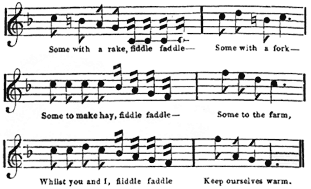
|
Catharine and Clement, be here, be here, Some of your apples, and some of your beer: Some for Peter, and some for Paul, And some for Him that made us all: Clement was a good man, For his sake give us some, Not of the worst, but some of the best, And God will send your soul to rest. |
|
Good morrow to you, Valentine! Curl your locks as I do mine; Two before and three behind; Good morrow to you, Valentine! |
|
Good morrow, Valentine! I be thine and thou be'st mine, So please give me a Valentine! |
|
Good morrow, Valentine, God bless you ever! If you'll be true to me, I'll be the like to thee; Old England for ever! |
|
Peep, fool, peep, What do you think to see? Every one has a valentine, And here's one for thee! |
|
The rose is red, The violet's blue, Pinks are sweet, And so are you! |
|
Good morrow, friends: St. Valentine is past; Begin these wood-birds but to couple now? |
|
Saint Valentine, of custom year by year Men have an usance in this region To look and search Cupid's calendere, And choose their choice by great affection: Such as be prick'd with Cupid's motion, Taking their choice as their lot doth fall: But I love one which excelleth all. |
Gay alludes to another popular notion referring to the same day:
|
Last Valentine, the day when birds of kind Their paramours with mutual chirpings find, I early rose, just at the break of day, Before the sun had chas'd the stars away; Afield I went, amid the burning dew, To milk my kine, for so should housewives do. Thee first I spied; and the first swain we see, In spite of fortune shall our true love be. |
|
She must no more a-maying; Or by rose-buds divine Who'll be her valentine. |
|
Sweet guardian angels, let me have What I most earnestly do crave, A valentine endow'd with love, That will both kind and constant prove. |
/ p.242 /
We believe the old custom of drawing lots on this eventful day is obsolete, and has given place to the favorite practice of sending pictures, with poetical legends, to objects of love or ridicule. The lower classes, however, seldom treat the matter with levity, and many are the offers of marriage thus made. The clerks at the post-offices are to be pitied, the immense increase of letters beyond the usual average adding very inconveniently to their labours.
"This iz Volantine day, mind, an be wot ah can see theal be a good deal a hanksiaty a mind sturrin amang't owd maids an't batchillors; luv sickness al be war than ivver wor nawn, espeshly amang them ats gettin raither owdish like; but all al end weel, so doant be daan abaght it. Ah recaleckt, when ah wor a yung man, ah went tut poast-office an bowt hauf a peck a volantines for tuppance, an when ah look't em ovver, thear wor wun dereckted for mesen, an this wor wot thear wor it inside:
|
Paper's scarce, and luv iz dear, So av sent ye a bit a my pig-ear; And if t'same bit case we yo, my dear, Pray send me a bit of yor pig-ear. |
|
Stand fast, root; bear well, top; God wend us a youling sop! E'ry twig, apple big; E'ry bough, apple enow. Hats full, caps full, Full quarter sacks full. |
For this incantation the confused rabble expect a gratuity in money, or drink, which is no less welcome; but if they are disappointed in both, they, with great solemnity, anathematize the owners and trees with altogether as insignificant a curse.
"It seems highly probable," says Hasted, in his History of Kent, "that this custom has arisen from the ancient one of perambulation among the heathens, when they made their prayers to the gods, for the use and blessing of the fruits coming up, with thanksgiving for those of the preceding year; and as the heathens supplicated Eolus, the god of the winds, for his favorable blasts, so in this custom they still retain his name, with a very small variation, the ceremony being called yeuling; and the word is often used in their invocations."
|
We go from Bickbury and Badger to Stoke on the Clee, To Monkhopton, Round Acton, and so return we. |
|
Here's two or three jolly boys all o' one mind, We've come a pace-egging, and hope you'll be kind; I hope you'll be kind with your eggs and your beer, And we'll come no more pace-egging until the next year. |
|
The first that comes in is old Toss-pot you see, A valiant old blade for his age and degree; He is a brave fellow on hill or in dale, And all he delights in is a-drinking of ale. |
Toss-pot then pretends to take a long draught from a huge quart-pot, and, reeling about, tries to create laughter by tumbling over as many boys as he can. A miser next enters, who is generally a boy dressed up as an old woman in tattered rags, with his face blackened. He is thus introduced by the captain:
|
An old miser's the next that comes in with her bags, And to save up her money, wears nothing but rags.
Chorus. Whatever you give us we claim for our right, |
|
Now, ye ladies and gentlemen, who sit by the fire, Put your hands in your pockets, 'tis all we desire; Put your hands in your pockets, and lug out your purse, We shall be the better, you'll be none the worse! |
|
Tid, Mid, Misera, Carl, Paum, good Pase-day" Kennett, MS. Lansd. 1033.
|
|
Collop Monday, Pancake Tuesday, Ash Wednesday, Bludee Thursday, Friday's lang, but will be dune, And hey for Saturday afternune! |
|
Pit-a-pat, the pan is hot, We are come a-shroving; A little bit of bread and cheese Is better than nothing. The pan is hot, the pan is cold; Is the fat in the pan nine days old? |
|
A Shrovun, a Shrovun, I be cum a Shrovun, A piece a bread, a piece a cheese, A bit a your fat beyacun, Or a dish of doughnuts, Aal of your own mayacun!
A Shrovun, a Shrovun,
Chorus. A Shrovun, A Shrovun, |
|
--------------------------- * Composed of flour and lard, with plums in the middle, and made into round substances about the size of a cricket-ball. They were called nuts or dough-nuts, and quite peculiar to the Isle of Wight. ---------------------------
|
|
A Shrovun, a Shrovun, I be cum a Shrovun, Linen stuff es good enuff, Vor we that cums a Shrovun. |
|
Vine veathers in a pie, My mouth is verrey dry. I wish a wuz zoo well a-wet, Then I'd zing louder vor a nut! Dame,* dame, a igg, a igg,† Or a piece a beyacun. Dro awaay‡ the porridge pot, Or crock to bwile the pecazun. Vine veathers in a pie, My mouth is verrey dry. I wish a wuz zoo well a-wet, Then I'd zing louder vor a nut!
Chorus. A Shrovun, A Shrovun, |
|
--------------------------- * Dame. The mistress of the house, if past the middle age, was called Dame, i.e. Madame. † An egg an egg ‡ Throw away. ---------------------------
|
|
A seyal, a seyal in our town, The cup es white and the eal es brown; The cup es meyad from the ashen tree, And the eal es brew'd vrom the good barlie. | ||
| Chorus. |
Cake and eal, cake and eal, A piece of cake and a cup of eal; We zing merrily one and aal For a piece of cake and a cup of eal. | |
|
Little maid, little maid, troll the pin,* Lift up the latch and we'll aal vall in;† Ghee us a cake and zum eal that es brown, And we dont keer a vig vor the seyal in the town. | ||
| Chorus. |
W'ill zing merrily one and aal Vor a cake and a cup of eal; God be there and God be here, We wish you aal a happy New Year. | |
|
--------------------------- * That is, turn the pin inside the door in order to raise the latch. In the old method of latching doors, there was a pin inside which was turned round to raise the latch. An old Isle of Wight song says,—
---------------------------
|
|
Love, to thee I send these gloves, If you love me, Leave out the G, And make a pair of loves! |
|
Good morrow, Valentine, I go to-day, To wear for you what you must pay, A pair of gloves next Easter-day. |
|
The rose is red, the violet's blue, The gilly-flower sweet, and so are you; These are the words you bade me say For a pair of new gloves on Easter-day. |
|
I see by the latch There is something to catch; I see by the string The good dame's within; Give a cake, for I've none; At the door goes a stone. Come give, and I'm gone. |
|
Care Sunday, care away, Palm Sunday and Easter-day. |
|
Tid, Mid, Misera, Carling, Palm, Paste-egg day. |
|
Fool, fool, April fool, You learn nought by going to school! |
|
April-fool time's past and gone, You're the fool, and I'm none! |
|
Rise up, fair maidens, fie, for shame, For I've been four lang miles from hame; I've been gathering my garlands gay; Rise up, fair maids, and take in your May. |
|
Good morning, missus and measter, I wish you a happy day; Please to smell my garland, 'Cause it is the first of May. |
|
Here's a health unto our maister, The founder of the feast, And I hope to God wi' all my heart, His soul in heaven mid rest.
That everything mid prosper |
|
Harvest home, harvest home, Ne'er a load's been overthrown. |
|
Here's a health to the barley mow, Here's a health to the man, Who very well can Both harrow, and plough, and sow. |
|
When it is well sown, See it is well mown, Both raked and gravell'd clean, And a barn to lay it in: Here's a health to the man, Who very well can Both thrash and fan it clean. |
|
"God have your saul, Beens and all." |
|
The fifth of November, Since I can remember, Gunpowder treason and plot: This was the day the plot was contriv'd, To blow up the King and Parliament alive; But God's mercy did prevent To save our King and his Parliament. A stick and a stake For King James's sake! If you won't give me one, I'll take two, The better for me, And the worse for you! |
This is the Oxfordshire song chanted by the boys when collecting sticks for the bonfire, and it is considered quite lawful to appropriate any old wood they can lay their hands on after the recitation of these lines. If it happen that a crusty chuff prevents them, the threatening finale is too often fulfilled. The operation is called going a progging, but whether this is a mere corruption of prigging, or whether progging means collecting sticks (brog, Scot. Bor.), I am unable to decide. In some places they shout, previously to the burning of the effigy of Guy Fawkes—
|
A penn'orth of bread to feed the Pope, A penn'orth of cheese to choke him; A pint of beer to wash it down, And a good old faggot to burn him. |
|
—— laws for all faults, But faults so countenanc'd, that the strong statutes Stand like the forfeits in a barber's shop, As much in mock as mark. |
|
--------------------------- * Review of Johnson's Shakespeare, 1765, p. 42. ---------------------------
|
|
And when arrived, keep your state; For he who from these rules shall swerve, Must pay the forfeits—so observe.
Who enters here with boots and spurs,
Who rudely takes another's turn,
Who reverentless shall swear or curse,
Who checks the barber in his tale,
Who will or cannot miss his hat |
|
And he who can or will not pay, Shall hence be sent half-trimm'd away, For will he nill he, if in fault He forfeit must in meal or malt, But mark, who is alreads in drink, The cannikin must never clink! |
|
My granny is sick, and now is dead,* And we'll go mould some cockle-bread; Up with my heels and down with my head, And this is the way to mould cockle-bread. |
|
--------------------------- * Another version says, "and I wish she was dead, that I may go mould," &c., which, if correct, may be supposed to mean, "My granny is ill, and I wish she was dead, that I may use a charm for obtaining a husband." ---------------------------
|
|
Cockeldy bread, mistley cake, When you do that for our sake. |
/ p.257 /
|
A pie sat on a pear tree, A pie sat on a pear tree, A pie sat on a pear tree, Heigh ho! heigh ho! heigh ho! |
When a boy finds anything, and another sees him stoop for it, if the latter cries halves before he has picked it up, he is, by schoolboy law, entitled to half of it. This right may, however, be negatived, if the finger cries out first—
|
Ricket, racket, find it, tack it, And niver give it to the aunder. |
|
No halfers, Findee, keepee; Lossee, seekee. |
|
Those that go my way, butter and eggs, Those that go your way chop off their legs. |
|
Philomel, with melody Sing in our sweet lullaby; Lulla, lulla, lullaby; Lulla, lulla, lullaby. |
|
Trylle the ball againe my Jacke, And be contente to make some play, And I will lull thee on my lappe, With hey be bird now say not nay. |
|
Hush, hush, hush, hush! And I dance mine own child, And I dance mine own child, Hush, hush, hush, hush! |
|
Where have you been to-day, Billy, my son? Where have you been to-day, my only man? I've been a wooing, mother, make my bed soon, For I'm sick at heart, and fain would lay down.
What have you ate to-day, Billy, my son? |
|
--------------------------- * Another version was obtained from Yorkshire:
|
|
Oh, where ha' ye been a' day, My boy Tammy?
Where ha' ye been a' day,My boy Tammy?
I've been by burn and flow'ry brae,Meadow green and mountain gray, Courting o' this young thing, Just come frae her mammy. And where gat ye that young thing. My boy Tammy?
And where gat ye that young thing,My boy Tammy?
I gat her down in yonder how,Smiling on a broomy knowe, Herding ae wee lamb and ewe For her poor mammy. What said you to the bonny bairn, My boy Tammy?
What said you to the bonny bairn,My boy Tammy?
I praised her een sae lovely blue,Her dimpled cheek and cherry mou' ; I preed it aft, as ye may trow— She said she'd tell her mammy. I held her to my beating breast, My young, my smiling lammy;
I held her to my beating breast,My young, my smiling lammy:
I hae a house, it cost me dear,I've wealth o' plenishing and gear, Ye'se get it a', war't ten times mair, Gin ye will leave your mammy. The smile gaed aff her bonny face, I maunna leave my mammy;
The smile gaed aff her bonny face,I maunna leave my mammy:
She's gi'en me meat, she's gi'en me claise,She's been my comfort a' my days; My father's death brought mony waes— I canna leave my mammy.
|
|
We'll tak' her hame, and mak' her fain, My ain kind-hearted lammy;
We'll tak' her hame, and mak' her fain,My ain kind-hearted lammy:
We'll gie her meat, we'll gie her claise,We'll be her comfort a' her days; The wee thing gi'es her han', and says— There! gang and ask my mammy.
Has she been to the kirk wi' thee, My boy Tammy?
Has she been to the kirk wi' thee,My boy Tammy?
She's been to kirk wi' me,And the tear was in her e'e; But, oh! she's but a young thing, Just come frae her mammy!
|
|
Ah! where have you been, Lairde Rowlande, my son? Ah! where have you been, &c.
|
|
Oh! you've been at your true love's, Lairde Rowlande, my son! Oh! you've been at your true love's, &c.
|
|
What got you to dinner, Lairde Rowlande, my son? What got you to dinner, &c.
|
|
What's become of your Warden, Lairde Rowlande, my son? What's become of your Warden, &c.
|
|
What's become of your stag-hounds, Lairde Rowlande, my son? What's become of your stag-hounds, &c.
|
The fable or plot of this seems to be, that Lord Rowlande, upon a visit at the castle of his mistress, has been poisoned by the drugged viands at the table of her father, who was averse to her marriage with the lord. Finding himself weary, and conscious that he is poisoned, he returns to his home, and wishes to retire to his chamber without raising in his mother any suspicions of the state of his body and mind. This may be gathered from his short and evasive answers, and the importunate entreaties with which he requests his mother to prepare his chamber.
In Swedish there are two distinct versions: one, the Child's Last Wishes, in Geijer and Afzelius, iii. 13, beginning—
|
Hvar har du varit så länge, Dotter, liten kind? Jag har varit hos min Amma, Kär styf-moder min! För aj aj! ondt hafver jag — jag!
Where hast thou been so long now, |
/ p.263 /
|
Hvar har du va't så länge, Lilla dotter kind? Jag har va't i Bänne, Hos broderen min! Aj, aj, ondt hafver jag, jag!
Where hast thou been so long now, |
|
I had a cock, and a cock lov'd me, And I fed my cock under a hollow tree; My cock cried—cock-cock-coo— Every body loves their cock, and I love my cock too!
I had a hen, and a hen lov'd me,
I had a goose, and a goose lov'd me,
I had a duck, and a duck lov'd me,
I had a drake, and a drake lov'd me,
I had a cat, and a cat lov'd me, |
|
My duck went—quack, quack, quack— My goose went—qua'k, qua'k, qua'k— My hen went—chickle-chackle, chickle-chackle— My cock cried—cock-cock-coo— Every body loves their cock, and I love my cock too! I had a dog, &c. My dog went—bow, wow, wow— I had a cow, &c. My cow went—moo, moo, moo— I had a sheep, &c. My sheep went—baa, baa, baa— I had a donkey, &c. My donkey went—hi-haugh, hi-haugh— I had a horse, &c.; My horse went—whin-neigh-h-h-h-h—
Every body loves their cock, and I love my cock too! |
|
Jack Sprat could eat no fat, His wife could eat no lean, And so between them both, They licked the platter clean. Jack eat all the lean, Joan eat all the fat, The bone they picked clean, Then gave it to the cat. When Jack Sprat was young, He dressed very smart, He courted Joan Cole, And he gained her heart. In his fine leather doublet, And old greasy hat, Oh, what a smart fellow Was little Jack Sprat! Joan Cole had a hole In her petticoat, Jack Sprat, to get a patch, Gave her a groat; The groat bought a patch, Which stopped the hole, "I thank you, Jack Sprat," Says little Joan Cole. Jack Sprat was the bridegroom, Joan Cole was the bride, Jack said, from the church, His Joan home should ride. But no coach could take her, The lane was so narrow, Said Jack, then I'll take her Home in a wheelbarrow. Jack Sprat was wheeling His wife by the ditch, |
|
The barrow turned over, And in she did pitch; Says Jack, she'll be drown'd, But Joan did reply, I don 't think I shall, For the ditch is quite dry. Jack brought home his Joan, And she sat in a chair, When in came his cat, That had got but one ear. Says Joan, I'm come home, Puss, Pray, how do you do? The cat wagg'd her tail, And said nothing but "mew." Jack Sprat took his gun, And went to the brook, He shot at the drake, But he killed the duck. He brought it to Joan, Who a fire did make To roast the fat duck, While Jack went for the drake. The drake was swimming With his curly tail, Jack Sprat came to shoot him, But happened to fail; He let off his gun, But missing his mark, The drake flew away, Crying, "Quack, quack, quack." Jack Sprat to live pretty, Now bought him a pig, It was not very little, It was not very big; It was not very lean, It was not very fat, It will serve for a grunter For little Jack Sprat. Then Joan went to market To buy her some fowls, She bought a jackdaw And a couple of owls. |
|
The owls they were white, The jackdaw was black, They'll make a rare breed, Says little Joan Sprat. Jack Sprat bought a cow, His Joan for to please, For Joan she could make Both butter and cheese; Or pancakes or puddings, Without any fat: A notable housewife Was little Joan Sprat. Joan Sprat went to brewing A barrel of ale, She put in some hops That it might not turn stale; But as for the malt, She forgot to put that, This is brave sober liquor, Said little Jack Sprat. Jack Sprat went to market, And bought him a mare, She was lame of three legs, And as blind as she could stare; Her ribs they were bare, For the mare had no fat, She looks like a racer, Says little Jack Sprat. Jack and Joan went abroad, Puss took care of the house, She caught a large rat And a very small mouse: She caught a small mouse, And a very large rat; You're an excellent hunter, Says little Jack Sprat. Now I have told you the story Of little Jack Sprat, And little Joan Cole, And the poor one-ear'd cat. Now Jack loved Joan, And good things he taught her. |
|
Then she gave him a son, Then after a daughter. Now Jack has got rich And has plenty of pelf; If you know any more, You may tell it yourself. |
|
Oh, where are you going, My pretty maiden fair, With your red rosy cheeks, And your coal-black hair? I'm going a-milking, Kind sir, says she; And it's dabbling in the dew, Where you'll find me.
May I go with you,
If I should chance to kiss you,
If I should chance to lay you down,
If I should chance to run away,
And what is your father, |
|
And what is your mother, My pretty maiden fair, &c. My mother is a dairy-maid, Kind sir, says she, &c.
And what is your sweetheart, |
|
There was an old couple, and they were poor, Fa la, fa la la lee!
They lived in a house that had but one door;Oh! what a poor couple were they.
The old man once he went far from his home, Fa la, fa la la lee!
The old woman afraid was to stay alone,Oh! what a weak woman was she.
The old man he came home at last, Fa la, fa la la lee!
And found the windows and door all fast.Oh! what is the matter? quoth he.
Oh ! I have been sick since you have been gone; Fa la, fa la la lee!
If you'd been in the garden you'd heard me groan;Oh! I'm sorry for that, quoth he.
I have a request to make unto thee; Fa la, fa la la lee!
To pluck me an apple from yonder tree.Ay, that will I, marry, quoth he.
The old man tried to get up in the tree, Fa la, fa la la lee!
But the ladder it fell, and down tumbled he.That's cleverly done! said she. |
|
Hey diddle diddle, The cat scraped the fiddle, The cow jump'd over the moon; |
|
--------------------------- * The above ingenious translation and remarks were communicated by Mr. George Burges. ---------------------------
|
|
The little dog bayed To see such sports played, And the dish ran away with the spoon.
'Ad' adhla, dhla d' ade, |
|
Tommy Linn is a Scotchman born, His head is bald and his beard is shorn; He has a cap made of a hare skin, An alderman is Tommy Linn.
Tommy Linn has no boots to put on,
Tommy Linn no bridle had to put on,
Tommy Linn's daughter sat on the stair,
Tommy Linn had no watch to put on,
Tommy Linn, his wife, and wife's mother, |
|
Oh, said the topmost, I've got a hot skin: It's hotter below, says Tommy Linn. |
|
As I went to Ratcliffe Fair, there I met with a jolly beggáre, Jolly beggáre, and his name was John, and his wife's name was Jumping Joan; So there was John and Jumping Joan, Merry companions every one.
As I went to Ratcliffe Fair, there I met with a jolly beggáre,
As I went to Ratcliffe Fair, there I met with a jolly beggáre,
As I went to Ratcliffe Fair, there I met with a jolly beggáre, |
|
As I went to Ratcliffe Fair, there I met with a jolly beggáre, Jolly beggáre, and his name was Jones, and his wife's name was Mrs. Ap Jones; So there was Jones and Mrs. Ap Jones, And there was Rice and Mrs. Ap Rice, And there was Robert and Mrs. Ap Robert, And there was Richard, and Mrs. Ap Richard, And there was John and Jumping Joan, Merry companions every one.
As I went to Ratcliffe Fair, there I met with a jolly beggáre,
As I went to Ratcliffe Fair, there I met with a jolly beggáre,
As I went to Ratcliffe Fair, there I met with a jolly beggáre, |
|
As I went to Ratcliffe Fair, there I met with a jolly beggáre, Jolly beggáre, and his name was Shenkyn, and his wife's name was Mrs. Ap Shenkyn; So there was Shenkyn and Mrs. Ap Shenkyn, And there was Lewin and Mrs. Ap Lewin, And there was Owen and Mrs. Ap Owen, And there was Lloyd and Mrs. Ap Lloyd, And there was Jones and Mrs. Ap Jones, And there was Rice and Mrs. Ap Rice, And there was Robert and Mrs. Ap Robert, And there was Richard, and Mrs. Ap Richard, And there was John and Jumping Joan, Merry companions every one.
As I went to Ratcliffe Fair, there I met with a jolly beggáre, |
|
The first time that I gaed to Coudingham fair, I fell in with a jolly beggar; The beggar's name O it was Harry, And he had a wife, and they ca'd her Mary: O Mary and Harry, and Harry and Mary, And Janet and John, That's the beggars one by one; But now I will gie you them pair by pair, All the brave beggars of Coudingham fair. |
|
The sports of childhood's roseate dawn Have passed from our hearts like the dew-gems from morn: We have parted with marbles—we own not a ball, And are deaf to the hail of a "whoop and a call." But there's an old game that we all keep up, When we've drank much deeper from life's mixed cup; Youth may have vanished, and manhood come round, Yet how busy we are on "Tom Tidler's ground Looking for gold and silver!" |

|