BOOKS AND
PRINTING

|
New Review.—"A modest volume, but one which is pretty in its vermilion lettering upon clear white buckram . . . all professional writers ought to possess." Daily Telegraph.—"Abundant information is stored within its pages; in short, no one whose bent is literary will take up the book without learning some fact in typography which will both interest and enlighten him." Literary World.—"With the aid of this guide, one intending to publish can go to his publisher not wholly ignorant of the technicalities of bookmaking, and others can pick up a good deal of interesting information." Publishers' Circular.—"Writers will save themselves much trouble and unnecessary labour if they diligently master its contents, and the knowledge so gained will in turn benefit the printers." The Bookman.—"This is a practical handbook for authors, publishers and printers, on types, proofs, stereotyping, binding, copyright, registration, and other matters relating to the issuing of books." The Speaker.—"It is the outcome of wide and practical experience in the making of all sorts and sizes of choice and artistic books." Birmingham Daily Post.—"Booklovers as well as bookmakers are certain to be interested in a work, modestly entitled 'Some Notes on Books and Printing, a Guide for Authors and Others,' by Mr. Charles T. Jacobi, the Examiner in Typography to the City and Guilds of London Institute, which is being issued from the Chiswick Press, of which Mr. Jacobi is manager." |
Week's Survey.—"Needs no commendation to experienced editors and authors. An admirable specimen of the exquisite care with which artistic bookprinting is done at the celebrated Chiswick Press." Spectator.—"It is a really practical guide for those who write and those who publish." Studio.—"No better work than this could be placed in the hands of any one who contemplates writing, printing, or publishing a book." Library Association Record.—"It is a volume that no librarian should be without, as it would enable him to master many technical details in the production of books and catalogues." Publishers' Circular.—"This may reasonably be called the 'Book of Books,' seeing that without the knowledge which it comprehends no book could be properly produced." Daily News.—"It is a publication that no beginner in the pursuit of journalism or literature should be without, as it would enable him to master many technical details in the production of books. Daily Graphic.—"The whole subject of printing and the preparation of books, beginning with the manuscript, and passing by way of the index, the type, the margin, the paper, the size of the paper, the binding, right on, indeed, until the idea has taken a concrete form and the work of publishing begins, is treated of at length by one who has little to learn on the subject." Literary World.—"We have said that Mr. Jacobi is practical, and indeed he is well qualified to deal with his subject from a practical standpoint, having been for some years, and still being, the managing partner of the Chiswick Press." |
[ p.ii ]
PRINTING. A Practical Treatise on the Art of Typo- |
[ p.iii ]
[ p.v ]
PUBLISHERS & OTHERS
BY CHARLES T. JACOBI
MANAGING PARTNER OF THE
CHISWICK PRESS

[ p.vi ]
|
First printed, Nov. 1892, 1000 copies. Reprinted, March, 1902, 500 copies. Reprinted, June, 1903, 500 copies. |
[ p.vii ]
 |
|
 |
/ p.xi /
| CHAPTER | PAGE | |
| I. II. III. IV. V. VI. VII. VIII. IX. |
THE MANUSCRIPT . . . . . THE INDEX . . . . . . . TYPES AND MARGINS . . . . . METHODS OF ILLUSTRATION . . PAPERS . . . . . . . . . THE SIZES OF BOOKS . . . . . BINDING . . . . . . . . . PUBLISHING . . . . . . . . COPYRIGHT . . . . . . . . |
I 18 22 33 50 55 59 62 70 |
| A SHORT GLOSSARY . . . . . . . SPECIMENS OF MANY TYPES . . . . . . SAMPLES OF VARIOUS PAPERS . . . . . GENERAL INDEX . . . . . . . . . |
75 89 138 160 | |
BOOKS AND PRINTING
CHAPTER I
T
 |
/ p.3 /
It is, however, advisable that all manuscript should be typewritten. In many instances publishers now make it a sine quâ non: they will not even "consider" any work until it is in this form.
Most frequently the MS. is simply sent to a typewriter to be copied; but now that a really good machine can be purchased for about ten pounds, it is very much better in every way for the author himself to learn it, and thus do away with the pen entirely for all work intended for the printer. A friend of the author's has used a typewriter for some years, and he asserts that it is no exaggeration to say that, with ordinary attention, at the end of the first month, after writing each day for an hour or more, the speed will more than equal that possible with the pen; and that with further practice this speed will be increased. The result is so good that it can always be treated as a first proof—to the great saving of the author's pocket. Another great advantage with typewriting is, that by placing a piece of thin paper and the ordinary black carbon paper over the one to be typewritten, a duplicate can be obtained as good as the one which will be sent to the printers. By this means any anxiety about the MS. being lost in transmission, or by fire—as occurred in the historic case of Carlyle's "French Revolution"—is removed, and the expense saved of postal registration and the insurance which is advisable with valuable matter. And to the young author all his / p.4 / writing is valuable before it has been submitted to a publisher!
It may be mentioned here that though the MS. be typewritten it is paid for at the "manuscript" rate. In London there are three distinct rates paid for type-setting: (a) where the copy is in print, and an absolute facsimile is to be made; (b) where the copy is in print, but is to be set up in a different type, measure, or width; (c) where the copy is wholly or partly written or typewritten.
Avoid all interlineations: if necessary, cut the sheet in two where the addition is required, and gum in the slip containing the added matter.
On reading the copy over, should it be desired to commence a new paragraph, a bracket mark thus [ should be put in front of the first word, and "new par." written in the margin against it.
Should, on the contrary, a paragraph already written as such appear unnecessary, a line should be drawn from the end of the last word of the first paragraph to the first word of the next, and a marginal note made, "run on."
Either of these alterations concerning paragraphs should only be made in the MS., as they are expensive when in type, for they often entail the alteration of a large amount of subsequent matter.
The following abbreviations, agreed to at the International Shorthand Congress, 1887, are a great convenience, and save writing many thousand useless letters in ordinary copy. The best way to learn them — and they are worth learning — / p.5 / is to write out several times both the shortened form and the word for which it stands.
|
About, ab t. Account, acc t. Afternoon, aft n. Again, ag n. Against, ag st. Among, am g. Amount, am t. Because, bec. Been, b n. Between, btwn. Brought, bro t. Caught, c t. Chairman, ch n. Circumstance, cir ce. Committee, com e. Could, c d. Difference, dif ce. Different, dif t. Difficult, dif clt. Difficulty, dif clty. Evening, ev g. Every, ev y. Extraordinary, xtr y. For, f. From, f m. Further, fu r. |
General, gen l. Government, gov t. Great, g t. Had, h d. Have, h. However, how r. Importance, imp ce. Important, imp t. Large, lge. Meeting, mt g. Might, m t. Morning, m g. Notwithstanding, notw g. Objection, obj n. O'clock, o'c. Of, o. Opinion, op n. Opportunity, opp y. Other, o r. Ought, o t. Particular, part r. Question, q n. Said, s d. |
|
Several, sev l. Shall, sh. Should, sh d. That, t. The, /. Their, there, th r. Though, tho. Through, thro. Together, tog r. Very, v y. Whenever, when r. Wherever, where r. Whether, wh r. Which, w h. Whichever, which r. With, w. Without, w t. |
Would, w d. Yesterday, yest y. You, y. Your, y r. Ever, r. Ing, g. Ion, sion, tion, n. Ment, m t. Sunday, Sun. Monday, Mon. Tuesday, Tues. Wednesday, Wed. Thursday, Thurs. Friday, Fri. Saturday, Sat. |
/ p.8 /
It is most important to remember that pages are not the same as leaves: a leaf, being printed on both sides, is equal to two pages. The one side, corresponding to the right-hand page of this book, being technically called the "recto"; and the other side, the left-hand page, back, or obverse, the "verso."
With regard to the corrections in the proofs it must be remembered that the more carefully a book is written, the less expense will be incurred for "author's corrections." This charge is often a great source of contention between the author, publisher, and printer, and is altogether unsatisfactory. A printer is bound, with certain reservations, to follow the copy supplied, and if he does that, and the author makes no alterations, there are no author's corrections and nothing to dispute. But should there be many alterations, they may prove disastrously troublesome and expensive, besides delaying the work.
The charges made for corrections are based on the time consumed in making them, and are very difficult to check, even by an expert.
A page of type may contain two, three or more thousands of letters, every word being built up letter by letter and line by line, till the page is complete. A small correction, trivial as it may seem to the inexperienced, may possibly involve much trouble to the printer, and the labour expended on it not being apparent, is only appreciated by a practical man. A word inserted or deleted may cause a / p.9 / page to be altered throughout line by line, and a few words may possibly affect several pages.
Therefore, if possible, in making verbal corrections always substitute words of an equal length to those removed — this is money saved in corrections.
"Extras" comprise the foregoing author's corrections, because the labour likely to be involved is not apparent when a volume is put in hand; extraneous or miscellaneous matter, such as tables, foreign languages, etc., being expensive in composition; and all charges for types smaller than the body of the work. In the case of printed copy, termed "reprint," the extras can be accurately estimated.
If it is necessary to correct a work in type, and the alterations are likely to disarrange lines and possibly pages, proofs in "galley" or "slip" form should be ordered. In America first proofs are generally in this form, and it will save an inexperienced author much expense if he always has them so. This means a little more trouble to the printer, but to the author or publisher less expense in the long run, because corrections can be more easily effected in slips.
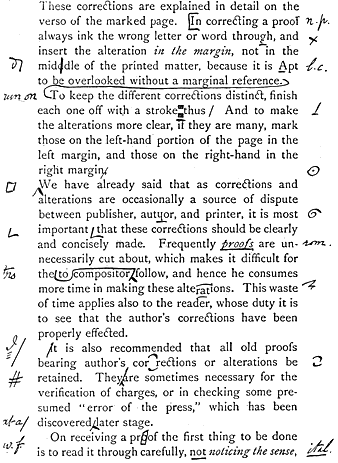
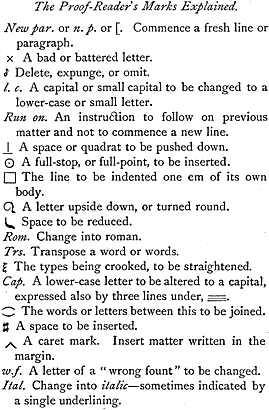
In marking corrections for the printer certain recognized signs and symbols are used which express concisely what is required. We give on page 11 the principal characters used, and the corrections as marked by a skilled person; on page 10 is shown the type corrected accordingly. / p.10 / These corrections are explained in detail on the verso of the marked page.
In correcting a proof always ink the wrong letter or word through, and insert the alteration in the margin, not in the middle of the printed matter, because it is apt to be overlooked without a marginal reference. To keep the different corrections distinct, finish each one off with a stroke thus / and to make the alterations more clear, if they are many, mark those on the left-hand portion of the page in the left margin, and those on the right-hand in the right margin.
We have already said that as corrections and alterations are occasionally a source of dispute between publisher, author, and printer, it is most important that these corrections should be clearly and concisely made. Frequently proofs are unnecessarily cut about, which makes it difficult for the compositor to follow, and hence he consumes more time in making these alterations. This waste of time applies also to the reader, whose duty it is to see that the author's corrections have been properly effected.
It is also recommended that all old proofs bearing author's corrections or alterations be retained. They are sometimes necessary for the verification of charges, or in checking some presumed "error of the press," which has been discovered at a later stage.
On receiving a proof the first thing to be done is to read it through carefully, not noticing the sense,
/ p.11 /
but searching for "letterals," or, in other words, seeing that every single word is spelt correctly. If sense and meaning be examined in the first place, the eyes get so accustomed to the words and their spelling that mistakes—even flagrant ones—are sometimes overlooked. Whatever else be wrong a book must be spelt correctly!
Among many other desirable things it is important that an author should always verify in the proofs all extracts, references to dates, titles, and so forth.
When the first proof has been read and marked by the author, and he wishes to see it again, he should write "Revise" on the top left-hand corner, and return it to the printer, who will submit a "revise" to him with the corrections carried out. Should the corrections be few and the author not wish to see it again, he writes "Press" on the sheet, which means that no more alterations will be made by him, and that after the corrections have been effected by the compositor it can at once be printed. The final, or "press proof," is always retained by the printer for future reference in case of any dispute, and the author or editor should always preserve the intermediate proofs bearing corrections, in case of queries afterwards arising.
Printer's readers, styled "correctors of the press," are, as a rule, a very careful and painstaking body of men. Generally with practical experience, and sometimes a classical knowledge, they virtually sub-edit the MS. The queries they / p.14 / mark on proofs should always be carefully considered, as they frequently indicate an interpretation of the copy that may not have occurred to the author. Searching for an interpretation of his query may often show that the passage may be understood in two ways—one of which the author may not have thought about. Hence their queries well repay consideration.
What amount of printed matter will the MS. make—how many pages will it cover, in fact? This is not always an easy question to answer. No exact rules can be laid down; manuscript copy varying so much in character of writing, and in the quantity of deletions and insertions. A practical man has frequently to spend much time and patience on manuscripts for estimation. Printers are frequently and astonishingly accurate in calculating most difficult manuscript.
It is not possible to explain in writing how to deal with intricate MSS.; it requires experience and practical knowledge. One blank page for the beginning and ending of each chapter must be allowed on the average, and extra matter and footnotes, should there be either, must be considered.
If your copy is a fair one, open the MS. at ten different places, taken purely at random (they must not be selected in any way), and count the number of lines on each of the pages, and also the number of words in any one line (taken again at random), on each of the ten pages; add together the number / p.15 / of lines. Strike out the last figure of the total, and you have the average number of lines per page; then do the same with the words, and you have their average number. Multiply these two together, and you have the number of words per page; multiply this by the number of pages, and you will have the approximate number of words in the whole.
Mark this number on the outside sheet, as a guide to the publisher, and do not forget at the same time to put your name and address, in case it may get lost.
By the same method it is easy to find the number of words in any printed book when, for instance, it is desired to compare sizes.
A rough and ready way to find the average quantity of English words contained in one square inch of ordinary printed matter in "old style" type will be to use the following table:
| Great Primer English Pica Small Pica Long Primer Bourgeois Brevier Minion Nonpareil Pearl |
|
|
|
T
HE INDEX |
T
YPES AND MARGINS |
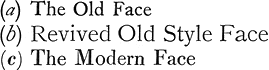
 , italic, and a bolder face of type is permissible in order to give emphasis to certain passages.
  is sometimes called "Clarendon," and occasionally "Egyptian." This one is generally termed
  , and has a pretty effect, especially with old style types. (enlargement)
/ p.24 /
/ p.25 /
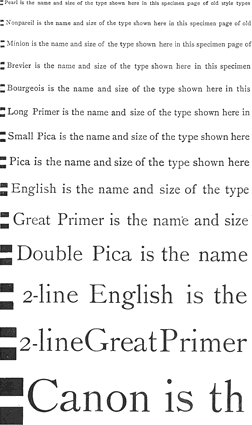
Each separate kind of type is made in many sizes, each size having a special name: that of the type used in this work is "Pica." The following table shows all the ordinary sizes for book work, with their approximate dimensions and equivalents where they happen to be in proportion. There are of course larger sizes, but these lie rather outside our present scope.
size of | "solid." | ||||
|
DIAMOND PEARL RUBY NONPAREIL MINION BREVIER BOURGEOIS LONG PRIMER SMALL PICA PICA ENGLISH GREAT PRIMER PARAGON DOUBLE PICA |
Bourgeois Long Primer Small Pica Pica English Two-line Brevier Great Primer Paragon Double Pica Two-line Pica Two-line English Two-line Great Primer Two-line Paragon Two-line Double Pica |
| |||
| Points | |||
|
Diamond Pearl Ruby Nonpareil Minion Brevier Bourgeois Long Primer Small Pica Pica English Great Primer |
= 4½ is half of = 5 " = 5½ " = 6 " = 7 " = 8 " = 9 " = 10 " = 11 " = 12 " = 14 " = 18 " |
Bourgeois Long Primer Small Pica Pica English Two-line Brevier Great Primer Paragon Double Pica Two-line Pica Two-line English Two-line Great Primer |
= 9 = 10 = 11 = 12 = 14 = 16 = 18 = 20 = 22 = 24 = 28 = 36 |
 is but the name for the unit which represents the actual square of the side of any particular body, and has no connection with the letter "m" excepting that it is sometimes thus abbreviated. An "en"
  is the same depth precisely, but half the width of an "em," so two ens
  make one em This pica "em" is the standard adopted for governing the measure or width of type matter (enlargement).The wages value of any page is / p.27 / obtained by measuring the actual length and width in ems of that fount in which the volume or work is composed, this being doubled to obtain the ens, e.g., 50 x 20=1,000 x 2=2,000. This gives the number of letters in a page—the en being considered the average thickness of the twenty-six letters of the alphabet. For example, supposing the twenty-six letters of the lower-case roman alphabet (a to z) were set up in the composing stick, the total length of the complete alphabet should not be less than twelve ems of its own body; more often it is thirteen or fourteen ems. If less than twelve ems it is a "thin" fount, and the compositors are paid extra for the additional work it entails.
|
Foolscap 6¾ x 4¼ Crown 7½ x 5 Post 8 x 5 Demy 8¾ x 5 5/8 Medium 9½ x 6 Royal 10 x 6¼ |
may become |
Crown 7½ x 5 inches. Demy 8¾ x 5 5/8. Medium 9½ x 6. Royal 10 x 6¼. Super Royal 10¼ x 6 7/8. Imperial 11 x 7½. |
|
Foolscap 8½ x 6¾ Crown 10 x 7½ Post 10 x 8 Demy 11¼ x 8¾ Medium 12 x 9½ Royal 12½ x 10 |
may become |
Crown 10 x 7½. Demy 11¼ x 8¾. Medium 12 x 9½. Royal 12½ x 10. Super Royal 13¾ x 10¼. Imperial 15 x 11. |
M
ETHODS OF ILLUSTRATION |
/ p.39 /
All that was required was to draw upon the zinc with a greasy pigment, or one containing a resisting varnish, and then to etch the plate with acid. The whites of the design were thus bitten away, and the lines, having been protected by the varnish from the action of the acid, were untouched and remained in relief. When mounted upon a wooden or metal support of sufficient thickness, the plate could be imposed with type and printed in the ordinary way.
We have already seen that the aid of photography was invoked by the wood engraver; it was destined to render still more important service to the process engraver. Instead of drawing directly upon the metal, the zincographer makes a reversed negative from his drawing, and having sensitized the surface of his plate proceeds to print the negative upon it. This is effected by covering the zinc plate with a thin coating of albumen, in which potassium bichromate has been dissolved. When dry the negative is exposed in contact to the action of light, and it is found that the physical condition of the sensitized albumen undergoes an important change. Where the light has penetrated the negative, the albumen has been rendered insoluble in water; where, on the contrary, the dense film of the negative prevents the passage of light, there is no alteration in the condition of the albumen. After rolling up with a lithographic ink the plate can be washed and the unprinted albumen dissolved away, the remaining portion, acted upon by light corresponding with the lines of the design, being / p.40 / undisturbed. The plate is then etched, and when sufficient relief is obtained mounted and printed from in the manner already described. Modified in various particulars and improved in detail this is the ordinary line process now in common use. Where a drawing is prepared with due regard to photographic requirements it is an excellent method of obtaining at very small cost an efficient and faithful reproduction. A subject that would have formerly cost several pounds if engraved on wood, can be reproduced by line process for a few shillings, the rate for the finest work of this class not exceeding sixpence per square inch, while in a great many instances it is much lower.
It must not be imagined, however, that line process will satisfactorily reproduce any drawing, although such a belief is commonly but erroneously entertained. The drawing must be made in a suitable manner; it must express everything the artist intends to convey, and, as a good photograph is an essential preliminary, it must be made in clear, firm, definite black lines. There must be no question as to colour, otherwise over-exposure in the negative cannot be avoided, and this results in thickened and distorted lines, or, on the other hand, in their becoming broken and rotten in the reproduction. The drawing should be rather hard; all the tone is to be obtained by cross-hatching or by tints made up of line; no wash or pencil work is admissible. Sometimes it is advantageous to make it somewhat larger in / p.41 / proportion than the resulting block, but when this is done the artist must not be tempted, because he has a larger surface to cover, to put more work upon his design than would be required for a reproduction to scale. Simplicity is desirable, and the most effective pen drawings are generally those which are made with the least effort.
The zincographic line process is very rapid in operation. Using artificial light and labour-saving contrivances in the various stages of its manufacture, a block can be completed in a very few hours; so quickly, indeed, that this process is extensively employed for daily newspaper purposes, where the entire preparation of the paper has to be completed between sunset and sunrise.
Another process in which the block is produced by swelling a photographic print made upon a gelatine film, so as to enable a cast of the lines to be obtained in relief, was for some time extensively used in America as well as in this country. Except in the case of originals where the colour is imperfect, or for reproductions from old and stained prints of existing engravings, it possesses no advantage over the ordinary zinc method, and being more complicated in working its use has almost entirely died out.
Artists accustomed to draw upon wood were unfettered as to technique. Sometimes they chose to indicate the precise treatment the engraver was to adopt when interpreting a design, but very fre- / p.42 / quently they were content to make a wash drawing on the wood-block, and left the engraver to use his own discretion in translating the monochrome into a line engraving, for it must be remembered that for letterpress printing a definite texture of lines or dots must exist. There is a level surface exposed to pressure, and, except as modified by the making-ready, the amount and distribution of colour in the design can only be expressed by means of lines and dots of different sizes, shapes, and directions. Men familiar with line drawing were quite at home when called upon to produce drawings for photographic reproduction, but a larger and equally capable class of illustrators were at a disadvantage inasmuch as they lacked the ability to express tone properly by means of line. So the photographers turned their attention to perfecting some arrangement whereby wash or monochrome drawing should be made available for printing at letterpress, and the solution of the problem resulted in what is known as the half-tone process, the most extensively used of any existing method of illustration.
The half-tone engraver does for the drawing in flat tint what the draughtsman in line does for himself, and his function is somewhat akin to that of the wood engraver engaged in cutting tints. In point of fact the half-tone operator converts an indefinite tint, whether in wash or pencil, or the tone of an ordinary photographic print, incapable as it stands of direct expression at the letterpress / p.43 / machine, into a texture of dots and points which can be readily printed from.
This is accomplished by very similar methods to those of the ordinary line process. There is, indeed, a close analogy between them, the only radical difference being found in the negative. A negative from an outline drawing will obviously represent that drawing exactly, the lines will appear as transparent replicas of those in the drawing, and the colour of the paper will be represented by the opaque film of the negative. In the case of a monochrome it has to be replaced by one made with a screen interposed between the drawing and the sensitive plate. The screen is a very fine piece of optical apparatus. It is composed of two sheets of plate glass absolutely free from flaws or defects of any description whatever. These are ruled by means of delicate machinery fitted with movements capable of exact mathematical adjustment so as to insure uniformity in the width both of the line itself and the spaces between the lines. The ruling on each generally follows the direction of the diagonal, and the two sheets are secured face to face and hermetically sealed. The sealing material is opaquely coloured, and when viewed against a luminous background the screen is seen to be composed of minute squares. The number of lines to the inch and the ratio between the width of line and intervening space vary. Originally screens of eighty or one hundred lines to the inch were employed, now screens of one / p.44 / hundred and fifty up to two hundred lines to the inch are common, and even finer screens are used where the conditions will permit of the most careful printing. When inserted in the camera in front of the sensitive plate the action of the screen is to intercept very much of the transmitted light from the copy, and to break up the image into that mass of dots and points, which, whether conspicuous or almost imperceptible, is always present in a half-tone engraving. Having secured the negative, the later stages of the production of a half-tone block are similar to those already described in connection with line blocks. Copper has largely replaced zinc as the material used, and the various stages of re-biting require greater deftness on the part of the operator than the corresponding steps in making a line block.
Before entirely leaving the subject of photography as applied to either letterpress or lithographic printing, a few words are necessary on the subject of colour printing, and also as to those photo-mechanical methods of printing which are sometimes used in connection with book illustration.
Colour printing involves a number of separate blocks or stones for one subject, the number varying with the number of colours to be used. The lithographer selects from his design the appropriate colours, and, having drawn the key or general outline, he lays down a number of transfers on to separate stones. On one he will draw in so much of the tint as is necessary to obtain, say, the yellow, / p.45 / and on another what is required to give the blue, and on another the violet, and so on. Each one of course is treated with sufficient inflection to convey the different strengths of colour, and again separate stones are provided for such intermediate tints as cannot very well be secured by a combination of any other colours used. All these transfers being laid down from one key they can be printed in succession in perfect register, and so the colour print is gradually built up.
Where a long run is required, some economy is found in employing relief blocks instead of lithographic stones, or again it is sometimes advantageous to combine the two methods, and print part of the work from stone and the rest from relief blocks. The increasing tendency to produce colour work by letterpress has lately contributed to an important development of the photographic half-tone process, which is generally known as "three-coloured work." The researches of Ives and others in the field of photographic optics have demonstrated that it is possible to construct photographic positives which will discriminate natural colours.
The photographer does this by making negatives in register on specially prepared sensitive plates so arranged that each one shall automatically select only a sympathetic colour and reject any other. In this way a negative may be obtained from any object which shall reproduce only so much of it as is coloured yellow, another shall reproduce / p.46 / the blue, and another the purple. If half-tone blocks are made from these, and are printed in pigments corresponding as closely as possible with the colours selected by the respective negative filters, a fairly satisfactory result may be obtained. It is clear, however, that any such result is an approximation only, and its success depends largely upon the character of the subject to be reproduced. Natural objects as a rule present fewer difficulties than paintings or drawings in colour.
A very brief reference to the photo-mechanical processes will suffice. They are numerous, and for fidelity of reproduction are valuable, but they involve separate printing, and in some cases this is a costly matter. The most important are the group of collotype processes, which are known by a variety of names. A collotype may be described as a mechanical print from a chemically prepared surface, and is in effect a lithograph printed from a gelatine film. In this country climatic changes are so frequent and sudden that it is difficult to rely upon the behaviour of gelatine, which is largely affected by variations of temperature, and by the amount of moisture present in the atmosphere. Very fine granulation can be employed, and therefore a collotype print is capable of expressing the most delicate textures and the lightest tints.
It only remains now to mention the group of illustrative methods known as intaglio or incised / p.47 / processes. Line engraving upon copper has been already referred to. A later development introduced the use of steel instead of copper plates, and a more delicate style of engraving became popular. During the earlier part of the last century, line and stipple engravings were used for book illustration in the case of sumptuous editions, but have now almost entirely died out. The revival of copper etching dates from the decline of line engraving. For the artist who is expert in the control of his treatment of line, no method can be simpler or more effective. Having covered a polished copperplate with a resist varnish, he draws in reverse with a sharp point the lines of his design, revealing the metal: he then proceeds to etch the plate, generally using a retarding mordant such as perchloride of iron. Not only can the width of line be varied, but its depth can also be regulated by re-covering the plate and re-biting those portions of the design which need strengthening.
Much more restricted in its application to book illustration is the mezzotinter's art. It is a complicated process to produce a mezzotint plate, and when done the number of perfect impressions that can be relied upon is not great. A copperplate is worked upon by a tool known as a "rocker," which raises a burr like velvet-pile. The engraving is made with a scraper, the burr is reduced in height for the middle tones, and is altogether removed for the high lights of the subject, which are represented by the smooth metal. / p.48 / The plate is inked and printed in the same manner as a line copperplate, but the tint obtained by the rocking is so full and deep, and of such a varied character, that a print from a mezzotint plate always presents a rich appearance, and possesses a quality unobtainable in any other way.
The fact that every print from a copperplate involves a large amount of manual manipulation insures variety, and the introduction among the illustrations of a book of at least one printed from a plate enables it to claim a higher place among the season's editions than is allotted to others. Hence the need for a cheap and speedy method of making copperplate illustrations, which has been satisfied by the introduction of photogravure.
In connection with relief work gelatine surfaces for electrotyping purposes have already been mentioned. The use of undulating gelatine films in conjunction with resin for granulating the plate gives the process of photogravure.
A negative of the subject is made in the usual manner, and from this a reversed glass positive is printed. A carbon print is then made, which is laid down on a copperplate already covered with finely powdered resin. The undulations in the carbon film corresponding with the gradations of light and shade in the subject regulate the time required for a mordant to penetrate to the surface of the copperplate beneath, and permit of the more immediate action of the acid upon those parts where the carbon film is thinnest. These corre- / p.49 / spond with the shadows, while the denser film indicating the lights of the subject does not permit of much, if any, chemical action. The printing texture is secured by the powdered resin, the separate grains of which prevent the uninterrupted action of the mordant and granulate the bitten area.
Although not a particularly cheap process photogravure is an efficient and comprehensive method of securing artistic results in the way of book illustration, and for the reproduction of paintings it is unsurpassed by any of the mechanical processes. It is not unusual for us to be told that these may be dismissed as unworthy of consideration from that point of view which insists upon the individuality of the craftsman as the only criterion of artistic excellence, and photogravure has consequently received less attention than it deserves, the circumstance that much of the beauty of the finished product depends upon the skill of the retoucher being conveniently ignored. In practice the plate which requires little or no retouching is the one which soonest fails in printing.
This closes our review of the processes available for purposes of illustration. The sketch is necessarily incomplete—it cannot pretend to be more. It aims only at giving information which will aid an inquiring reader in his search for more.
P
APERS |
/ p.52 /
The principal sizes of machine-made printing papers measure in inches:
|
Foolscap . . . . . . . . . Crown . . . . . . . . . . . Post . . . . . .. .. . .. .. . Demy . . . . . . . . . . . . Medium . . . . . . . . . . Double Pott . . . . . . . Royal . . . . . . . . . . . . . Double Foolscap . . . Super Royal . . . . . . . Double Crown . . . . . Imperial . . . . . . . . . . . Double Post . . . . . . . Columbia . . . . . . . . . . Atlas . . . . . . . .. . . . . . |
17 20 20 22½ 24 25 25 27 27½ 30 30 32 34½ 36 |
x 13½ x 15 x 16 x 17½ x 19 x 15½ x 20 x 17 x 20½ x 20 x 22 x 20 x 23½ x 26 |
/ p.54 /
A ream of writing or hand-made paper usually consists of twenty quires, containing twenty-four sheets, or 480 in all; but machine-made paper generally contains 516 sheets (twenty-one and a half quires), termed "printers' reams." As long numbers are mostly printed on these papers, each ream, allowing for waste and spoilage, thus gives something more than 500 perfect copies.
Vellum is occasionally used for very special copies of a choice work, but its first cost and the subsequent trouble and expense in printing render it truly an édition de luxe. Nowadays it is somewhat difficult to obtain that material uniform in colour, thickness, and flexibility.
A substitute for vellum which has come into use during the past few years is the Japanese hand-made vellum paper. It is almost untearable, and its beautifully even and smooth surface is capable of receiving the finest impression. So much so, that it is largely used for printing engravings and etchings. Its cost as compared with real vellum is small, and not very much more than the best English hand-made rag paper. This paper is admirably adapted for children's toy-books, and also for sheet music, which has, as a rule, a bad habit of soon parting at the folds.
One objection, however, to the Japanese paper is that it is not easily cleaned should it become fingered, as its surface becomes rough in the process of cleaning.
T
HE SIZES OF BOOKS |
to |
one sheet. |
hand-made | ||||
| Folio Quarto Octavo Duodecimo Sextodecimo Octodecimo Vigesimo-quarto Trigesimo-secundo |
|
|
vertical horizontal vertical horizontal horizontal vertical vertical vertical |
| Pott . . . . . . . . Foolscap . . . . . Crown . . . . . . Post . . . . . . . . Demy . . . . . . . Medium . . . . . Royal . . . . . . . Super Royal . . Imperial . . . . . |
6¼ 6¾ 7½ 8 8¾ 9½ 10 10¼ 11 |
x x x x x x x x x |
3 7/8 4½ 5 5 5 5/8 6 6¼ 6 7/8 7½ |
. . . . . . . . . . . . . . . . . . . . . . . . . . . |
7¾ 8½ 10 10 11¼ 12 12½ 13¾ 15 |
x x x x x x x x x |
6¼ 6¾ 7½ 8 8¾ 9½ 10 10¼ 11 |
/ p.58 /
according to the signature on the first page. This is only requisite in such sizes of books as duodecimo or octodecimo, where a sheet cannot be properly folded without first cutting off and insetting a small section within the larger: this second signature indicating its position and acting as a check on its proper sheet.
B
INDING |
P
UBLISHING |
| (1) (2) (3) (4) (5) | Sale outright. Limited sale. Profit-sharing. Royalty. Commission. |
/ p.67 /
Some such form as the accompanying is generally used for soliciting subscriptions:
M .....................................................
           Please enter my name as a subscriber for ...........
cop........ of the work entitled ......................................
by ............................................ for which I undertake
to pay ...................................... on delivery [or enclose].
                                Name ..............................................
                                Address ...........................................
                                         ...............................................
Date ............................................
This scheme may be modified if necessary. Should there be two editions, large and small paper, this should be stated, and room for choice allowed in the order-form.
*** This is to certify that only copies of this edition have been printed, all of which are numbered [and signed].
If there are two editions to be printed, they may both be expressed in the certificate, but the numbers of the two sizes can either be distinct and each start at No.
In all editions limited to a certain number of copies, a certificate should be printed in each volume stating:
No.
Signed ..................................
Ordinary books are frequently issued having a limited large paper edition struck off at the same time. These are generally subscribed for in the manner just mentioned.
Directly a work is ready to be issued by the publisher, it is customary to send certain copies for review to various newspapers and journals. The character of the work must be considered before sending them out broadcast, or perhaps they may be sent where no notice will be taken of them. The publisher generally knows where to place these copies, but the author should mention any particular papers to which he desires them to be sent. Good notices of a work materially add to its success.
Advertising a work is another very important matter. In arranging for this with a publisher, supposing it is a commission book, the author should name some limit. If the advertisement can be included with other books in a general way, the expense is not so great; but the announcement of a work singly is expensive.
Insurance, too, must not be overlooked if the book is a commission one, and the author may either insure the stock himself, or give instructions that it should be covered.
Presentation or gratis copies are frequently sent out in order to give the book a fillip, the copies generally allotted to the writer as "author's copies" / p.69 / probably being distributed amongst his more immediate friends.
All criticisms on the book are filed by the publisher, and use may be made of the best of them should it be necessary to send out a prospectus. Some extracts from these opinions of the press may be included in any future advertisement of the volume.
Most publishers, and sometimes authors too, subscribe to some press-cutting agency, but it is very advisable to see that a competent firm is employed.
C
OPYRIGHT |
/ p.72 /
It is essential that the precise terms of the Statute be complied with, and upon application to "The Registrar, Stationers' Hall, London," he will forward full printed instructions, the following extract from which will be found useful:
Mode of Registration.—A proprietor of copyright desiring to register at Stationers' Hall must lodge there a demand signed by him and witnessed, in the form printed on the back thereof, together with a fee of 5s. for each entry.
/ p.73 /
British Possessions.—Books first published in any British Possession which does not provide for registration should be registered at Stationers' Hall.
It should be noted that one of the conditions of copyright being granted in the United States is / p.74 / that a work must be printed from type actually set up in America.
OF BIBLIOGRAPHICAL AND TYPOGRAPHICAL TERMS IN
|
Backs.—The "back" margin of pages—that margin next the binding.
Bastard title.—A fly- or half-title before the full title of a work.
Black-letter.—A general expression used to indicate  (enlargement) gothic text, or church type.
Bleed.—When a book or pamphlet has been cut down too much, so as to touch the printed matter, it is said to "bleed."
Blind blocked (or tooled).—Simple impressed lettering on bookcovers, not inked or gilt.
Blind P (or paragraph mark ¶).—Frequently used in old printed books.
/ p.76 /
Blocks.—A general term embracing woodcuts, electros, etc.
Calendered paper.—Paper very highly rolled or glazed, much used for printing illustrations.
Cancel.—A term used for a new leaf or leaves reprinted in consequence of some error or defect.
Capitals.—Letters thus, CAPITALS. Shortly called "caps."
Caps. and Small Caps.—CAPITALS and
 ; the older founts were called "Egyptian."
/ p.77 /
Clean sheets.—Sheets put aside as they are printed off to show the progress of the work.
Dead reprint.—An absolute facsimile reprint, line for line and page for page.
Decimo-sexto.—The same as sixteenmo, q.v.
Deckle.—The raw, rough edge of hand-made paper.
Dele (or delete).—To expunge, cancel, delete, or omit, indicated thus
/ p.78 /
Double Pica.—A size of type having three and a half lines to the inch.
Edition de luxe.—An elaborate, costly and limited edition on large paper.
Egyptian.—See "Clarendon."
Eighteenmo.—A book having eighteen leaves to the sheet, written shortly 18mo. Bibliographically termed "octodecimo".
Electrotyping.—A means of duplicating woodcuts, etc., by an electro deposit of copper, which is afterwards backed up by a kind of type metal.
End leaves (or papers).—The blank flyleaves at each end of a book.
English.—A size of type having five and a quarter lines to the inch.
Errata (pl.), Erratum (s.).—A list of errors, not necessarily printers' errors.
Even pages.—The left-hand or verso pages of a book.
Fine paper edition.—The best edition of a book; sometimes expressed by the letters F. P.
Finishing.—The lettering or tooling on a book-cover.
Flat pull (or impression).—A simple proof without under- or over-laying.
Flexible.—A style of binding which allows the book to open quite flat.
Flyleaf.—A blank leaf at each end of a book.
/ p.79 /
Fly-title.—The half-title in front of the general title, or the one dividing sections of a work.
Galley proofs.—Those supplied in slips about two feet long, before the matter is made up into pages.
Gilt tops.—Books with the top edges cut and gilt, to prevent them being soiled by the dust which collects there.
Gratis copies.—Those copies not sold, but sent out for presentation, review, etc.
Great Primer.—A size of type having four and a quarter lines to the inch.
Guarded.—Books are said to be "guarded" when the plates are mounted or sewn on guards (as maps are), instead of being stitched or pasted in the ordinary way.
Hair leads.—Very thin leads for spacing out printed matter. Frequently they measure sixteen to a pica, or ninety-six to an inch.
/ p.80 /
Hair space.—The thinnest space made for placing between words.
Imperfections.—Sheets required by a binder to complete books imperfect through bad gathering, collating, or spoiled sheets.
Imperial.—A size of printing paper, 30 x 22 inches. Folio, 22 x 15; quarto, 15 x 11; octavo, 11 x 7½.
Imposition.—A term applied generally to the laying-down of the pages in certain positions, to form, when printed, quartos, octavos, etc.
Imprint.—The printer's name and address in a book, which is necessary by Act of Parliament.
Indent.—To set back any line or lines, as in the commencement of a paragraph.
In quires.—Unbound books in sheets.
In slip.—Galley-proofs printed before making-up into pages.
In the press.—A work in the course of being printed is thus announced.
India paper.—A fine paper used for engraver's proofs. It is generally imported from China, though called "India."
India rubbered.—Books with plates are sometimes coated at the back with a solution of india rubber to save stitching or expense of guarding: when open the book will lie perfectly flat.
Inferior figures and letters.—Made to range at the bottom of a letter, thus—1 2 3 a e i o u
Initial letters.—Large block or floriated letters used at the commencement of a chapter or work.
Inset.—A sheet, or part of one, placed inside another sheet to complete sequence of pagination.
Intaglio.—A term used for printing from an incised copperplate; the reverse of ordinary or "relief" printing.
Italic.—The sloping characters, distinct from roman types, invented by Aldus Manutius, the Venetian printer.
/ p.81 /
Japanese paper.—Hand-made paper with a vellum surface manufactured in Japan.
Keep standing.—An order not to distribute the type, pending possible reprinting.
Laid paper.—Those papers that show, when held up to the light, parallel waterlines, at intervals of an inch or so.
Large paper.—The best copies of a work with large margins, etc. ; also termed édition de luxe. Sometimes expressed by the initials L. P.
Leaded matter.—Lines of type separated by leads, or narrow strips of metal.
Leatherette or Leatheroid.—An imitation of leather, usually made of embossed paper.
Leaves.—Must not be confused with pages, because the leaf being printed on both sides is equal to two pages.
Letter paper.—A term for quarto paper: note paper being octavo.
Letterpress.—Matter printed from type as distinct from lithographic or plate printing.
Ligatures.—Tied letters cast on one body, thus,  , etc.
Line process block.—A direct photographic relief printing block, suitable for ordinary work in line, or drawings in "black and white."
Lining papers.—Papers used by bookbinders for pasting down on and inside the covers.
Literals (or letterals).—Single errors by the printer in setting up type—a first proof is usually well sprinkled with such before it is submitted to the author.
Lithography.—Printing from the surface of a smooth but porous stone, invented by Aloys Senefelder over one hundred years ago.
LL.—The abbreviation for "leaves" in a book.
Long Primer.—A size of type having seven and a half lines to the inch.
/ p.82 /
Lower-case letters.—The small letters, a, b, c, d, e, f, g, etc., not capitals.
Mackle.—A printed sheet with a slurred appearance, owing to some mechanical defect in the impression.
Make-up.—To measure off matter into pages.
Marbled edges.—When the cut edges of books representmarble.
Margin.—The blank paper surrounding a page of print.
Marginalia.—The bibliographical term for marginal notes.
Medium.—A size of printing paper, 24 x 19 inches. Folio, 19 x 12; quarto, 12 x 9½ octavo, 9½ x 6.
Mezzotint.—An elaborate but effective method of illustration from an intaglio copperplate engraved by hand.
Minion.—A size of type having ten and one-eighth lines to the inch.
Modern face type.—That class oftype mostly used in newspaper printing. See specimens at the end of this volume.
Moulds.—The preliminary stage in stereotyping by the paper process. They are also used for plaster work and electrotyping.
Movable.—A general term applied to type to distinguish it from stereotype, etc.
N. D.—An abbreviation denoting "no date" on a book.
Nonpareil.—A size of type having twelve lines to the inch.
Note papers.—Papers octavo in shape, but of various sizes; letter papers being quarto shape, and also of various sizes.
N. P.—An abbreviation for new paragraph, either in MS. or in corrected proof.
Octavo.—Shortly written 8vo. A book having eight leaves to the sheet.
Octodecimo.—Written shortly 18mo. A book having eighteen leaves to the sheet.
Odd pages.—The right-hand or recto pages of a book.
Off-cut.—That part of the sheet which has to be cut off in order that the sheet may be folded correctly, as in a "twelvemo."
Off-set.—The set-off of ink from one sheet to another, a result of bad ink or insufficient drying.
/ p.83 /
Old English.—Founts of type of
 character. Sometimes expressed by O. E.
P.—An abbreviation for the word "page." The plural is "pp."
Page.—This must not be confused with a leaf or leaves. Each leaf, being printed on both sides, is equal to two pages.
Paragon.—A size of type having three and three-quarter lines to the inch.
Paste-downs.—The blank flyleaves, sometimes coloured, at each end of a book, which are pasted down on the covers.
Pearl.—A size of type having fifteen lines to the inch.
Photogravure.—A mechanical intaglio process superseding the hand-engraved copperplate.
Pica.—A size of type having six lines to the inch.
Pointing.—The general term used by printers for punctuation. "Stiff pointing" is matter well peppered with commas and other punctuation marks.
Points.—All marks of punctuation.
Post.—A size of printing paper, 20 x 16 inches.
Pott.—A sheet measuring 15½ x 12½ inches. Folio, 12½ x 7¾; quarto, 7¾ x 6¼; octavo, 6¼ x 3
/ p.84 /
Press proof.—The final proof marked by the author or editor "press."
Quad papers.—Those papers made in large size, such as quad crown, 30 x 40 in.—four times the size of crown, 20 x 15 in.
Quadrat.—Blank pieces of metal used by the printer to fill up short lines.
Quarter bound.—Books bound with the back only of leather.
Quarto.—Written shortly 4to. A book having four leaves to the sheet.
Quaternions.—Printed sheets folded and insetted in sections of four.
Query.—A mark (?) made by the corrector of the press to call attention to a possible error.
Quinternions.—Printed sheets folded and insetted in sections of five.
Quire.—Twenty-four sheets of paper.
Quires.—Unbound books in sheets are said to be in quires.
Ream.—Paper in parcels or bundles of a certain size, a printer's ream being 516 sheets. Hand-made and drawing papers may contain 472, 480, or 500 sheets.
Recto.—The right-hand pages of any book.
Register.—The adjustment of print on one side of a leaf to that on the other.
Relief printing.—Letterpress and block printing, as distinct from lithography or plate printing.
Removes.—The difference between one size of type and another.
Retree.—The rejected or slightly damaged paper of different reams, marked x x. Distinct from outsides or "broken," marked x x x
/ p.85 /
Revise.—A proof bearing author's corrections, which has to be submitted again before being set to press.
Script.—Type similar in character to handwriting.
Serif.—The fine lines on the top and bottom of a letter, as in H. A sanserif is
/ p.86 /
Small Pica.—A size of type having seven lines to the inch.
 etc.
etc.
Tails.—The bottom or tail-end of a page.
Ternions.—A bibliographical expression for three sheets folded together in folio.
Thick leads.—Strips of metal one twenty-fourth of an inch in thickness, used for separating lines of type.
Thickness copy.—A thickness or dummy copy of blank paper to show a specimen of size and binding.
Thin leads.—Strips of metal one forty-eighth of an inch in thickness, used for separating lines of type.
Thirty-twomo.—Written shortly 32mo. A book having thirty-two leaves to the sheet.
Three-colour process.—The method of printing any coloured picture by the use of the three primary colours superimposed
/ p.87 /
on each other—the blocks being automatically dissected for the purpose in photographing.
Uncut edges.—Leaves uncut by machinery, not necessarily "unopened" by hand.
Unopened edges.—Applied to books the edges of which have not been opened.
Verso.—The reverse or back of a leaf; the left-hand page of a book; the reverse or opposite of "recto."
Vigesimo-quarto.—The bibliographical term for "twenty-fourmo."
Vignettes.—A class of illustration with the edges undefined and shaded off gradually.
Waste.—Surplus odd sheets of a book beyond the plus copies.
Watermark.—The wire-mark of any particular design woven in a sheet of paper.
White.—The space between any lines or words of type.
White edges.—Edges of books machine-cut, not coloured or gilt.
White out.—To space or "branch out" any composed matter, such as in advertisements.
/ p.88 /
White paper.—Unprinted paper, whether white or tinted.
Xylography.—The cutting and printing of old block-books.
Zincography.—The art of producing engravings on zinc by a chemical process.
/ p.90 /
|
[ p.91 ]
| GREAT PRIMER . ENGLISH . . . . . . PICA . . . . . . . . . SMALL PICA . . . LONG PRIMER . BOURGEOIS . . . BREVIER . . . . . . MINION . . . . . . NONPAREIL . . . PEARL . . . . . . . . |
|
|
|
116 117 118 119 120 121 122 123 124 125 |
| OLD FACE ROMAN CAPITALS . . . . . . . . OLD STYLE ROMAN CAPITALS . . . . . . . MODERN ROMAN CAPITALS . . . . . . . . OLD FRENCH ROMAN CAPITALS . . . . . . FLEMISH ROMAN CAPITALS . . . . . . . . . OLD FACE ITALIC . . . . . . . . . . . . . . . OLD STYLE ITALIC . . . . . . . . . . . . . . . MODERN ITALIC . . . . . . . . . . . . . . . . OLD ENGLISH BLACK LETTER . . . . . . . . DUTCH BLACK LETTER . . . . . . . . . . . . TUDOR BLACK LETTER . . . . . . . . . . . . VENETIAN TEXT BLACK LETTER . . . . . . |
126 127 128 129 130 131 132 133 134 135 136 137 |
| Thick leaded. | Thin leaded. | Solid. | OLD FACE. | ||||||
|
GREAT PRIMER . . ENGLISH . . PICA . . SMALL PICA . . LONG PRIMER . . BOURGEOIS . . BREVIER . . NONPAREIL . . |
|
. . . . . . . . . . . . . . . . |
|
. . . . . . . . . . . . . . . . |
| OLD STYLE. | |||
|
GREAT PRIMER . . ENGLISH . . PICA . . SMALL PICA . . LONG PRIMER . . BOURGEOIS . . BREVIER . . MINION . . NONPAREIL . . PEARL . . |
|
. . . . . . . . . . . . . . . . . . . . |
|
. . . . . . . . . . . . . . . . . . . . |
| ANTIQUE ROMAN. | |||
|
GREAT PRIMER . . PICA . . LONG PRIMER . . BREVIER . . NONPAREIL . . |
|
. . . . . . . . . . |
|
. . . . . . . . . . |
| MODERN. | |||
|
GREAT PRIMER . . ENGLISH . . PICA . . SMALL PICA . . LONG PRIMER . . BOURGEOIS . . BREVIER . . MINION . . NONPAREIL . . PEARL . . |
|
. . . . . . . . . . . . . . . . . . . . |
|
. . . . . . . . . . . . . . . . . . . . |
| ||||
[Pages 89 to 137, which contain the chapter SPECIMENS OF MANY TYPES, are here placed in a separate document.]
/ p.138 /
 |
/ p.139 /
| PAGE | |||
| 140 141 142 143 144 145 146 147 148 149 150 |
ORDINARY WHITE SHADE. " CREAMY " " TONED " " ANTIQUE LAID, DECKLE EDGE. " WOVE, " ". LIGHT BULKING ANTIQUE LAID. " " WOVE. SUPER-CALENDERED SURFACE. ENAMELLED (SO-CALLED " ART"). CHROMO SURFACE. PLATE PAPER. |
151 152 153 154 155 156 157 158 159 |
FRENCH. DUTCH, VAN GELDER, CREAM SHADE. " " TONED " ENGLISH, SPALDING AND HODGE. " ARNOLD AND FOSTER. " WHATMAN (W. AND R. BALSTON). " BATCHELOR AND SON. " O. W. PAPER AND ARTS CO. JAPANESE VELLUM. |
Abbreviations: manuscript, 4, 5; sizes of books, 55, 56. Advertising, 68. Agreements: between authors and publishers, 64. Alphabet : printers', 57. American system of type bodies, 25,26. Antique roman type, 23; various specimens, 111-115. Antique papers: laid, 143, 145; wove, 144, 146. Arnold and Foster: hand-made paper, 155. Art paper, 148. Author's copies, 68. Author's corrections, 8. Authors to verify dates, refer- ences, etc., 13. Authors: Incorporated Society of, 62. Batchelor and Son: hand-made paper, 157. Bewick: his method of engrav- ing, 37. Bibliographical: list of editions, 17; terms, 75-88. Binding: case work, 59; paper or cloth, 59; varieties of leather, 60; wire-sewing, 60; parchment, 61; rules for, 61; vellum, 61. Black letter: its use, 23; various specimens, 134-137. Block books, 34. Book: reprint of a, 28; margin an important feature, 30; large paper copies, 31; illustration to be considered, 33; deckled edges, 50. Books: to find number of words in printed, 15; table of biblio- graphical sizes, 55; rules for binding, 61. |
Bourgeois: specimen pages in old face, 98; old style, 106; modern face, 121. Brevier: specimen pages in old face, 99; old style, 107; antique roman, 114; modern face, 122. British Museum, 70, 71. Calendered paper, 52, 147. Capitals: how to express, 7; capitals and small capitals, 7; specimens of various kinds, 126-130. Caslon: William, 22; old face type, 22; various specimens, 93-100, 126, 131. Casting-off: in manuscript, 14; printed matter, 15. Certificate of limited editions, 17; form of, 67. Chromo paper, 149. Clarendon type, 23. Collotype: processes of, 46. Colour-printing, 44, 45. Commission: publishng on, 65, 66, 67. Copperplate engraving, 35. Copyright: rules and regula- tions, 70-74. Corrections: author's, 8; charges for, 8; more easily effected in slip form, 9; signs used in marking, 9; a source of dis- pute, 10. Correctors of the press, 13. Criticism of works, 68, 69. Customs of the house, 6. Cut edges: books with, 56, 57. Deckled edges, 50. Dutch black letter: specimen, 135. Dutch hand-made paper, 152, 153. |
Edition de luxe: difference must not be too great, 31. Egyptian, 23. Electrotyping, 29. Em: the printers', 26. En: the printers', 26. Enamelled paper, 148. English hand-made paper. See Arnold, Batchelor, O. W. Co., Spalding, Whatman. English: specimen pages in old face, 94; old style, 102; modern face, 117. Engraving: various methods, 33-49. Etching on copper, 47. Extract matter, 7. Extras: printers' charges for, 9. Fancy types, 23. Flemish: specimen of capitals, 130. Footnotes, 7. French hand-made paper, 151. Galley proofs, 9. Gelatine processes, 46. Glossary: bibliographical and typographical, 75-88. Gratis copies, 68. Great Primer: specimen pages in old face, 93; old style, 101; antique roman, 111; modern face, 116. Guarantee: limited edition, 17, 67. Half-tone: process of, 42, 43. Hand-made paper, 50; various samples, 151-159. Headlines, 16. Illustration: methods of, 33-49. Index: how to make, 18; omis- sion, 18; punctuation, 20; should be checked, 21. Insurance, 68. Intaglio: processes by, 46, 47. International copyright, 73. International Shorthand Con- gress, 4. |
Italic, 7, 23; specimens of vari- ous kinds, 131-133. Japanese hand-made vellum 54; sample, 159. Kelmscott Press, 31, 53. Laid paper, 50. Large Paper editions: sizes sug- gested for, 32. Leaded type: thick-, 27; thin-, 27. Leaves and pages: difference between, 8. Limited editions, 17. Line engraving: process of, 40. Lithographic stones, 45. Lithography: art of, 36; invented by Senefelder, 36. Long Primer: specimen pages in old face, 97; old style, 105; antique roman, 113; modern face, 120. Machine-made paper, 50; various samples, 140-150. Manuscript: preparation of, 1; typewritten, 3; registration of, 3; longhand abbreviations for, 5, 6; casting-off, 14; illu- minated, 34. Margins: types and, 22; an im- portant feature, 30; proportion of, 31. Methods of illustration, 33-49. Mezzotint engraving, 47, 48. Miller and Richard: old style type, 23, 24; various speci- mens, 101-110, 127, 132. Minion: specimen pages in old style, 108; modern face, 123. Modern face type: character- istics, 22; various specimens, 116-125, 128, 133. Morris: William, 53. Nonpareil: specimen pages in old face, 100; old style, 109; antique roman, 115; modern face, 124. |
Old English: form of black letter, 134. Old face type. See Caslon. Old French roman: specimen of capitals, 129. Old style type. See Miller and Richard. O. W. Paper and Arts Co. Ltd.: hand-made paper, 158. Page: as corrected, 10; showing corrections, 11. Pages and leaves: difference between, 8. Paper moulds: stereo, 28. Paper: samples of hand-made, French, 151; Van Gelder's Dutch (cream or toned), 152, 153; Spalding's 154; Arnold, 155; Whatman, 156; Bat- chelor, 157; O. W. Co., 158; Japanese vellum, 159. Paper: samples of machine- made, white shade, 140; creamy, 141; toned, 142; antique laid, 143, 145; antique wove, 144, 146; super-calend- ered, 147; enamelled, 148; chromo, 149; plate, 150. Paper: varieties of, 50-54; index of samples, 139. Papers: table of sizes, 52; ap- proximate cost of, 53; number of sheets in a ream, 54. Papier-mache: moulds of, 28. Pearl: specimen pages in old style, 110; modern face, 125. Photography: used for wood- engraving, 38. Photogravure, 48, 49. Pica: specimen pages in old face, 95; old style, 103; antique roman, 112; modern face, 118. Plaster stereotyping: process of, 29. Plate paper, 150. Plates: guards for binding, 61. Point system: American type, 26. Preface, 16. Preliminary matter, 16. Presentation copies, 68. |
Press: when a proof should be so marked, 13. Press-cutting agencies, 69. Press reviews, 68, 69. Printers' alphabet, 57. Printers' readers, 13. Processes: photo-mechanical, 46. Proof-readers: their marks ex- plained, 12. Proofs: varieties of, 9. Public Libraries: copies sent to, 70. Publishers: their methods, 62- 69. Queries: printers', 13. Readers, publishers', 63. Ream : the printers', 54. Registration : needful at Station- ers' Hall, 71, 73. Reprint, 9, 28. Review : copies for, 68. Revise : when a proof should be so marked, 13. Revived old style face type, 22, 23, 24. Roman capitals : various speci- mens, 126-130. Royalty system : publishing on, 65. Samples of paper: various, 139- 159. Senefelder: lithography invented by, 36. Signatures: use of, 55, 57. Signs: used for marking correc- tions, 9. Sizes: of types, 24; suggested for large paper editions, 32; papers, 52; books, 55-58. Slips: proofs in, 9. Small capitals, 7. Small Pica: specimen pages in old face, 96; old style, 104; modern face, 119. Society of Arts, 61. Solid type, 27. Spalding and Hodge hand- made paper, 154. |
Specimens : type, with names, 24, 89-138. Standing type, 30. Star Chamber, 71. Stationers' Hall, 70, 71, 74. Stereotype: paper process, 28; plaster process, 29. Style of the house, 6. Subscription: publishing by, 66; form, 67. Super-calendered paper, 147. Thin fount, 27. Three-colour process, 45. Trimmed edges: books with, 57. Tudor black letter, 136. Type: old face, 22; old style, 22; modern, 22; revived old style, 22, 23; antique roman, 23; black letter, 23; Claren- don, 23; Egyptian, 23; fancy, 23; specimen of sizes and names, 24; lines to inch, 25; table of sizes, 25; leaded and |
solid, 27; standing, 30; index of, 91; analysis, 92. Typo-etched blocks, 41. Typographical and bibliographi- cal terms. See Glossary. Uncut edges: books with, 56, 57. Underlining of words: meaning of, 7. Van Gelder, 152, 153. Vellum: real, 54; Japanese, 54. Venetian text black letter, 137. Whatman: hand-made papers, 53, 156. Wire-sewing, 60. Woodcuts: duplication of, 29. Wood-cutting, 34. Wood-engraving, 34; revival of, 37; a slow process, 38. Wove paper, 50. Zincography, 38, 39, 41. |

|