N U R S E R Y R H Y M E S
OF
ENGLAND,
Collected chiefly from Oral Tradition.
JAMES ORCHARD HALLIWELL, ESQ.
EDITED BY
FOURTH EDITION, WITH ILLUSTRATIONS.
LONDON:
J O H N R U S S E L L S M I T H,
4, OLD COMPTON STREET, SOHO SQUARE.
MDCCCXLVI.
[ p.i ]
TO
T H E F O U R T H E D I T I O N.
|
THE present edition of this little work, which, in former impressions, has met with a circulation far beyond the most sanguine expectations of those who have shared in the task of endeavouring to render it worthy of public patronage, has been enlarged by the addition of a Supplement, chiefly selected from collections formed in various parts of the country. These reached our hands too recently to be included in the original classification, a defect which will not, perhaps, be considered of much importance; nor can it, indeed, interfere with the utility of the / p.ii / work. We shall, however, hope that public favour may enable us at some future period to remove the incongruity. We beg to offer our best thanks to the correspondents who have kindly furnished us with corrections and additions to this collection. A valuable communication from MR. GEORGE STEPHENS deserves our special acknowledgement, and several important papers have reached us anonymously. We need scarcely say that any further contributions in the power of our readers to supply will be very acceptable. They may be addressed to MR. HALLIWELL, care of MR. J. RUSSELL SMITH, 4, Old Compton Street, Soho Square, London. Nov. 21st, 1845.
|
TO
T H E T H I R D E D I T I O N.
~~~~~~~~~
So much of our early popular ballad literature has perished, that although from internal evidence it would appear that a large number of our nursery songs are at least as ancient as the time of Queen Elizabeth, yet we have not succeeded in tracing many; but a few antiquarian novelties will be found in the following pages, and in time probably further discoveries / p.v / will be made. Perhaps one of the most curious in this way is the early version of the Carrion Crow, at p.53, which is still found in the chapbook collections, and with less variation than might have been expected after the lapse of more than two hundred years. The dissemination of scraps like these through all parts of England, in forms very slightly varying from each other during a long period of years, may be considered one of the most singular facts in the history of our literature. In the expectation of rendering our collection an unexceptionable contribution to a juvenile library, every allusion that could possibly offend the most fastidious reader has been carefully excluded, and rhymes founded on portions of / p.vi / the Scriptures have been altogether omitted. These facetious compositions frequently degenerate into mere vulgarities. An ingenious writer has lately endeavoured to find the "originals" of our nursery rhymes in the ancient Dutch language, and if the odd similarities produced by him in aid of his theory had been discovered instead of invented, it would have been an interesting subject for antiquarian investigation. But as it is, we are afraid Mr. Ker will rarely receive thanks for treating them so barbarously; nor do we owe any obligations to those who have attempted to substitute popular science in that place in the education of infants which those truly English compositions have so long occupied. We cannot / p.vii / help thinking that harmless and euphonious nonsense may reasonably be considered a more useful instrument in the hands of children than that overstraining of the intellect in very early age, which must unavoidably be the result of a more refined system:
|
| CLASS | PAGE |
| 1. HISTORICAL | 1 |
| 2. LITERAL | 11 |
| 3. TALES | 17 |
| 4. PROVERBS | 41 |
| 5. SCHOLASTIC | 45 |
| 6. SONGS | 49 |
| 7. RIDDLES | 73 |
| 8. CHARMS | 83 |
| 9. GAFFERS AND GAMMERS | 87 |
| 10. GAMES | 99 |
[ p.x ]
| CLASS | PAGE |
| 11. PARADOXES | 125 |
| 12. LULLABIES | 129 |
| 13. JINGLES | 135 |
| 14. LOVE AND MATRIMONY | 143 |
| 15. NATURAL HISTORY | 159 |
| 16. ACCUMULATIVE STORIES | 173 |
| 17. LOCAL | 185 |
| 18. RELICS | 189 |
| 19. LIFE AND DEATH OF TOM THUMB | 205 |
[ p.xi ]
[ p.1 ]
|
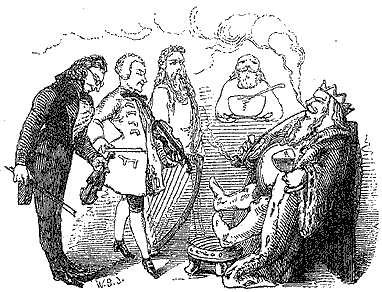
OLD King Cole Was a merry old soul, And a merry old soul was he ; He called for his pipe, And he called for his bowl, And he called for his fiddlers three. Every fiddler, he had a fiddle, And a very fine fiddle had he ; Twee tweedle dee, tweedle dee, went the fiddlers. Oh, there's none so rare, As can compare With King Cole and his fiddlers three ! |
|
[The traditional Nursery Rhymes of England commence with a legendary satire on King Cole, who reigned in Britain, as the old chronicles inform us, in the third century after Christ. According to Robert of Gloucester, he was the father of St. Helena, and if so, Butler must be wrong in ascribing an obscure origin to the celebrated mother of Constantine. King Cole was a brave and popular man in his day, and ascended the throne of Britain on the death of Asclepiod, amidst the acclamations of the people, or, as Robert of Gloucester expresses himself, the "folc was tho of this lond y-paid wel y-nou." At Colchester there is a large earthwork, supposed to have been a Roman amphitheatre, which goes popularly by the name of "King Cole's kitchen." According to Jeffrey of Monmouth, King Cole's daughter was well skilled in music, but we unfortunately have no evidence to show that her father was attached to that science, further than what is contained in the foregoing lines, which are of doubtful antiquity. In Lewis's 'History of Great Britain,' fol. Lond. 1729, three kings of Britain of the same name are mentioned.]
|
|
WHEN good king Arthur ruled this land, He was a goodly king; He stole three pecks of barley-meal, To make a bag-pudding. A bag-pudding the king did make, And stuff'd it well with plums: And in it put great lumps of fat, As big as my two thumbs. The king and queen did eat thereof, And noblemen beside; And what they could not eat that night, The queen next morning fried. |
/ p.3 /
| [The following song relating to Robin Hood, the celebrated outlaw, is well known at Worksop, in Nottinghamshire, where it constitutes one of the nursery series.] |
|
ROBIN HOOD, Robin Hood, Is in the mickle wood ! Little John, Little John, He to the town is gone. Robin Hood, Robin Hood, Is telling his beads, All in the green wood, Among the green weeds. Little John, Little John, If he comes no more, Robin Hood, Robin Hood, He will fret full sore !
|
|
|
|
ONE moonshiny night As I sat high, Waiting for one To come by ; The boughs did bend, My heart did ache To see what hole the fox did make.
|
/ p.4 /
|
|
|
I HAD a little nut tree, nothing would it bear But a silver nutmeg and a golden pear ; The king of Spain's daughter came to visit me, And all was because of my little nut tree. I skipp'd over water, I danced over sea, And all the birds in the air couldn't catch me.
|
| [From a MS. in the old Royal Library, in the British Museum, the exact reference to which is mislaid. It is written, if I recollect rightly, in a hand of the time of Henry VIII, in an older manuscript.] |
|
WE make no spare Of John Hunkes' mare ; And now I Think she will die ; He thought it good To put her in the wood, To seek where she might ly dry ; If the mare should chance to fale, Then the crownes would for her sale.
|
| [From MS. Sloane, 1489, fol.19, written in the time of Charles I.] |
|
THE king of France, and four
thousand men, They drew their swords, and put them up again.
|
/ p.5 /
| [In a tract, called 'Pigges Corantoe, or Newes from the North,' 4to, Lond. 1642, p.3, this is called "Old Tarlton's Song." It is perhaps a parody on the popular epigram of "Jack and Jill." I do not know the period of the battle to which it appears to allude, but Tarlton died in the year 1588, so that the rhyme must be earlier.] |
|
THE king of France went up the hill, With twenty thousand men ; The king of France came down the hill, And ne'er went up again.
|
|
THE king of France, with twenty thousand men, Went up the hill, and then came down again ; The king of Spain, with twenty thousand more, Climb'd the same hill the French had climb'd before.
|
| [Another version. The nurse sings the first line, and repeats it, time after time, until the expectant little one asks, what next? Then comes the climax.] |
|
THE king of France, the king of France, with forty thousand men, Oh, they all went up the hill, and so—came back again!
|
|
AT the siege of Belle-isle I was there all the while, All the while, all the while, At the siege of Belle-isle.
|
/ p.6 /
|
|
|
THE rose is red, the grass is green, Serve Queen Bess our noble queen ; Kitty the spinner Will sit down to dinner, And eat the leg of a frog ; All good people Look over the steeple, And see the cat play with the dog.
|
|
PLEASE to remember The fifth of November, Gunpowder treason and plot ; I know no reason Why gunpowder treason Should ever be forgot.
|
|
|
|
SEE saw, sack-a-day ; Monmouth is a pretie boy, Richmond is another, Grafton is my onely joy, And why should I these three destroy, To please a pious brother !
|
/ p.7 /
|
OVER the water, and over the lee, And over the water to Charley. Charley loves good ale and wine, And Charley loves good brandy, And Charley loves a pretty girl, As sweet as sugar-candy.
|
|
|
|
AS I was going by Charing Cross, I saw a black man upon a black horse ; They told me it was King Charles the First ; Oh dear! my heart was ready to burst !
|
|
HIGH diddle ding, Did you hear the bells ring ? The parliament soldiers are gone to the king ! Some they did laugh, some they did cry, To see the parliament soldiers pass by.
|
|
HIGH ding a ding, and ho ding a ding, The parliament soldiers are gone to the king ; Some with new beavers, some with new bands, The parliament soldiers are all to be hang'd.
|
/ p.8 /
| [The following is a fragment of a song on the subject, which was introduced by Russell in the character of Jerry Sneak. Mr. Sharpe showed me a copy of the song with the music to it.] |
|
POOR old Robinson Crusoe ! Poor old Robinson Crusoe ! They made him a coat, Of an old nanny goat, I wonder how they could do so ! With a ring a ting tang, And a ring a ting tang, Poor old Robinson Crusoe !
|
| [Written on occasion of the marriage of Mary, the daughter of James duke of York, afterwards James II, with the young Prince of Orange. The song from which these lines are taken may be seen in 'The Jacobite Minstrelsy,' 12mo, Glasgow, 1828, p.28.] |
|
WHAT is the rhyme for poringer ? The king he had a daughter fair, And gave the Prince of Orange her.
|
|
|
|
WILLIAM and Mary, George and Anne, Four such children had never a man : They put their father to flight and shame, And call'd their brother a shocking bad name.
|
/ p.9 /
| [From MS. Sloane, 1489, fol.19, written in the time of Charles I. It appears from MS. Harl. 390, fol.85, that these verses were written in 1626, against the Duke of Buckingham.] |
|
THERE was a monkey climb'd up a tree, When he fell down, then down fell he.
There was a crow sat on a stone,
There was an old wife did eat an apple,
There was a horse going to the mill,
There was a butcher cut his thumb,
There was a lackey ran a race,
There was a cobbler clowting shoon,
There was a chandler making candle,
There was a navy went into Spain,
|
/ p.10 /
|
|
|
JIM and George were two great lords, They fought all in a churn ; And when that Jim got George by the nose, Then George began to gern.
|
|
LITTLE General Monk Sat upon a trunk, Eating a crust of bread ; There fell a hot coal And burnt in his clothes a hole, Now General Monk is dead. Keep always from the fire : If it catch your attire, You too, like Monk, will be dead.
|
|
|
|
EIGHTY-EIGHT wor Kirby feight, When nivver a man was slain ; They yatt their meaat, an drank ther drink, An sae com merrily heaam agayn. |
[ p.11 ]
|
ONE, two, three, I love coffee, And Billy loves tea. How good you be, One, two, three, I love coffee, And Billy loves tea.
|
|
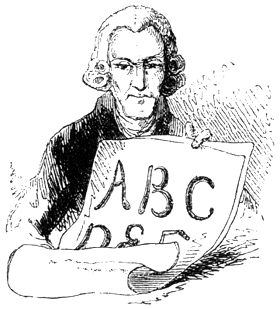
A, B, C, tumble down D, The cat's in the cupboard and can't see me.
|
/ p.12 /
|
|
|
F for fig, J for jig, And N for knuckle bones, I for John the waterman, And S for sack of stones.
|
|
1, 2, 3, 4, 5 ! I caught a hare alive ; 6, 7, 8, 9, 10 ! I let her go again.
|
|
GREAT A, little a, Bouncing B ! The cat's in the cupboard, And she can't see.
|
|
ONE's none ; Two's some ; Three's a many ; Four's a penny ; Five is a little hundred.
|
/ p.13 /
|
|
|
A was an archer, and shot at a frog, B was a butcher, and kept a bull-dog. C was a captain, all covered with lace, D was a drunkard, and had a red face. E was an esquire, with insolent brow, F was a farmer, and followed the plough. G was a gamester, who had but ill luck, H was a hunter, and hunted a buck. I was an innkeeper, who lov'd to bouse, J was a joiner, and built up a house. K was King William, once governed this land, L was a lady, who had a white hand. M was a miser, and hoarded up gold, N was a nobleman, gallant and bold. O was an oyster wench, and went about town, P was a parson, and wore a black gown. Q was a queen, who was fond of good flip, R was a robber, and wanted a whip. S was a sailor, and spent all he got, T was a tinker, and mended a pot. U was an usurer, a miserable elf. V was a vintner, who drank all himself. W was a watchman, and guarded the door, X was expensive, and so became poor. Y was a youth, that did not love school, Z was a zany, a silly old fool.
|
/ p.14 /
|
A was an apple-pie ; B bit it ; C cut it ; D dealt it ; E eat it ; F fought for it ; G got it ; H had it ; J joined it ; K kept it ; L longed for it ; M mourned for it ; N nodded at it ; O opened it ; P peeped in it ; Q quartered it ; R ran for it ; S stole it ; T took it ; [Handwritten entry] U upset it ; V viewed it ; W wanted it ; X, Y, Z, and &, all wish'd for a piece in hand.
|
|
MISS one, two, and three could never agree, While they gossiped round a tea-caddy.
|
/ p.15 /
|
ONE, two, Buckle my shoe ; Three, four, Shut the door ; Five, six, Pick up sticks ; Seven, eight, Lay them straight ; Nine, ten, A good fat hen ; Eleven, twelve, Who will delve ? Thirteen, fourteen, Maids a courting ; Fifteen, sixteen, Maids a kissing ; Seventeen, eighteen, Maids a waiting ; Nineteen, twenty, My stomach's empty.
|
|
PAT-A-CAKE, pat-a-cake, baker's man ! So I will, master, as fast as I can : Pat it, and prick it, and mark it with T, Put in the oven for Tommy and me.
|
/ p.16 /
|
A, B, C, and D, Pray playmates agree. E, F, and G, Well so it shall be. J, K, and L, In peace we will dwell. M, N, and O, To play let us go. P, Q, R, and S, Love may we possess. W, X, and Y, Will not quarrel or die. Z, and &, Go to school at command.
|
|
APPLE-PIE, pudding, and pancake, All begins with an A.
|
[ p.17 ]
|
|
|
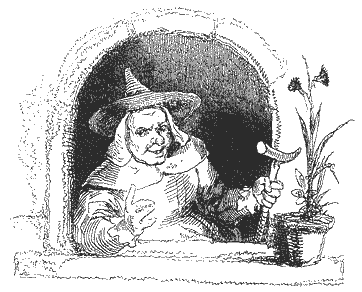
BESSY BELL and Mary Gray, They were two bonny lasses : They built their house upon the lea, And covered it with rashes.[lit.]
Bessy kept the garden gate,
|
/ p.18 /
|
THERE was a lady all skin and bone, Sure such a lady was never known : This lady went to church one day, She went to church all for to pray.
And when she came to the church stile,
When she came to the church door,
On looking up, on looking down,
Then she unto the parson said, |
|
------------------ * This line, slightly altered, has been adopted in Lewis's ballad of "Alonzo the brave and fair Imogine." The version given above was obtained from Lincolnshire, and differs slightly from the one in 'Gammer Gurton's Garland,' 8vo, Lond. 1810, pp.29-30.
|
/ p.19 /
|
OLD Boniface he loved good cheer, And took his glass of Burton, And when the nights grew sultry hot, He slept without a shirt on.
|
|
|
|
TAFFY was a Welshman, Taffy was a thief ; Taffy came to my house and stole a piece of beef : I went to Taffy's house, Taffy was not at home ; Taffy came to my house and stole a marrow-bone.
I went to Taffy's house, Taffy was not in ;
|
| [The tale of Jack Horner has long been appropriated to the nursery. The four lines which follow are the traditional ones, and they form part of 'The pleasant History of Jack Horner, containing his witty Tricks and pleasant Pranks, which he plaied from his Youth to his riper Years,' 12mo ; a copy of which is in the Bodleian Library, and this extended story is in substance the same with 'The Fryer and the Boy,' 12mo, Lond. 1617, and both of them are taken from the more ancient story of 'Jack and his step-dame,' which has been printed by Mr. Wright.] |
|
LITTLE Jack Horner sat in the corner, Eating a Christmas pie : He put in his thumb, and he took out a plum, And said, "What a good boy am I !"
|
/ p.20 /
| [As related by an old nurse, aged eighty-one. The story is of oriental origin ; but the song, as recited, was so very imperfect, that a few necessary additions and alterations have been made.] |
|
THERE once was a gentleman grand, Who lived at his country seat ; He wanted an heir to his land, For he'd nothing but daughters yet.
His lady's again in the way,
The gentleman answered gruff,
The lady at this declaration,
She sent her away to be nurs'd, |
|
Fifteen summers are fled, Now she left good Mrs. Jervis ; To see home she was forbid,— She determined to go and seek service.
Her dresses so grand and so gay,
She knock'd at a castle gate,
My lady look'd long in her face,
So Catskin was under the cook,
There is now a grand ball to be, |
|
"You go with your Catskin robe, You dirty impudent slut ! Among the fine ladies and lords, A very fine figure you'd cut."
A basin of water she took,
She washed every stain from her skin,
When she entered, the ladies were mute,
He pray'd her his partner to be,
"Pray tell me, fair maid, where you live ?"
|
|
Then she flew from the ball-room, and put On her Catskin robe again ; And slipt in unseen by the cook, Who little thought where she had been.
The young lord, the very next day,
There's another grand ball to be,
"You go with your Catskin robe,
In a rage the ladle she took,
She washed every blood-stain off |
|
My lord, at the ball-room door, Was waiting with pleasure and pain ; He longed to see nothing so much As the beautiful Catskin again.
When he asked her to dance, she again
"Pray tell me," said he, "where you live ?"
Then she flew from the ball, and put on Her Catskin robe again ; And slipt in unseen by the cook, Who little thought where she had been.
My lord did again, the next day,
Now another grand ball is to be, |
|
"You go with your Catskin robe, You impudent, dirty slut ! Among the fine ladies and lords, A very fine figure you'd cut."
In a fury she took the skimmer,
She washed the stains of blood
My lord, at the ball-room door,
When he asked her to dance, she again
"Pray tell me, fair maid, where you live ?"
|
|
Then she flew from the ball, and threw on Her Catskin cloak again ; And slipt in unseen by the cook, Who little thought where she had been.
But not by my lord unseen, —
Next day he took to his bed,
He told him how dearly he lov'd her,
There's a struggle of pride and love,
Then my lord got quickly well, |
|
To a wayfaring woman and child, Lady Catskin one day sent an alms ; The nurse did the errand, and carried The sweet little lord in her arms.
The child gave the alms to the child,
This throw went to Catskin's heart,
They set out in my lord's own coach ;
They put up at the head inn,
When folks are away, in short time |
|
Her father repented too late, And the loss of his youngest bemoan'd, In his old and childless state, He his pride and cruelty own'd.
The old gentleman sat by the fire,
But my lord drew a chair close by,
The old man alarm'd, cried aloud,
Then my lord brought his wife and child
The bells, ringing up in the tower,
|
/ p.29 /
|
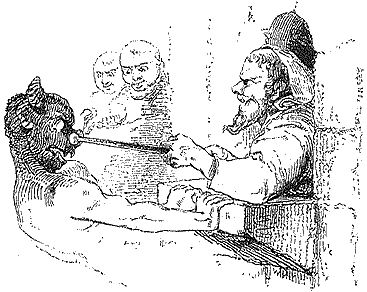
ST. DUNSTAN, as the story goes, Once pulled the devil by the nose, With red-hot tongs, which made him roar, That he was heard ten miles or more.
|
|
THERE was a crooked man, and he went a crooked mile, He found a crooked sixpence against a crooked stile : He bought a crooked cat, which caught a crooked mouse, And they all lived together in a little crooked house.
|
/ p.30 /
|
LITTLE blue Betty lived in a den, She sold good ale to gentlemen : Gentlemen came every day, And little blue Betty hopp'd away. She hopp'd up stairs to make her bed, And she tumbled down and broke her head.
|
|
MY lady Wind, my lady Wind, Went round about the house to find A chink to get her foot in : She tried the key-hole in the door, She tried the crevice in the floor, And drove the chimney soot in.
And then one night when it was dark,
And thus when once, my little dears, |
/ p.31 /
|
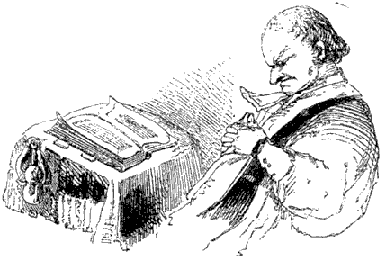
OLD Doctor Foster went to Glo'ster, To preach the word of God : When he came there, he sat in his chair, And gave all the people a nod.
|
|
DOCTOR Foster went to Glo'ster, In a shower of rain ; He stepp'd in a puddle up to his middle, And wouldn't go there again.
|
|
THE man in the moon, Came tumbling down, And ask'd his way to Norwich. He went by the south, And burnt his mouth With supping cold pease-porridge.
|
/ p.32 /
|
OLD Mother Goose, when She wanted to wander, Would ride through the air On a very fine gander.
Mother Goose had a house,
This is her son Jack,
She sent him to market,
Jack's goose and her gander
Jack found one morning,
Jack rode to his mother, |
|
She call'd him a good boy, And said it was well.
Jack sold his gold egg
Then Jack went a courting
The Jew and the Squire
The old Mother Goose,
She then with her wand,
The gold egg into the sea |
|
The Jew got the goose, Which he vow'd he would kill, Resolving at once His pockets to fill.
Jack's mother came in,
|
| The following lines, slightly altered, occur in a little black-letter book by W. Wagner, printed about the year 1560 ; entitled, 'A very mery and pythie commedie, called, the longer thou livest, the more foole thou art.' See also a whole song, ending with these lines, in Ritson's 'North Country Chorister,' 8vo, Durham, 1802, p.1.] |
|
BRYAN O'LIN, and his wife, and wife's mother, They all went over a bridge together : The bridge was broken, and they all fell in, The deuce go with all ! quoth Bryan O'Lin.
|
|
LITTLE Tommy Tittlemouse Lived in a little house ; He caught fishes In other men's ditches.
|
|
THERE was a rat, for want of stairs, Came down the rope to say his prayers.
|
/ p.35 /
|
THE lion and the unicorn Were fighting for the crown ; The lion beat the unicorn All round about the town Some gave them white bread, And some gave them brown ; Some gave them plum-cake, And sent them out of town.
|
|
THERE was a jolly miller Lived on the river Dee, He look'd upon his pillow, And there he saw a flea. Oh ! Mr. Flea, You have been biting me, And you must die : So he crack'd his bones Upon the stones, And there he let him lie.
|
|
I'LL tell you a story About Jack a Nory,— And now my story's begun: I'll tell you another About Jack his brother,— And now my story's done.
|
/ p.36 /
| [The "foles of Gotham" are mentioned as early as the fifteenth century in the 'Townley Mysteries;' and at the commencement of the sixteenth century, Dr. Andrew Borde made a collection of stories about them, not however including the following, which rests on the authority of nursery tradition.] |
|
THREE wise men of Gotham Went to sea in a bowl : And if the bowl had been stronger, My song would have been longer.
|
|
|
|
ROBIN
and Richard were two pretty men ; They laid in bed till the clock struck ten ; Then up starts Robin and looks at the sky, Oh ! brother Richard, the sun's very high :
The bull's in the barn threshing the corn,
|
|
TOM,
Tom, the piper's son, Stole a pig, and away he run ! The pig was eat, and Tom was beat, And Tom went roaring down the street.
|
/ p.37 /
|
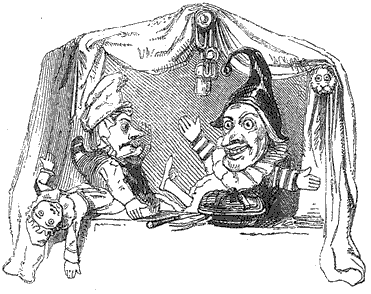
PUNCH
and Judy Fought for a pie; Punch gave Judy A knock of the eye.
Says Punch to Judy
|
|
|
|
SIMPLE
Simon met a pieman Going to the fair : Says Simple Simon to the pieman, "Let me taste your ware." |
|
Says the pieman to Simple Simon, "Show me first your penny." Says Simple Simon to the pieman, "Indeed I have not any."
Simple Simon went to town,
Simple Simon went a fishing
Simple Simon went to look
|
|
ON
Christmas eve I turn'd the spit, I burnt my fingers, I feel it yet ; The cock-sparrow flew over the table ; The pot began to play with the ladle ; The ladle stood up, like a naked man, And vow'd he'd fight the frying-pan ; The frying-pan, behind the door, Said he never saw the like before ; And the kitchen clock, I was going to wind, Said he never saw the like behind !
|
/ p.39 /
|
THE
Queen of Hearts She made some tarts, All on a summer's day : The Knave of Hearts He stole the tarts, And took them clean away.
The King of Hearts
|
|
ROBIN
the Bobbin, the big-bellied Ben, He eat more meat than fourscore men ; He eat a cow, he eat a calf, He eat a butcher and a half ; He eat a church, he eat a steeple, He eat the priest and all the people !
A cow and a calf,
|
/ p.40 /
|
SOLOMON GRUNDY, Born on a Monday, Christened on Tuesday, Married on Wednesday, Took ill on Thursday, Worse on Friday, Died on Saturday, Buried on Sunday : This is the end Of Solomon Grundy.
|
|
JACK SPRAT Had a cat, It had but one ear ; It went to buy butter, When butter was dear.
|
|
THERE
was a king, and he had three daughters, And they all lived in a basin of water ; The basin bended, My story'd ended, If the basin had been stronger, My story would have been longer.
|
[ p.41 ]
|
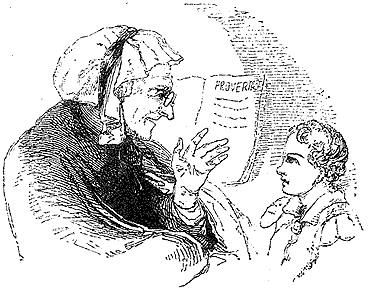
ST Swithin's day, if thou dost rain, For forty days it will remain : St. Swithin's day, if thou be fair, For forty days 'twill rain na mair.
|
|
TO make your candles last for a', You wives and maids give ear-o ! To put 'em out's the only way, Says honest John Boldero.
|
/ p.42 /
|
A SWARM of bees in May Is worth a load of hay ; A swarm of bees in June Is worth a silver spoon ; A swarm of bees in July Is not worth a fly.
|
|
THEY
that wash on Monday Have all the week to dry ; They that wash on Tuesday Are not so much awry ; They that wash on Wednesday Are not so much to blame ; They that wash on Thursday, Wash for shame ; They that wash on Friday, Wash in need ; And they that wash on Saturday, Oh ! they're sluts indeed.
|
|
NEEDLES and pins, needles and pins, When a man marries his trouble begins.
|
/ p.43 /
| [One version of the following song, which I believe to be the genuine one, is written on the last leaf of MS. Harl. 6580, between the lines of a fragment of an old charter, originally used for binding the book, in a hand of the end of the seventeenth century, but unfortunately it is scarcely adapted for the "ears polite" of modern days.] |
|
A MAN of words and not of deeds Is like a garden full of weeds ; And when the weeds begin to grow, It's like a garden full of snow ; And when the snow begins to fall, It's like a bird upon the wall ; And when the bird away does fly, It's like an eagle in the sky ; And when the sky begins to roar, It's like a lion at the door ; And when the door begins to crack, It's like a stick across your back ; And when your back begins to smart, It's like a penknife in your heart ; And when your heart begins to bleed, You're dead, and dead, and dead, indeed.
|
|
HE that would thrive Must rise at five ; He that hath thriven May lie till seven ; And he that by the plough would thrive, Himself must either hold or drive.
|
/ p.44 /
|
SEE
a pin and pick it up, All the day you'll have good luck ; See a pin and let it lay, Bad luck you'll have all the day !
|
|
GO to bed first, a golden purse ; Go to bed second, a golden pheasant ; Go to bed third, a golden bird !
|
|
WHEN the wind is in the east, 'Tis neither good for man nor beast ; When the wind is in the north, The skilful fisher goes not forth ; When the wind is in the south, It blows the bait in the fishes' mouth ; When the wind is in the west, Then 'tis at the very best.
|
| [The following proverb is alluded to in Clarke's 'Phraseologia Puerilis,' 12mo, Lond. 1655, p.21. See also Brand's 'Popular Antiquities,' vol i, p.266, and the 'Archæologist,' p.182.] |
|
BOUNCE BUCKRAM, velvet's dear ; Christmas comes but once a year.
|
[ p.45 ]
|
DOCTOR FAUSTUS was a good man, He whipt his scholars now and then ; When he whipp'd them he made them dance Out of Scotland into France, Out of France into Spain, And then he whipp'd them back again !
|
|
A DONKEY walks on four legs, And I walk on two ; The last donkey I saw Was very like you.
|
|
CROSS patch, Draw the latch, Sit by the fire and spin ; Take a cup, And drink it up, Then call your neighbours in.
|
|
WHEN I was a little boy my mammy kept me in, But now I am a great boy I'm fit to serve the king ; I can hand a musket, and I can smoke a pipe, And I can kiss a pretty girl at twelve o'clock at night.
|
|
CRY, baby, cry, Put your finger in your eye, And tell your mother it wasn't I.
|
|
|
|
MISTRESS MARY, quite contrary, How does your garden grow ? With cockle-shells, and silver bells, And muscles all a row.
|
/ p.47 /
|
A DILLER, a dollar, A ten o'clock scholar, What makes you come so soon ? You used to come at ten o'clock, But now you come at noon.
|
|
TELL tale, tit ! Your tongue shall be slit, And all the dogs in the town Shall have a little bit.
|
| [The joke of the following consists in saying it so quick that it cannot be told whether it is English or gibberish. For the version now printed, which is more complete than the one given by Chambers, I am indebted to Professor de Morgan, who has heard it in Dorsetshire. It is remarkable that the last two lines are quoted in MS. Sloan. 4, of the fifteenth century, as printed in the 'Reliq. Antiq.,' vol i, p.324.] |
|
In fir tar is, In oak none is. In mud eel is, In clay none is. Goat eat ivy, Mare eat oats.
|
/ p.48 /
|
|
|
MULTIPLICATION is vexation, Division is as bad ; The Rule of Three doth puzzle me, And Practice drives me mad.
|
| [The following memorial lines are by no means modern. They occur, with slight variations, in an old play, called 'The Returne from Parnassus,' 4to, Lond. 1606 ; and another version may be seen in Winter's 'Cambridge Almanac' for 1635. See the 'Rara Mathematica,' p.119.] |
|
THIRTY
days hath September, April, June, and November ; February has twenty-eight alone, All the rest have thirty-one, Excepting leap-year, that's the time When February's days are twenty-nine.
|
[ p.49 ]
| [This is the version generally given in nursery collections, but is somewhat different in the 'Pills to Purge Melancholy,' 1719, vol.iv, p.148.] |
|
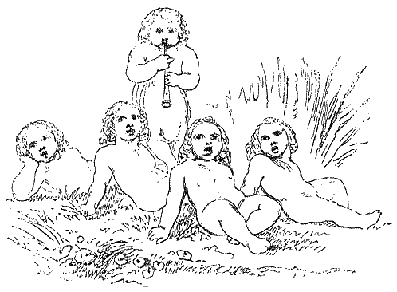
ONE misty moisty morning When cloudy was the weather, There I met an old man Clothed all in leather ; Clothed all in leather, With cap under his chin,— How do you do, and how do you do, And how do you do again !
|
/ p.50 /
|
THERE was a man in our toone, in our toone, in our toone, There was a man in our toone, and his name was Billy Pod ; And he played upon an old razor, an old razor, an old razor, And he played upon an old razor, with my fiddle fiddle fe fum fo.
And his hat it was made of the good roast beef,
And his coat it was made of the good fat tripe,
And his breeks were made of the bawbie baps, |
|
And there was a man in tither toone, in tither toone, in tither toone, And there was a man in tither toone, and his name was Edrin Drum ; And he played upon an old laadle, an old laadle, an old laadle, And he played upon an old laadle, with my fiddle fiddle fe fum fo.
And he eat up all the good roast beef, the good
|
|
JOHN COOK had a little grey mare ; he, haw, hum ! Her back stood up, and her bones they were bare ; he, haw, hum !
John Cook was riding up Shuter's bank ; he, haw, hum ! |
|
John Cook was riding up Shuter's hill ; he haw, hum ! His mare fell down, and she made her will ; he, haw, hum !
The bridle and saddle were laid on the shelf ; he, haw, hum !
|
|
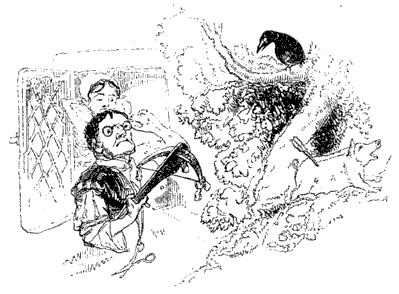
A CARRION crow sat on an oak, Fol de riddle, lol de riddle, hi ding do, Watching a tailor shape his cloak ; Sing heigh ho, the carrion crow, Fol de riddle, lol de riddle, hi ding do
Wife, bring me my old bent bow,
The tailor he shot and missed his mark, |
|
Wife, bring brandy in a spoon ; Fol de riddle, lol de riddle, hi ding do, For our old sow is in a swoon, Sing heigh ho, the carrion crow, Fol de riddle, lol de riddle, hi ding do. |
|
|
|
HIC hoc, the carrion crow, For I have shot something too low : I have quite missed my mark, And shot the poor sow to the heart ; Wife, bring treacle in a spoon, Or else the poor sow's heart will down.
|
/ p.54 /
| [The original of the following is to be found in 'Deuteromelia, or the second part of Músicks Melodie,' 4to, Lond. 1609, where the music is also given.] |
|
THREE blind mice, see how they run ! They all ran after the farmer's wife, Who cut off their tails with the carving-knife, Did you ever see such fools in your life ? Three blind mice.
|
| [The music to the following song, with different words, is given in 'Melismata,' 4to, Lond. 1611. See also the 'Pills to Purge Melancholy,' 1719, vol. i, p.14. The well-known song, 'A frog he would a wooing go,' appears to have been borrowed from this. See Dauney's 'Ancient Scottish melodies,' 1838, p.53. The story is of old date, and in 1580 there was licensed 'A most strange weddinge of the frogge and the mouse,' as appears from the books of the Stationers' Company, quoted in Warton's Hist. Engl. Poet., ed. 1840, vol.iii, p.360.] |
|
THERE
was a frog liv'd in a well, Kitty alone, Kitty alone, There was a frog liv'd in a well, Kitty alone, and I. There was a frog liv'd in a well, And a farce* mouse in a mill, [*merry. Cock me cary, Kitty alone, Kitty alone and I.
This frog he would a wooing ride, |
|
He rode till he came to my Lady Mouse hall, Kitty alone, &c. He rode till he came to my Lady Mouse hall, And there he did both knock and call, Cock me cary, &c.
Quoth he, Miss Mouse, I'm come to thee,
Quoth she, answer I'll give you none,
And when her uncle Rat came home,
Sir, there's been a worthy gentleman, |
|
The frog he came whistling through the brook, Kitty alone, &c. The frog he came whistling through the brook, And there he met with a dainty duck, Cock me cary, &c.
This duck she swallow'd him up with a pluck,
|
|
|
|
AWA'
birds, away ! Take a little, and leave a little, And do not come again ; For if you do, I will shoot you through, And there is an end of you.
|
|
IF I'd as much money as I could spend, I never would cry old chairs to mend ; Old chairs to mend, old chairs to mend ; I never would cry old chairs to mend.
If I'd as much money as I could tell,
|
/ p.57 /
| [A song of the fifteenth century, somewhat similar to the following, is printed in the 'Reliquiæ Antiquæ,' vol. i, p. 4, from a MS. at Cambridge.] |
|
THE
fox and his wife they had a great strife, They never eat mustard in all their whole life; They eat their meat without fork or knife, And loved to be picking a bone, e-oh !
The fox jumped up on a moonlight night ;
The fox when he came to yonder stile,
The fox when he came to the farmer's gate,
The gray goose she ran round the hay-stack, |
|
The farmer's wife she jump'd out of bed, And out of the window she popped her head : Oh, husband ! oh, husband ! the geese are all dead, For the fox has been through the town, e-oh !
The farmer he loaded his pistol with lead,
|
|
I'LL sing you a song : The days are long, The woodcock and the sparrow : The little dog has burnt his tail, And he must be hanged to-morrow.
|
|
|
|
SAYS
t'auld man tit oak tree, Young and lusty was I when I kenn'd thee ; I was young and lusty, I was fair and clear, Young and lusty was I mony a lang year; But sair fail'd am I, sair fail'd now, Sair fail'd am I sen I kenn'd thou.
|
/ p.59 /
| [The following lines are part of an old song, the whole of which may be found in 'Deuteromelia,' 1609, and also in MS. Additional, 5336, fol. 5.] |
|
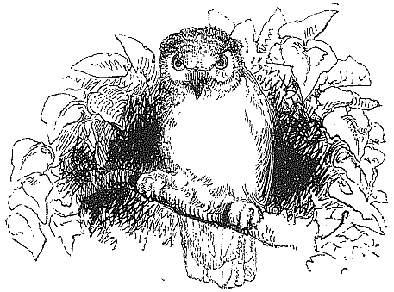
OF all the gay birds that e'er I did see, The owl is the fairest by far to me ; For all the day long she sits on a tree, And when the night comes away flies she.
|
|
I LOVE sixpence, pretty little sixpence, I love sixpence better than my life ; I spent a penny of it, I spent another, And took fourpence home to my wife.
Oh, my little fourpence, pretty little fourpence,
Oh, my little twopence, my pretty little twopence,
Oh, my little nothing, my pretty little nothing,
|
/ p.60 /
|
|
|
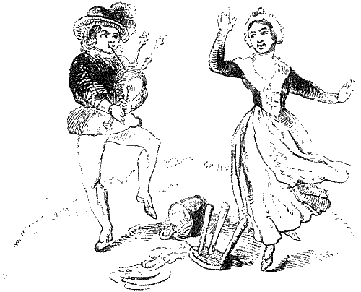
TOM he was a piper's son, He learn'd to play when he was young, But all the tunes that he could play, Was "Over the hills and far away ;" Over the hills, and a great way off, And the wind will blow my top-knot off.
Now Tom with his pipe made such a noise,
Tom with his pipe did play with such skill,
As Dolly was milking her cow one day, |
|
He met old dame Trot with a basket of eggs, He used his pipe and she used her legs ; She danced about till the eggs were all broke, She began for to fret, but he laughed at the joke.
He saw a cross fellow was beating an ass,
|
/ p.62 /
|
AS I was going up the hill, I met with Jack the piper, And all the tunes that he could play Was "Tie up your petticoats tighter."
I tied them once, I tied them twice,
|
|
THERE were two birds sat on a stone, Fa, la, la, la, lal, de ; One flew away, and then there was one, Fa, la, la, la, lal, de ; The other flew after, and then there was none, Fa, la, la, la, lal, de ; And so the poor stone was left all alone, Fa, la, la, la, lal, de !
|
|
AS I was going along, long, long, A singing a comical song, song, song, The lane that I went was so long, long, long, And the song that I sung was as long, long, long, And so I went singing along.
|
/ p.63 /
|
LONDON bridge is broken down, Dance o'er my lady lee ; London bridge is broken down, With a gay lady.
How shall we build it up again ?
Silver and gold will be stole away,
Build it up again with iron and steel,
Iron and steel will bend and bow,
Build it up with wood and clay, |
|
Wood and clay will wash away, Dance o'er my lady lee ; Wood and clay will wash away, With a gay lady.
Build it up with stone so strong,
|
|
THE north wind doth blow, And we shall have snow, And what will poor Robin do then ? Poor thing ! He'll sit in a barn, And to keep himself warm, Will hide his head under his wing. Poor thing ! |
|
|
|
THE white dove sat on the castle wall, I bend my bow and shoot her I shall ; I put her in my glove both feathers and all ; I laid my bridle upon the shelf, If you will any more, sing it yourself.
|
/ p.65 /
|
WOOLEY FOSTER has gone to sea, With silver buckles at his knee, When he comes back he'll marry me, Bonny Wooley Foster.
Wooley Foster has a cow,
Wooley Foster has a hen,
|
|
|
|
BUZ, quoth the blue fly, Hum, quoth the bee, Buz and hum they cry, And so do we : In his ear, in his nose, Thus, do you see ? He ate the dormouse, Else it was he. |
/ p.66 /
|
JOHNNY shall have a new bonnet, And Johnny shall go to the fair, And Johnny shall have a blue ribbon To tie up his bonny brown hair. And why may not I love Johnny ? And why may not Johnny love me ? And why may not I love Johnny, As well as another body ? And here's a leg for a stocking, And here is a leg for a shoe, And he has a kiss for his daddy, And two for his mammy, I trow. And why may not I love Johnny ? And why may not Johnny love me ? And why may not I love Johnny, As well as another body ?
|
|
AS I was walking o'er little Moorfields, I saw St. Paul's a running on wheels, With a fee, fo, fum. Then for further frolics I'll go to France, While Jack shall sing and his wife shall dance, With a fee, fo, fum.
|
/ p.67 /
|
TRIP upon trenchers, and dance upon dishes, My mother sent me for some barm, some barm ; She bid me tread lightly, and come again quickly, For fear the young men should do me some harm. Yet didn't you see, yet didn't you see, What naughty tricks they put upon me : They broke my pitcher, And spilt the water, And huff'd my mother, And chid her daughter, And kiss'd my sister instead of me.
|
|
|
|
SOME up, and some down, There's players in the town, You wot well who they be ; The sun doth arise, To three companies, One, two, three, four, make wee !
Besides we that travel,
|
/ p.68 /
| [Douce, in his MS. Additions to Ritson's 'Grammer Gurton's Garland,' gives one version of the following song, in which Jack Straw is introduced in the chorus.] |
|
MY father he died, but I can't tell you how, He left me six horses to drive in my plough : With my wing wang waddle oh, Jack sing saddle oh, Blowsey boys bubble oh, Under the broom.
I sold my six horses and I bought me a cow,
I sold my cow, and I bought me a calf ;
I sold my calf, and I bought me a cat ;
I sold my cat, and bought me a mouse ; |
/ p.69 /
|
LITTLE Bo-peep has lost her sheep, And can't tell where to find them ; Leave them alone, and they'll come home, And bring their tails behind them.
Little Bo-peep fell fast asleep,
Then up she took her little crook,
It happen'd one day, as Bo-peep did stray,
She heav'd a sigh and wip'd her eye,
|
/ p.70 /
|
ABOUT the bush, Willy, About the bee-hive, About the bush, Willy, I'll meet thee alive.
Then to my ten shillings,
Five and five shillings,
Five and five shillings,
|
/ p.71 /
| [The first line of this nursery rhyme is quoted in Beaumont and Fletcher's 'Bonduca,' Act v, sc.2. It is probable also that Sir Toby alludes to this song in 'Twelfth Night,' Act ii, sc.2, when he says, "Come on; there is sixpence for you ; let's have a song.' In 'Epulario, or the Italian banquet,' 1589, is a receipt "to make pies so that the birds may be alive in them, and flie out when it is cut up," a mere device, live birds being introduced after the pie is made. This may be the original subject of the following song.] |
|
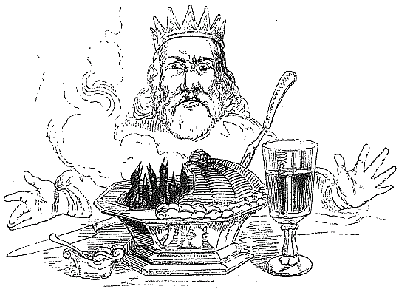
SING a song of sixpence, A bag full of rye ; Four and twenty blackbirds Baked in a pie ;
When the pie was open'd, |
|
The king was in his counting-house Counting out his money ; The queen was in the parlour Eating bread and honey ;
The maid was in the garden
Jenny was so mad,
|
[ p.73 ]
|
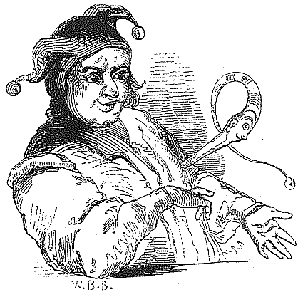
Silk an' satin was her gowne, Silk an' satin, gold an' velvet Guess her name, three times I've tell'd it.
|
/ p.74 /
|
And he that made it did it bring ; But he 'twas made for did not know Whether 'twas a thing or no.
|
|
I met mister Rusticap ; Pins and needles on his back, A going to Thorney fair.
|
|
|
|
TWO legs sat upon three legs, With one leg in his lap ; In comes four legs, And runs away with one leg. Up jumps two legs, Catches up three legs, Throws it after four legs, And makes him bring back one leg.
|
/ p.75 /
|
Employed while others sleep ; What few would like to give away, Nor any wish to keep.
|
|
A hundred eyes, and never a nose.
|
|
And all the king's horses can't pull it up.
|
|
Who should I meet but Dick Red-cap ! A stick in his hand, a stone in his throat, If you'll tell me this riddle, I'll give you a groat.
|
/ p.76 /
|
ELIZABETH, Elspeth, Betsy and Bess, They all went together to seek a bird's nest, They found a bird's nest with five eggs in, They all took one, and left four in.
|
|
AS
I was going to St. Ives, I met a man with seven wives, Every wife had seven sacks, Every sack had seven cats, Every cat had seven kits : Kits, cats, sacks, and wives, How many were there going to St. Ives ?
|
|
The king could not read it, no more could the queen ; They sent for a wise man out of the East, Who said it had horns, but was not a beast !
|
|
SEE, see ! what shall I see ? A horse's head where his tail should be.
|
/ p.77 /
|
Humpty dumpty had a great fall ; Three score men and three score more Cannot place Humpty Dumpty as he was before.
|
|
|
|
PURPLE, yellow, red, and green, The king cannot reach it nor the queen ; Nor can old Noll, whose power's so great : Tell me this riddle while I count eight.
|
|
PEASE- porridge hot, pease-porridge cold, Pease-porridge in the pot, nine days old. Spell me that in four letters.
|
|
AS I was going o'er Westminster bridge, I met with a Westminster scholar ; He pulled off his cap an' drew off his glove, And wished me a very good morrow. What is his name ?
|
/ p.78 /
|
THERE
were three sisters in a hall, There came a knight amongst them all ; Good morrow, aunt, to the one, Good morrow, aunt, to the other, Good morrow, gentlewoman, to the third, If you were my aunt, As the other two be, I would say good morrow, Then, aunts, all three.
|
|
CONGEAL'D water and Cain's brother, That was my lover's name, and no other.
|
|
Now they tramp, now they champ, now they stand still.
|
|
BLACK we are, but much admired ; Men seek for us till they are tired. We tire the horse, but comfort man : Tell me this riddle if you can.
|
/ p.79 /
|
THERE was a man who had no eyes, He went abroad to view the skies : He saw a tree with apples on it, He took no apples off, yet left no apples on it.
|
|
THE moon nine days old, The next sign to cancer, Pat rat without a tail, And now, sir, for your answer.
|
|
LITTLE Nancy Etticoat, In a white petticoat, And a red nose ; The longer she stands, The shorter she grows.
|
|
LONG legs, crooked thighs, Little head and no eyes.
|
/ p.80 /
|
WHAT
shoe-maker makes shoes without leather, With all the four elements put together ? Fire and water, earth and air, Ev'ry customer has two pair.
|
|
HIGGLEDY piggledy Here we lie, Pick'd and pluck'd, And put in a pie. My first is snapping, snarling, growling, My second's industrious, romping, and prowling. Higgledy piggledy Here we lie, Pick'd and pluck'd, And put in a pie.
|
|
THOMAS A TATTAMUS took two Ts, To tie two tups to two tall trees, To frighten the terrible Thomas a Tattamus ! Tell me how many Ts there are in all THAT.
|
|
KING
Charles walked and talked Half an hour after his head was cut off !
|
/ p.81 /
|
I HAVE
a little sister, they call her peep, peep, She wades the waters deep, deep, deep, She climbs the mountains high, high, high, Poor little creature she has but one eye.
|
|
TWELVE
pears hanging high, Twelve knights riding by ; Each knight took a pear, And yet left eleven there !
|
|
OLD
mother Twitchett had but one eye, And a long tail which she let fly ; And every time she went over a gap, She left a bit of her tail in a trap.
|
|
IN
marble walls as white as milk, Lined with a skin as soft as silk ; Within a fountain crystal clear, A golden apple doth appear. No doors there are to this strong-hold. Yet things break in and steal the gold.
|
/ p.82 /
|
THERE was a king met a king In a narrow lane, Says this king to that king, "Where have you been ?"
"Oh ! I've been a hunting
"There's the dog take the dog."
|
|
FLOUR of England, fruit of Spain, Met together in a shower of rain ; Put in a bag tied round with a string, If you'll tell me this riddle, I'll give you a ring.
|
|
EVERY lady in this land Has twenty nails upon each hand, Five and twenty hands and feet, All this is true without deceit.
|
[ p.83 ]
|
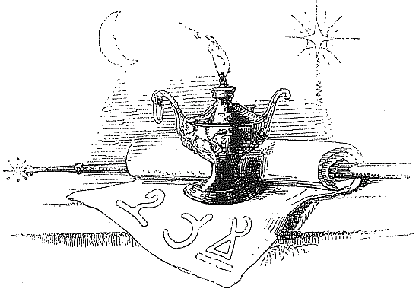
CUSHY cow bonny, let down thy milk, And I will give thee a gown of silk : A gown of silk and a silver tee, If thou wilt let down thy milk to me.
|
|
ROBERT ROWLEY rolled a round roll round, A round roll Robert Rowley rolled round ; Where rolled the round roll Robert Rowley rolled round ?
|
/ p.84 /
| [Ady, in his 'Candle in the Dark,' 4to, Lond. 1656, p.59, says that this was a charm to make butter come from the churn. It was to be said thrice.] |
|
COME,
butter, come, Come, butter, come ! Peter stands at the gate, Waiting for a butter'd cake ; Come, butter, come !
|
| [The following, with a very slight variation, is found in Ben Jonson's 'Masque of Queen's,' and it is singular to account for its introduction into the modern nursery.] |
|
I WENT
to the toad that lies under the wall, I charmed him out, and he came at my call ; I scratch'd out the eyes of the owl before, I tore the bat's wing, what would you have more ?
|
|
SWAN
swam over the sea— Swim, swan, swim ; Swan swam back again, Well swam swan.
|
/ p.85 /
| [From Dr. Wallis's 'Grammatica Linguæ Anglicanæ," 12mo, Oxon. 1674, p.164. This and the following are said to be certain cures for the hiccup if repeated in one breath.] |
|
WHEN
a Twister a twisting, will twist him a twist ; For the twisting of his twist, he three times doth intwist ; But if one of the twines of the twist do untwist, The twine that untwisteth, untwisteth the twist.
Untwirling the twine that untwisteth between,
The twain that, in twining, before in the twine,
|
|
A THATCHER of Thatchwood went to Thatchet a thatching, Did a thatcher of Thatchwood go to Thatchet a thatching ? If a thatcher of Thatchwood went to Thatchet a thatching, Where's the thatching the thatcher of Thatchwood has thatch'd ?
|
/ p.86 /
|
|
|
PETER PIPER picked a peck of pickled pepper ; A peck of pickled pepper Peter Piper picked ; If Peter Piper picked a peck of pickled pepper, Where's the peck of pickled pepper Peter Piper picked ?
|
|
MY
father he left me, just as he was able, One bowl, one bottle, one lable, Two bowls, two bottles, two lables, Three, &c. [And so on ad. lib. in one breath.]
|
| [A charm somewhat similar to the following may be seen in the 'Townley Mysteries,' p.91. See a paper in the 'Archæologia,' vol. xxvii, p.253, by the Rev. Lancelot Sharpe, M.A. See also MS. Lansd. 231, fol.114, and Ady's 'Candle in the Dark,' 4to, London 1650, p. 58.] |
|
MATTHEW, Mark, Luke, and John, Guard the bed that I lay on ! Four corners to my bed, Four angels round my head ; One to watch, one to pray, And two to bear my soul away !
|
|
|
|
IF
you love me, pop and fly ; If you hate me, lay and die.
|
|
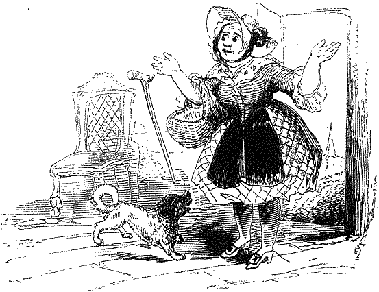
THERE was an old woman, as I've heard tell, She went to market her eggs for to sell ; She went to market all on a market-day, And she fell asleep on the king's highway.
There came by a pedlar whose name was Stout, |
|
When this little woman first did wake, She began to shiver and she began to shake, She began to wonder and she began to cry, "Lauk a mercy on me, this is none of I !
"But if it be I, as I do hope it be,
Home went the little woman all in the dark,
|
|
OLD woman, old woman, shall we go a shearing ? Speak a little louder, sir, I am very thick of hearing. Old woman, old woman, shall I kiss you dearly ? Thank you, kind sir, I hear you very clearly.
|
|
THERE
was an old woman who lived in a shoe, She had so many children she didn't know what to do ; She gave them some broth without any bread, She whipped them all well and put them to bed.
|
/ p.89 /
|
THERE
was an old woman sat spinning, And that's the first beginning ; She had a calf, And that's half ; She took it by the tail, And threw it over the wall, And that's all.
|
|
THERE
was an old woman, her name it was Peg ; Her head was of wood, and she wore a cork-leg. The neighbours all pitch'd her into the water, Her leg was drown'd first, and her head follow'd a'ter.
|
|
A LITTLE old man of Derby, How do you think he served me ? He took away my bread and cheese, And that is how he served me.
|
|
THERE
was an old woman in Surrey, Who was morn, noon, and night in a hurry ; Call'd her husband a fool, Drove the children to school, The worrying old woman of Surrey.
|
/ p.90 /
|
OLD
mother Widdle Waddle jumpt out of bed, And out of the casement she popt out her head ; Crying, the house is on fire, the gray goose is dead, And the fox he is come to the town, oh !
|
|
THERE
was an old woman, And she sold puddings and pies : She went to the mill, And the dust flew in her eyes : Hot pies and cold pies to sell ! Wherever she goes,— You may follow her by the smell.
|
|
OLD
Mother Niddity Nod swore by the pudding-bag She would go to Stoken Church fair ; And then old Father Peter said he would meet her Before she got half-way there.
|
|
THERE
was an old woman Lived under a hill ; And if she's not gone, She lives there still.
|
/ p.91 /
|
|
|
THERE
was an old woman toss'd up in a basket Nineteen times as high as the moon ; Where she was going I couldn't but ask it, For in her hand she carried a broom.
Old woman, old woman, old woman, quoth I,
|
|
THERE
was an old man who liv'd in Middle Row, He had five hens, and a name for them, oh ! Bill and Ned and Battock, Cut-her-foot and Pattock, Chuck, my lady Prattock, Go to thy nest and lay.
|
|
THERE
was an old woman of Leeds Who spent all her time in good deeds ; She worked for the poor Till her fingers were sore, This pious old woman of Leeds !
|
/ p.92 /
|
THERE
was an old man, And he had a calf, And that's half ; He took him out of the stall, And put him on the wall ; And that's all.
|
|
OLD
mother Hubbard Went to the cupboard, To get her poor dog a bone ; But when she came there The cupboard was bare, And so the poor dog had none.
She went to the baker's
She went to the joiner's |
|
* Probably loffing or loffin', to complete the rhyme. So in Shakspeare's 'Mids. Night's Dream,' act ii, sc.1 : |
/ p.93/
|
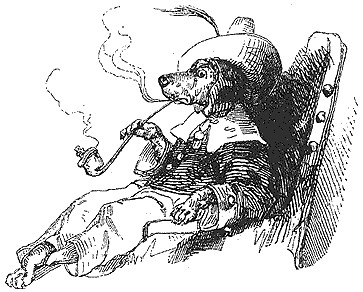
She took a clean dish To get him some tripe, But when she came back He was smoking his pipe. |
|
She went to the fishmonger's To buy him some fish, And when she came back, He was licking the dish.
She went to the ale-house |
|
She went to the tavern For white wine and red, But when she came back The dog stood on his head.
She went to the hatter's
She went to the barber's
She went to the fruiterer's
She went to the tailor's
She went to the cobbler's |
|
She went to the sempstress To buy him some linen, But when she came back The dog was spinning.
She went to the hosier's
The dame made a curtsey,
|
|
THERE
was an old woman called Nothing-at-all, Who rejoiced in a dwelling exceedingly small : A man stretched his mouth to its utmost extent, And down at one gulp house and old woman went.
|
|
THERE
was an old woman of Norwich, Who lived upon nothing but porridge ; Parading the town, She turned cloak into gown, This thrifty old woman of Norwich.
|
/ p.96 /
|
OLD
Betty Blue Lost a holiday shoe, What can old Betty do ? Give her another To match the other, And then she may swagger in two.
|
| [The following is part of a comic song called 'Success to the Whistle and Wig,' intended to be sung in rotation by the members of a club.] |
|
THERE
was an old woman had three sons, Jerry, and James, and John : Jerry was hung, James was drowned, John was lost and never was found, And there was an end of the three sons, Jerry, and James, and John !
|
|
|
|
THERE
was an old woman Lived under a hill, She put a mouse in a bag, And sent it to mill ;
The miller did swear,
|
/ p.97 /
| [The tale on which the following story is founded is found in a MS. of the fifteenth century in the Chetham Library at Manchester, and printed in the Reliq. Antiq. vol. ii, p.196.] |
|
THERE
was an old man, who lived in a wood, As you may plainly see ; He said he could do as much work in a day, As his wife could do in three. With all my heart, the old woman said, If that you will allow, To-morrow you'll stay at home in my stead, And I'll go drive the plough :
But you must milk the Tidy cow,
The old woman took a staff in her hand, |
|
High ! Tidy ! ho ! Tidy ! high ! Tidy ! do stand still ; If ever I milk you, Tidy, again, 'Twill be sore against my will ! He went to feed the little pigs, That were within the sty ; He hit his head against the beam, And he made the blood to fly.
He went to mind the speckled hen,
So he swore by the sun, the moon, and the stars,
|
|
THERE
was an old man of Tobago, Who lived on rice, gruel, and sago ; Till, much to his bliss, His physician said this— "To a leg, sir, of mutton you may go."
|
|
OH,
dear, what can the matter be ? Two old women got up in an apple tree ; One came down, And the other staid till Saturday.
|
[ p.99 ]
|
|
|
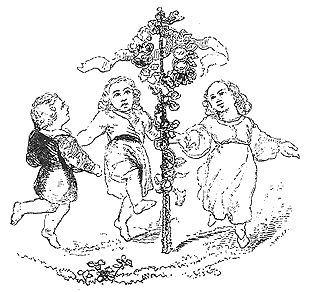
ONE-ERY, two-ery, Ziccary zan ; Hollow bone, crack a bone, Ninery, ten : Spittery spot, It must be done ; Twiddleum twaddleum, Twenty-one. |
|
Hink spink, the puddings stink, The fat beings to fry, Nobody at home, but jumping Joan, Father, mother, and I. Stick, stock, stone dead, Blind man can't see, Every knave will have a slave, You or I must be he.
|
| [From 'Bracebridge Hall,' 8vo, London, 1822, vol. ii, p.37. A Fox. In a children's game, where all the little actors are seated in a circle, the following stanza is used as question and answer :] |
|
WHO
goes round my house this night ? None but bloody Tom ! Who steals all the sheep at night ? None but this poor one.
|
|
GAY go up and gay go down, To ring the bells of London town.
Bull's eyes and targets,
Brickbats and tiles,
Halfpence and farthings,
|
|
Oranges and lemons, Say the bells of St. Clement's.
Pancakes and fritters,
Two sticks and an apple,
Old Father Baldpate,
You owe me ten shillings,
Pokers and tongs,
Kettles and pans,
When will you pay me ?
When I grow rich,
Pray when will that be ?
I am sure I don't know,
Here comes a candle to light you to bed,
|
/ p.102 /
|
INTERY,
mintery, cutery-corn, Apple seed and apple thorn ; Wine, brier, limber-lock, Five geese in a flock, Sit and sing by a spring, O–U–T, and in again.
|
| [The game of water-skimming is of high antiquity, being mentioned by Julius Pollux, and also by Eustathius, in his commentary upon Homer. Brand quotes a curious passage from Minucius Felix ; but all antiquaries seem to have overlooked the very curious notice in Higins' adaptation of Junius's 'Nomenclator,' 8vo, London, 1585, p.299, where it is called "a duck and a drake, and a halfe-penie cake." Thus it is probable that lines like the following were employed in this game as early as 1585 ; and it may be that the last line has recently furnished a hint to Mathews in his amusing song in 'Patter v. Clatter.'] |
|
A DUCK
and a drake, A nice barley-cake, With a penny to pay the old baker ; A hop and a scotch, Is another notch, Slitherum, slatherum, take her.
|
|
SEE, saw, Margery Daw, Little Jackey shall have a new master ; Little Jackey shall have but a penny a day, Because he can't work any faster.
|
/ p.103 /
|
SEE,
Saw, Margery Daw, Sold her bed and lay upon straw ; Was not she a dirty slut, To sell her bed and lie in the dirt !
|
|
MARGERY MUTTON-PIE, and Johnny Bopeep, They met together in Grace-church street ; In and out, in and out, over the way, Oh! says Johnny, 'tis chop-nose day.
|
|
1. I am a gold lock. 2. I am a gold key. 1. I am a silver lock. 2. I am a silver key. 1. I am a brass lock. 2. I am a brass key. 1. I am a lead lock. 2. I am a lead key. 1. I am a monk lock. 2. I am a monk key !
|
|
JACK
be nimble, And Jack be quick : And Jack jump over The candle-stick.
|
/ p.104 /
|
|
|
ONE-ery, two-ery, hickary, hum, Fillison, follison, Nicholson, John, Quever, quauver, Irish Mary, Stinkarum, stankarum, buck !
|
|
RIDE
a cock-horse to Banbury-cross, To see what Tommy can buy ; A penny white loaf, a penny white cake, And a twopenny apple-pie.
|
|
RIDE
a cock-horse to Banbury-cross, To buy little Johnny a galloping-horse ; It trots behind, and it ambles before, And Johnny shall ride till he can ride no more.
|
|
WHOOP,
whoop, and hollow, Good dogs won't follow, Without the hare cries "pee wit."
|
|
TOM BROWN'S two little Indian boys, One ran away, The other wouldn't stay,— Tom Brown's two little Indian boys.
|
/ p.105 /
|
THERE were two blackbirds, Sitting on a hill, The one nam'd Jack, The other nam'd Jill ; Fly away Jack ! Fly away Jill ! Come again Jack ! Come again Jill !
|
|
TIP,
top, tower, Tumble down in an hour.
|
|
1.
I WENT
up one pair of stairs. 2. Just like me. 1. I went up two pair of stairs. 2. Just like me. 1. I went into a room. 2. Just like me. 1. I looked out of a window. 2. Just like me. 1. And there I saw a monkey. 2. Just like me.
|
|
NUMBER
number nine, this hoop's mine ; Number number ten, take it back again.
|
/ p.106 /
| [This is acted by two or more girls, who walk or dance up and down, turning, when they say, 'turn, cheeses, turn.' The 'green cheeses,' as I am informed, are made with sage and potato-tops. Two girls are said to be 'cheese and cheese.'] |
|
GREEN cheese, yellow laces, Up and down the market-places, Turn, cheeses, turn !
|
|
RIDE a cock-horse to Coventry-cross ; To see what Emma can buy ; A penny white cake I'll buy for her sake And a twopenny tart or a pie.
|
|
RIDE a cock-horse to Banbury-cross, To see an old lady upon a white horse, Rings on her fingers, and bells on her toes, And so she makes music wherever she goes.
|
|
TO market ride the gentlemen, So do we, so do we ; Then comes the country clown, Hobbledy gee, Hobbledy gee ; First go the ladies, nim, nim, nim : Next come the gentlemen, trim trim, trim ; Then come the country clowns, gallop-a-trot.
|
/ p.107 /
|
1.
LET us go to the wood, says this pig ; 2. What to do there ? says that pig ; 3. To look for my mother, says this pig ; 4. What to do with her ? says that pig ; 5. Kiss her to death, says this pig.
|
| [A number of boys and girls stand round one in the middle, who repeats the following lines, counting the children until one is counted out by the end of the verses.] |
|
RING me (1), ring me (2), ring me rary (3), As I go round (4), ring by ring (5), A virgin (6) goes a maying (7), Here's a flower (8), and there's a flower (9), Growing in my lady's garden (10), If you set your foot awry (11), Gentle John will make you cry (12), If you set your foot amiss (13), Gentle John (14) will give you a kiss. |
| [The child upon whom (14) falls is then taken out and forced to select one of the other sex. The middle child then proceeds.] |
|
This [lady or gentleman] is none of ours, Has put [him or her]self in [the selected child's] power, So clap all hands, and ring all bells, and make the wedding o'er. [All clap hands.]
|
|
[If the child taken by lot joins in the clapping, the selected child is rejected, and, I think, takes the middle place. Otherwise, I think, there is a salute.]
|
/ p.108 /
| [Another game, played exclusively by boys. Two, who are fixed upon for the purpose, leave the group, and privately arrange that the pass-word shall be some implement of a particular trade. The trade is announced in the dialogue, and then the fun is, that the unfortunate wight who guesses the 'tool' is beaten with the caps of his fellows till he reaches a fixed goal, after which he goes out in turn.] |
|
"Two broken tradesmen, Newly come over, The one from France and Scotland, The other from Dover." "What's your trade ?" |
|
[Carpenters, nailors, smiths, tinkers, or any other is answered, and on guessing the instrument 'plane him, hammer him, rasp him, or solder him,' is called out respectively during the period of punishment.]
|
|
THIS is the key of the kingdom. In that kingdom there is a city. In that city there is a town. In that town there is a street. In that street there is a lane. In that lane there is a yard. In that yard there is a house. In that house there is a room. In that room there is a bed. On that bed there is a basket. In that basket there are some flowers. Flowers in the basket, basket in the bed, bed in the room, &c. &c.
|
/ p.109 /
|
CLAP hands, clap hands, Hie Tommy Randy, Did you see my good man ?— They call him Cock-a-bandy.
Silken stockings on his legs,
|
|
1.
THIS pig went to market ; 2. This pig staid at home ; 3. This pig had a bit of meat ; 4. And this pig had none ; 5. This pig said, Wee, wee, wee ! I can't find my way home.
|
|
BAT, bat, (clap hands,) Come under my hat, And I'll give you a slice of bacon ; And when I bake, I'll give you a cake, If I am not mistaken.
|
/ p.110 /
|
CUCKOO, cherry tree, Catch a bird, and give it to me ; Let the tree be high or low, Let it hail, rain, or snow.
|
|
A.
WHO is going round my sheepfold ? B. Only poor old Jacky Lingo. A. Don't steal any of my black sheep. B. No, no more I will, only by one, Up, says Jacky Lingo. (Strikes one.) |
|
[The child struck leaves the ring, and takes hold of B behind; B in the same manner takes the other children, one by one, gradually increasing his tail on each repetition of the verses, until he has got the whole : A then tries to get them back ; B runs away with them ; they try to shelter themselves behind B; A drags them off, one by one, setting them against a wall, until he has recovered all. A regular tearing game, as children say.]
|
He shall have little dog tied to the other, And then he goes trid trod to see his grandmother.
|
/ p.111 /
| [Children stand round, and are counted one by one, by means of this rhyme. The child upon whom the last number falls is out, for 'Hide or Seek,' or any other game where a victim is required. A cock and bull story of this kind is related of the historian Josephus. There are other versions of this, and one may be seen in 'Blackwood's Magazine' for August, 1821, p.36.] |
|
HICKORY (1), Dickory (2), Dock (3), The mouse ran up the clock (4), The clock struck one (5), The mouse was gone (6) ; O (7), U (8), T (9), spells OUT !
|
|
ONE old Oxford ox opening oysters ; Two tee-totums totally tired of trying to trot to Tadbury ; Three tall tigers tippling tenpenny tea ; Four fat friars fanning fainting flies ; Five frippy Frenchmen foolishly fishing for flies ; Six sportsmen shooting snipes ; Seven Severn salmons swallowing shrimps ; Eight Englishmen eagerly examining Europe ; Nine nimble noblemen nibbling nonpareils ; Ten tinkers tinkling upon ten tin tinder-boxes with ten tenpenny tacks ; Eleven elephants elegantly equipt ; Twelve typographical topographers typically translating types.
|
/ p.112 /
|
SEE-SAW, jack a daw, What is a craw to do wi' her ? She has not a stocking to put on her, And the craw has not one for to gi' her.
|
|
|
|
GOOD horses, bad horses, What is the time of day ? Three o'clock, four o'clock, Now fare you away.
|
| [The following is a game played as follows: A string of boys and girls, each holding by his predecessor's skirts, approaches two others, who with joined and elevated hands form a double arch. After the dialogue, the line passes through, and the last is caught by a sudden lowering of the arms—if possible.] |
|
HOW many miles is it to Babylon ?— Threescore miles and ten. Can I get there by candle-light ?— Yes, and back again ! If your heels are nimble and light, You may get there by candle-light.
|
|
SEE-SAW sacradown, Which is the way to London town ? One foot up, and the other down, And that is the way to London town.
|
/ p.113 /
|
|
| B. |
TRIP trap over the grass: If you please will you let one of your [eldest] daughters come, Come and dance with me ? I will give you pots and pans, I will give you brass, I will give you anything for a pretty lass. |
| A. | says "No." |
| B. |
I will give you gold and silver, I will give you pearl, I will give you anything for a pretty girl. |
| A. | Take one, take one, the fairest you may see. |
| B. |
The fairest one that I can see Is pretty Nancy,—come to me. |
|
|
|
|
You shall have a duck, my dear, And you shall have a drake, And you shall have a young man apprentice for your sake. |
|
|
|
|
|
If this young man should happen to die, And leave this poor woman a widow, The bells shall all ring, and the birds shall all sing, And we'll all clap hands together.
| |
|
|
/ p.114 /
| [The 'Three Knights of Spain' is a game played in nearly the same manner as the preceding. The dramatis personæ form themselves in two parties, one representing a courtly dame and her daughters, the other the suitors of the daughters. The last party, moving backwards and forwards, with their arms entwined, approach and recede from the mother party, which is stationary, singing to a very sweet air. See Chambers' 'Popular Rhymes,' p.66.] |
|
Come to court your daughter Jane.
|
|
And has not learned her mother-tongue.
|
|
For her beauty she must be sold. So fare you well, my lady gay, We'll call again another day.
|
|
And rub thy spurs till they be bright.
|
|
For in this town they were not bought. So fare you well, my lady gay, We'll call again another day. |
|
And take the fairest in your sight.
|
|
Is pretty Nancy,—come to me.
Here comes your daughter safe and sound,
|
/ p.116 /
| [A string of children, hand in hand, stand in a row. A child (A) stands in front of them, as leader ; two other children (B and C) form an arch, each holding both the hands of the other.] |
| A. |
DRAW a pail of water, For my lady's daughter ; My father's a king, and my mother's a queen, My two little sisters are dress'd in green, Stamping grass and parsley, Marigold leaves and daisies. |
| B. |
One rush, two rush, Pray thee, fine lady, come under my bush. |
| [A passes by under the arch, followed by the whole string of children, the last of whom is taken captive by B and C. The verses are repeated, until all are taken.] |
|
|
|
SIEVE my lady's oatmeal, Grind my lady's flour, Put it in a chesnut, Let it stand an hour ; One may rush, two may rush, Come, my girls, walk under the bush.
|
|
QUEEN ANNE, queen Anne, you sit in the sun, As fair as a lily, as white as a wand. I send you three letters, and pray read one, You must read one, if you can't read all, So pray, Miss or Master, throw up the ball.
|
/ p.117 /
|
IS John Smith within ?— Yes, that he is. Can he set a shoe ?— Ay, marry, two, Here a nail, there a nail, Tick tack, too.
|
|
THERE were three jovial Welshmen, As I have heard them say, And they would go a-hunting Upon St. David's day.
All the day they hunted,
One said it was a ship,
And all the night they hunted,
One said it was the moon,
|
/ p.118 /
| [One child holds a wand to the face of another, repeating these lines, and making grimaces, to cause the latter to laugh, and so to the others ; those who laugh paying a forfeit.] |
|
BUFF says Buff to all his men, And I say Buff to you again ; Buff neither laughs nor smiles, But carries his face With a very good grace, And passes the stick to the very next place !
|
|
HEY,
the dusty miller, And his dusty coat, He'll earn a shilling, Or he'll spend a groat. Dusty was the coat, Dusty was the colour, Dusty was the kiss That I got from miller.
|
|
PEASE-PUDDING hot, Pease-pudding cold, Pease-pudding in the pot, Nine days old. Some like it hot, Some like it cold, Some like it in the pot, Nine days old.
|
/ p.119 /
|
EGGS,
butter, cheese, bread, Stick, stock, stone, dead ! Stick him up, stick him down, Stick him in the old man's crown !
|
| [In the following childish amusement, one extends his arm, and the other, in illustration of the narrative, strikes him gently with the side of his hand at the shoulder and wrist ; and then at the word 'middle,' with considerable force, on the flexor muscles at the elbow-joint.] |
|
MY
father was a Frenchman, He bought to me a fiddle, He cut me here, he cut me here, He cut me right in the middle.
|
|
"GOOD
morrow to you, father, I'm come to confess." "Good morrow to you, child, Pray what have you done ?" "Last night I bought some fish, And I put it in a dish, And the cat stole the fish, And I killed the cat For doing of that." "Oh! that was a sad crime indeed, You must do penance for that." "Pray what must I do ? Kiss your old father," &c.
|
/ p.120 /
|
GOOD
morning, father Francis !— Good morning, Mrs. Sheckleton!— What has brought you abroad so early, Mrs. Sheckleton ? I have come to confess a great sin, father Francis.— What's it, Mrs. Sheckleton ?— Your cat stole a pound of my butter, father Francis.— O, no sin at all, Mrs. Sheckleton.— But I kill'd your cat for it, father Francis.— O, a very great sin indeed, Mrs. Sheckleton, you must do penance.— What penance, father Francis ?— Kiss me three times.— Oh ! but I can't.— Oh ! but you must.— Oh ! but I can't, &c. (ad lib.)— Well, what must be must, So kiss, kiss, kiss, and away.
|
|
|
|
THUMBIKIN, Thumbikin, broke the barn, Pinnikin, Pinnikin, stole the corn, Long back'd Gray Carried it away. Old Mid-man sat and saw, But Peesy-weesy, paid for a'.
|
/ p.121 /
|
|
|
HERE
comes a poor woman from baby-land, With three small children in her hand : One can brew, the other can bake, The other can make a pretty round cake. One can sit in the garden and spin, Another can make a fine bed for the king ; Pray ma'am will you take one in ?
|
|
I CAN
make diet bread, Thick and thin ; I can make diet bread, Fit for the king.
|
|
HERE
we come a piping, First in spring, and then in May ; The queen she sits upon the sand, Fair as a lily, white as a wand : King John has sent you letters three, And begs you'll read them unto me.— We can't read one without them all, So pray, Miss Bridget, deliver the ball !
|
|
THE
first day of Christmas My mother sent to me A partridge in a pear-tree. |
|
The second day of Christmas My mother sent to me Two turtle-doves and a partridge in a pear-tree. The third, &c. Three French hens, two turtle-doves, and a partridge, &c. The fourth, &c. Four canary birds, three French hens, two turtle, &c. The fifth, &c. Five gold rings, &c. The sixth, &c. Six geese a laying, &c. The seventh, &c. Seven swans a swimming, &c. The eighth, &c. Eight ladies dancing, &c. The ninth, &c. Nine lords a leaping, &c. The tenth, &c. Ten ships a sailing, &c. The eleventh, &c. Eleven ladies spinning, &c. The twelfth, &c. Twelve bells ringing, &c. |
|
[Each child in succession repeats the gifts of the day, and forfeits for each mistake. This accumulative process is a favorite with children ; in early writers, such as Homer, the repetition of messages, &c. pleases on the same principle.]
|
/ p.123 /
|
|
|
TWELVE huntsmen with horns and hounds, Hunting over other men's grounds ! Eleven ships sailing o'er the main, Some bound for France and some for Spain : I wish them all safe home again : Ten comets in the sky, Some low and some high ; Nine peacocks in the air, I wonder how they all came there, I do not know and I do not care ; Eight joiners in joiner's hall, Working with the tools and all ; Seven lobsters in a dish, As fresh as any heart could wish ; Six beetles against the wall, Close by an old woman's apple-stall ; Five puppies by our dog Ball, Who daily for their breakfast call ; Four horses stuck in a bog, Three monkeys tied to a clog ; Two pudding-ends would choke a dog, With a gaping, wide-mouthed, waddling frog.
|
/ p.124 /
|
DANCE, Thumbkin, dance, [Keep the thumb in motion.
Dance, ye merrymen, every one : [All the fingers in motion.
For Thumbkin, he can dance alone, [The thumb only moving.
Thumbkin, he can dance alone.[Ditto.
Dance, Foreman, dance,[The first finger moving.
Dance, ye merrymen, every one ; [The whole moving
But Foreman, he can dance alone,Foreman, he can dance alone. |
| [And so on with the others—naming the 2d finger Longman—the 3d finger Ringman—and the 4th finger Littleman. Littleman cannot dance alone.] |
|
|
|
ONE
to make ready, And two to prepare ; God bless the rider, And away goes the mare.
|
[ p.125 ]
| [The following is quoted in Parkin's reply to Dr. Stukeley's second number of 'Origines Roystonianæ,' 4to, London, 1748, p.vi.] |
|
PETER WHITE will ne'er go right, Would you know the reason why ? He follows his nose where'er he goes, And that stands all awry.
|
|
O THAT I was where I would be, Then would I be where I am not ! But where I am I must be, And where I would be I cannot.
|
/ p.126 /
| [The following was sung to the tune of Chevy Chace. It was taken from a poetical tale in the 'Choyce Poems,' 12mo, London, 1662, the music to which may be seen in D'Urfey's 'Pills to Purge Melancholy,' 1719, vol. iv, p.1.] |
|
THREE
children sliding on the ice Upon a summer's day, As it fell out, they all fell in, The rest they ran away.
Now had these children been at home,
You parents all that children have,
|
|
THERE
was a man of Newington, And he was wondrous wise, He jump'd into a quickset hedge, And scratch'd out both his eyes: But when he saw his eyes were out, With all his might and main He jump'd into another hedge, And scratch'd 'em in again.
|
/ p.127 /
|
IF
all the world was apple-pie, And all the sea was ink, And all the trees were bread and cheese, What should we have for drink ?
|
| [The following occurs in a MS. of the seventeenth century in the Sloane collection, the reference to which I have unfortunately mislaid.] |
|
THE
man in the wilderness asked me, How many strawberries grew in the sea ? I answered him, as I thought good, As many as red herrings grew in the wood.
|
|
THERE
was an old woman, and what do you think ? She lived upon nothing but victuals and drink : Victuals and drink were the chief of her diet; This plaguy old woman could never be quiet.
She went to the baker, to buy her some bread,
|
/ p.128 /
|
HERE
am I, little jumping Joan ; When nobody's with me I'm always alone.
|
|
THERE
was an old woman had nothing, And there came thieves to rob her ; When she cried out she made no noise But all the country heard her.
|
|
THERE was a little Guinea-pig, Who, being little, was not big, He always walked upon his feet, And never fasted when he eat.
When from a place he ran away,
He often squeak'd, and sometimes vi'lent,
One day, as I am certified,
|
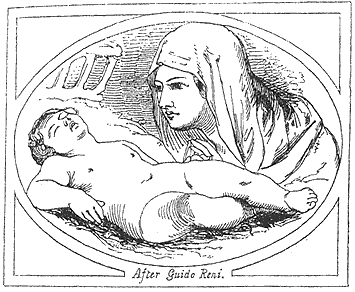
|
HUSHY baby, my doll, I pray you don't cry, And I'll give you some bread and some milk by and bye ; Or, perhaps you like custard, or may-be a tart,— Then to either you're welcome, with all my whole heart.
|
/ p.130 /
|
DANTY
baby diddy, What can a mammy do wid'e, But sit in a lap, And give 'un a pap ? Sing danty baby diddy.
|
|
ROCK-A-BYE, baby, thy cradle is green ; Father's a nobleman, mother's a queen ; And Betty's a lady, and wears a gold ring ; And Johnny's a drummer, and drums for the king.
|
|
BYE,
O my baby ! When I was a lady, O then my poor baby did'nt cry ! But my baby is weeping, For want of good keeping, Oh, I fear my poor baby will die !
|
|
HUSH a bye a ba lamb, Hush a bye a milk cow, You shall have a little stick To beat the naughty bow-wow.
|
/ p.131 /
|
HUSH
thee, my babby, Lie still with thy daddy, Thy mammy has gone to the mill, To grind thee some wheat, To make thee some meat, And so, my dear babby, lie still.
|
|
HEY,
my kitten, my kitten, And hey, my kitten, my deary ! Such a sweet pet as this Was neither far nor neary.
Here we go up, up, up,
|
|
I WON'T be my father's Jack, I won't be my mother's Gill, I will be the fiddler's wife, And have music when I will. T'other little tune, T'other little tune, Pr'ythee, love, play me T'other little tune.
|
/ p.132 /
|
RIDE,
baby, ride ! Pretty baby shall ride, And have a little puppy-dog tied to her side, And little pussy-cat tied to the other, And away she shall ride to see her grandmother, To see her grandmother, To see her grandmother.
|
|
HUSH a bye, baby, on the tree top, When the wind blows, the cradle will rock ; When the bough bends ; the cradle will fall, Down will come baby, bough, cradle, and all.
|
|
BYE,
baby bunting, Daddy's gone a hunting, To get a little hare's skin To wrap a baby bunting in.
|
|
WHISKUM whaskum, over the knee ; Thank you mamma, for slapping of me.
|
/ p.133 /
|
DANCE, little baby, dance up high, Never mind, baby, mother is by ; Crow and caper, caper and crow, There, little baby, there you go ; Up to the ceiling, down to the ground, Backwards and forwards, round and round ; Dance, little baby, and mother will sing, With the merry coral, ding, ding, ding !
|
|
|
|
TO market,
to market, To buy a plum-bun : Home again, come again, Market is done.
|
|
DANCE
to your daddy, My little babby, Dance to your daddy, My little lamb.
You shall have a fishy
|
/ p.134 /
|
TOM
shall have a new bonnet, With blue ribands to tie on it, With a hush-a-bye and a lull-a-baby, Who so like to Tommy's daddy ?
|
|
BYE,
baby bumpkin, Where's Tony Lumpkin ? My lady's on her death-bed, With eating half a pumpkin.
|
|
HUSH,
hush, hush, hush ! And I dance mine own child, And I dance mine own child, Hush, hush, hush, hush !
|
|
GIVE
me a blow, and I'll beat 'em, Why did they vex my baby ? Kissy, kiss, kissy, my honey, And cuddle your nurse, my deary.
|
[ p.135 ]
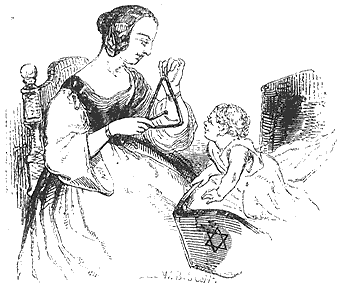
| [The first line of the following is the burden of a song in the 'Tempest,' act i, sc. 2. and also of one in the 'Merchant of Venice,' act iii, sc.2.] |
|
DING, dong, bell, Pussy's in the well ! Who put her in ?— Little Tommy Lin. Who pulled her out ?— Dog with long snout. What a naughty boy was that To drown poor pussy-cat, Who never did any harm, But kill'd the mice in his father's barn.
|
/ p.136 /
|
HEY ding a ding, what shall I sing ? How many holes in a skimmer ? Four and twenty,—my stomach is empty ; Pray, mamma, give me some dinner.
|
|
COCK a doodle doo ! My dame has lost her shoe ; My master's lost his fiddling stick, And don't know what to do.
Cock a doodle doo !
Cock a doodle doo !
Cock a doodle doo !
Cock a doodle doo !
|
/ p.137 /
|
LITTLE
Tee Wee, He went to sea In an open boat ; And while afloat The little boat bended, And my story's ended.
|
|
SING, sing, what shall I sing ? The cat has eat the pudding-string ! Do, do, what shall I do ? The cat has bit it quite in two.
|
| [I do not know whether the following may have reference to the game of handy-dandy, mentioned in 'King Lear,' act iv, sc.6, and in Florio's 'New World of Words,' 1611, p.57.] |
|
HANDY SPANDY, Jack-a-dandy, Loved plum-cake and sugar-candy ; He bought some at a grocer's shop, And out he came, hop, hop, hop.
|
|
TIDDLE
liddle lightum, Pitch and tar ; Tiddle liddle lightum, What's that for ?
|
/ p.138 /
|
SING
jigmijole, the pudding-bowl, The table and the frame ; My master he did cudgel me For kissing of my dame.
|
|
DIBBITY,
dibbity, dibbity, doe, Give me a pancake And I'll go. Dibbity, dibbity, dibbity, ditter, Please to give me A bit of a fritter.
|
|
DEEDLE,
deedle, dumpling, my son John Went to bed with his breeches on ; One shoe off, the other shoe on, Deedle, deedle, dumpling, my son John.
|
|
FEEDUM,
fiddledum fee, The cat's got into the tree. Pussy, come down, Or I'll crack your crown, And toss you into the sea.
|
/ p.139 /
|
GILLY
Silly Jarter, Who has lost a garter ? In a shower of rain, The miller found it, The miller ground it, And the miller gave it to Silly again.
|
|
HUB a dub dub, Three men in a tub ; And who do you think they be ? The butcher, the baker, The candlestick-maker, Turn 'em out, knaves all three !
|
|
HYDER
iddle diddle dell, A yard of pudding's not an ell ; Not forgetting tweeddle-dye, A tailor's goose will never fly.
|
|
HEY
diddle, dinkety, poppety, pet, The merchants of London they wear scarlet ; Silk in the collar, and gold in the hem, So merrily march the merchantmen.
|
/ p.140 /
|
FIDDLE-de-dee, fiddle-de-dee, The fly shall marry the humble-bee. They went to the church, and married was she, The fly has married the humble-bee.
|
|
HEY,
dorolot, dorolot ! Hey, dorolay, dorolay ! Hey, my bonny boat, bonny boat, Hey, drag away, drag away !
|
|
A CAT
came fiddling out of a barn, With a pair of bag-pipes under her arm ; She could sing nothing but fiddle cum fee, The mouse has married the humble-bee ; Pipe, cat,—dance, mouse, We'll have a wedding at our good house.
|
|
HEY !
diddle diddle, The cat and the fiddle, The cow jumped over the moon ; The little dog laug'd To see such craft, While the dish ran after the spoon.
|
/ p.141 /
|
COME
dance a jig To my Granny's pig, With a raudy, rowdy, dowdy ; Come dance a jig To my Granny's pig, And pussy-cat shall crowdy.
|
|
DOODLEDY, doodledy, doodledy, dan, I'll have a piper to be my good man ; And if I get less meat, I shall get game, Doodledy, doodledy, doodledy, dan.
|
|
PUSSICAT,
wussicat, with a white foot, When is your wedding ? for I'll come to't. The beer's to brew, the bread's to bake. Pussy-cat, pussy-cat, don't be too late.
|
|
DING, dong, darrow, The cat and the sparrow ; The little dog has burnt his tail, And he shall be hang'd to-morrow.
|
/ p.142 /
|
LITTLE
Dicky Dilver Had a wife of silver, He took a stick and broke her back, And sold her to the miller ; The miller wouldn't have her, So he threw her in the river.
|
|
TO
market, to market, to buy a fat pig, Home again, home again, dancing a jig ; Ride to the market to buy a fat hog, Home again, home again, jiggety-jog.
|
|
RUMPTY-iddity, row, row, row, If I had a good supper, I could eat it now.
|
| [Magotty-pie is given in MS. Lansd. 1033, fol.2, as a Wiltshire word for a magpie. See also Macbeth,' act iii, sc.4. The same term occurs in the dictionaries of Hollyband, Cotgrave, and Minsheu.] |
|
ROUND
about, round about, Magotty-pie, My father loves good ale, And so do I.
|
[ p.143 ]
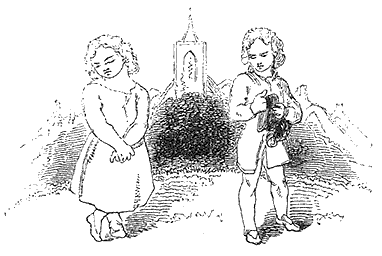
|
AS I was going up Pippen-hill, Pippen-hill was dirty, There I met a pretty miss, And she dropt me a curtsey.
Little miss, pretty miss,
|
/ p.144 /
|
TOMMY TROT, a man of law, Sold his bed and lay upon straw : Sold the straw and slept on grass, To buy his wife a looking-glass.
|
|
WE'RE
all dry with drinking on't, We're all dry with drinking on't ; The piper kiss'd the fiddler's wife, And I can't sleep for thinking on't.
|
|
"JOHN,
come sell thy fiddle, And buy thy wife a gown." "No, I'll not sell my fiddle, For ne'er a wife in town."
|
|
HERE
comes a lusty wooer, My a dildin, my a daldin : Here comes a lusty wooer, Lily bright and shine a'.
Pray, who do you woo, |
|
For your fairest daughter, My a dildin, my a daldin ; For your fairest daughter, Lily bright and shine a'.
Then there she is for you,
|
|
UP
hill and down dale ; Butter is made in every vale ; And if that Nancy Cook Is a good girl, She shall have a spouse, And make butter anon, Before her old grandmother Grows a young man.
|
|
JACK
in the pulpit, out and in ; Sold his wife for a minikin pin.
|
|
DID
you see my wife, did you see, did you see, Did you see my wife looking for me ? She wears a straw bonnet, with white ribands on it, And dimity petticoats over her knee.
|
/ p.146 /
|
WHAT
care I how black I be, Twenty pounds will marry me ; If twenty won't, forty shall, I am my mother's bouncing girl !
|
|
"WHERE
have you been all the day, My boy Willy ?" "I've been all the day, Courting of a lady gay : But oh ! she's too young To be taken from her mammy."
"What work can she do,
"She can brew and she can bake,
"What age may she be? What age may she be ?
"Twice two, twice seven,
|
/ p.147 /
|
MASTER
I have. and I am his man, Gallop a dreary dun ; Master I have, and I am his man, And I'll get a wife as fast as I can ; With a heighly gaily gamberally, Hiddledy piggledy, niggledy, niggledy, Gallop a dreary dun.
|
|
A COW
and a calf, An ox and a half, Forty good shillings and three ; Is that not enough tocher For a shoe-maker's daughter, A bonny lass with a black e'e ?
|
|
AS
Tommy Snooks and Bessy Brooks Were walking out one Sunday, Says Tommy Snooks to Bessy Brooks, "To-morrow will be Monday."
|
|
LITTLE
Jack Jingle, He used to live single : But when he got tired of this kind of life, He left off being single, and liv'd with his wife.
|
/ p.148 /
| [This is part of a little work called 'Authentic Memoirs of the little Man and the little Maid, with some interesting particulars of their lives,' which I suspect is more modern than the following. Walpole printed a small broadside containing a different version.] |
|
THERE
was a little man, And he woo'd a little maid, And he said, "little maid, will you wed, wed, wed? I have little more to say, Than will you, yea or nay, For least said is soonest mended-ded, ded, ded."
The little maid replied,
|
|
THERE
was a little boy and a little girl Lived in an alley ; Says the little boy to the little girl, "Shall I, oh ! shall I ?"
Says the little girl to the little boy,
|
|
O the little rusty, dusty, rusty miller ! I'll not change my wife for either gold or siller.
|
/ p.149 /
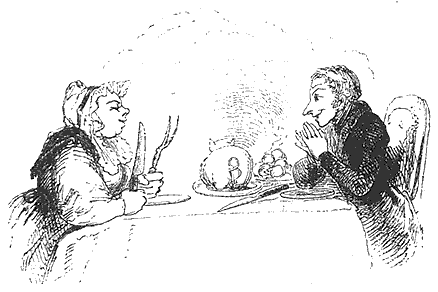
|
JACK SPRAT could eat no fat, His wife could eat no lean ; And so, betwixt them both, you see, They lick'd the platter clean.
|
|
LITTLE
Jack Dandy-prat was my first suitor ; He had a dish and a spoon, and he'd some pewter ; He'd linen and woollen, and woollen and linen, A little pig in a string cost him five shilling.
|
/ p.150 /
|
CURLY
locks ! curly locks ! wilt thou be mine ? Thou shalt not wash dishes, nor yet feed the swine ; But sit on a cushion and sew a fine seam, And feed upon strawberries, sugar and cream !
|
|
GILES COLLINS he said to his old mother, "Mother, come bind up my head ; And send to the parson of our parish, For to-morrow I shall be dead, dead, For to-morrow I shall be dead."
His mother she made him some water-gruel,
Lady Anna was sitting at her window,
"What bear ye there, ye six strong men, |
|
"Set him down ! set him down ! (Lady Anna, she cry'd,) On the grass that grows so green ; To-morrow before the clock strikes ten, My body shall lie by his'n, his'n, My body shall lie by his'n."
Lady Anna was buried in the east,
There blew a cold north-easterly wind,
|
|
ON
Saturday night, Shall be all my care To powder my locks And curl my hair.
On Sunday morning
|
/ p.152 /
|
"LITTLE
maid, pretty maid, whither goest thou ?" "Down in the forest to milk my cow." "Shall I go with thee ?" "No, not now ; When I send for thee, then come thou."
|
|
I AM
a pretty wench, And I come a great way hence, And sweethearts I can get none : But every dirty sow, Can get sweethearts enow, And I, pretty wench, can get never a one.
|
|
BIRDS
of a feather flock together, And so will pigs and swine ; Rats and mice will have their choice, And so will I have mine.
|
| [The practice of sowing hempseed on Allhallows Even is often alluded to by early writers, and Gay, in his 'Pastorals,' quotes part of the following lines as used on that occasion.] |
|
HEMP-SEED I set, Hemp-seed I sow, The young man that I love, Come after me and mow !
|
/ p.153 /
|
DUSTY
was the coat, Dusty was the collar, Dusty was the kiss Of my charming miller. If I had my pockets Full of gold and siller, I would give it all To my charming miller. If I had, &c.
|
|
"MADAM,
I am come to court you, If your favour I can gain." "Ah, ah !" said she, "you are a bold fellow, If I e'er see your face again !"
"Madam, I have rings and diamonds,
"I care not for rings and diamonds,
"Madam, you think much of beauty,
|
/ p.154 /
|
THERE
was a little maid, and she was afraid, That her sweetheart would come unto her ; So she went to bed, and she cover'd up her head, And she fasten'd the door with a skewer.
|
|
OH !
mother, I shall be married to Mr. Punchinello. To Mr. Punch, To Mr. Joe, To Mr. Nell, To Mr. Lo. Mr. Punch, Mr. Joe, Mr. Nell, Mr. Lo, To Mr. Punchinello.
|
|
UP
street and down street, Each window's made of glass ; If you go to Tommy Tickler's house, You'll find a pretty lass :
Hug her and kiss her,
|
/ p.155 /
| [This nursery song may probably commemorate a part of Tom Thumb's history, extant in a little Danish work, treating of 'Swain Tomling, a man no bigger than a thumb, who would be married to a woman three ells and three quarters long.' See Mr. Thoms' Preface to 'Tom à Lincoln,' p.xi.] |
|
I HAD
a little husband, No bigger than my thumb, I put him in a pint pot, And there I bid him drum.
I bought a little horse,
I gave him some garters,
|
|
CAN
you make me a cambric shirt, Parsley, sage, rosemary, and thyme ; Without any seam or needlework ? And you shall be a true lover of mine.
Can you wash it in yonder well, |
|
Can you dry it on yonder thorn, Parsley, &c. Which never bore blossom since Adam was born ? And you, &c.
Now you have ask'd me questions three,
Can you find me an acre of land,
Can you plough it with a ram's horn,
Can you reap it with a sickle of leather,
When you have done and finish'd your work,
|
/ p.157 /
|
LITTLE
Tom Dandy, Was my first suitor, He had a spoon and dish, And a little pewter.
|
|
LITTLE
John Jiggy Jag, He rode a penny nag, And went to Wigan to woo : When he came to a beck, He fell and broke his neck,— Johnny, how dost thou now ?
I made him a hat,
|
|
JACK
and Jill went up the hill, To fetch a pail of water ; Jack fell down, and broke his crown, And Jill came tumbling after.
|
/ p.158 /
| [The following version is taken from Douce's MS. additions to Ritson, but the more common one commences "When I was a bachelor I lived by myself."] |
|
THERE
was a little pretty lad, And he lived by himself, And all the meat he got He put upon a shelf.
The rats and the mice
The lanes they were so broad,
The wheelbarrow broke,
|
|
ROWLEY POLEY, pudding and pie, Kissed the girls and made them cry ; When the girls begin to cry, Rowley Poley runs away.
|
[ p.159 ]
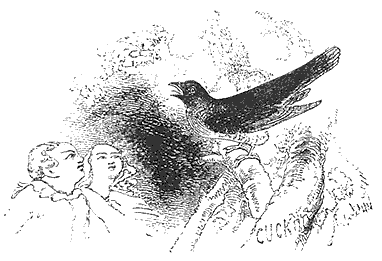
|
THE cuckoo's a fine bird, He sings as he flies ; He brings us good tidings, He tells us no lies.
He sucks little birds' eggs,
|
/ p.160 /
|
THE
cat sat asleep by the side of the fire, The mistress snored loud as a pig : Jack took up his fiddle, by Jenny's desire, And struck up a bit of a jig.
|
|
I HAD
a little hobby-horse, and it was well shod, It carried me to the mill-door, trod, trod, trod ; When I got there I gave a great shout, Down came the hobby-horse, and I cried out. Fie upon the miller, he was a great beast, He would not come to my house, I made a little feast, I had but little, but I would give him some, For playing of his bag-pipes and beating his drum.
|
|
I HAD
a little dog, and his name was Blue Bell, I gave him some work, and he did it very well ; I sent him up-stairs to pick up a pin, He stepped in the coal-scuttle up to the chin ; I sent him to the garden to pick some sage, He tumbled down and fell in a rage ; I sent him to the cellar, to draw a pot of beer, He came up again and said there was none there.
|
/ p.161 /
| [The snail scoops out hollows, little rotund chambers, in limestone, for its residence. This habit of the animal is so important in its effects, as to have attracted the attention of geologists, and Dr. Buckland alluded to it at the meeting of the British Association in 1841. See Chambers' 'Popular Rhymes,' p.43. The following rhyme is a boy's invocation to the snail to come out of such holes.] |
|
SNAIL,
snail, come out of your hole, Or else I will beat you as black as a coal.
|
|
SNEEL,
snaul, Robbers are coming to pull down your wall ; Sneel, snaul, Put out your horn, Robbers are coming to steal your corn, Coming at four o'clock in the morn.
|
|
SOME
little mice sat in a barn to spin ; Pussy came by, and she popped her head in ; "Shall I come in, and cut your threads off ?" "Oh! no, kind sir, you will snap our heads off ?"
|
|
BURNIE
bee, burnie bee, Tell me when your wedding be ? If it be to-morrow day, Take your wings and fly away.
|
/ p.162 /
|
THE
sow came in with the saddle, The little pig rock'd the cradle, The dish jump'd over the table, To see the pot with the ladle. The broom behind the butt Call'd the dish-clout a nasty slut : Odds-bobs, says the gridiron, can't you agree ? I'm the head constable,—come along with me.
|
|
"WHAT
do they call you ?" "Patchy Dolly." "Where were you born ?" "In the cow's horn." "Where were you bred ?" "In the cow's head." "Where will you die ?" "In the cow's eye."
|
|
AS
I went over the water, The water went over with me. I saw two little blackbirds sitting on a tree : The one called me a rascal, The other called me a thief ; I took up my little black stick, and knocked out all their teeth.
|
/ p.163 /
|
FOUR
and twenty tailors went to kill a snail, The best man among them durst not touch her tail ; She put out her horns like a little Kyloe cow, Run, tailors, run, or she'll kill you all e'en now.
|
|
'TWAS
the twenty-ninth of May, 'twas a holiday, Four and twenty tailors set out to hunt a snail ; The snail put forth his horns, and roared like a bull, Away ran the tailors, and catch the snail who wull.
|
|
GRAY
goose and gander, Waft your wings together ; And carry the good king's daughter Over the one strand river.
|
|
PUSSY
cat, pussy cat, where have you been ? I've been up to London to look at the queen. Pussy cat, pussy cat, what did you there ? I frighten'd a little mouse under the chair.
|
/ p.164 /
|
I HAD
a little dog, and they called him buff ; I sent him to the shop for a hap'orth of snuff ; But he lost the bag, and spill'd the snuff, So take that cuff, and that's enough.
|
|
ALL
of a row, Bend the bow, Shot at a pigeon, And killed a crow.
|
|
THE
cock doth crow To let you know, If you be wise, 'Tis time to rise.
|
|
THERE
was an owl lived in an oak, Wisky, wasky, weedle ; And every word he ever spoke Was fiddle, faddle, feedle.
A gunner chanced to come that way,
|
/ p.165 /
|
A PIE
sate on a pear tree, A pie sate on a pear tree, A pie sate on a pear tree, Heigh O, heigh O, heigh O ! Once so merrily hopp'd she, Twice so merrily hopp'd she, Thrice so merrily hopp'd she, Heigh O, heigh O, heigh O !
|
|
CATCH
him, crow! carry him, kite ! Take him away till the apples are ripe ; When they are ripe and ready to fall, |
| Home comes | { | Johnny Baby |
} | apples and all. |
| |||
|
In April I open my bill ; In June I change my tune ; |
In May I sing night and day ; In July Away I fly ; | ||
| |||
/ p.166 /
|
"ROBERT BARNES, fellow fine, Can you shoe this horse of mine ?" "Yes, good sir, that I can, As well as any other man : There's a nail, and there's a prod, And now, good sir, your horse is shod."
|
|
THERE
was an old crow Sat upon a clod : There's an end of my song, That's odd !
|
|
DICKERY,
dickery, dare, The pig flew up in the air ; The man in brown soon brought him down, Dickery, dickery, dare.
|
|
HICKETY,
pickety, my black hen, She lays eggs for gentlemen ; Gentlemen come every day To see what my black hen doth lay.
|
/ p.167 /
|
LITTLE
Robin Red-breast Sat upon a rail : Niddle naddle went his head, Wiggle waggle went his tail.
|
|
LITTLE
Robin Red-breast, Sat upon a birdle ; With a pair of speckle legs, And a green girdle.
|
|
JOHNNY ARMSTRONG kill'd a calf, Peter Henderson got the half ; Willy Wilkinson got the head, Ring the bell, the calf is dead!
|
|
HIE
hie, says Anthony, Puss in the pantry Gnawing, gnawing A mutton mutton-bone ; See now she tumbles it, See how she mumbles it, See how she tosses The mutton mutton-bone.
|
/ p.168 /
|
A long-tail'd pig, or a short-tail'd pig, Or a pig without e'er a tail, A sow-pig, or a boar-pig, Or a pig with a curly tail.
|
|
ONCE
I saw a little bird Come hop, hop, hop ; So I cried, little bird, Will you stop, stop, stop ? And was going to the window To say, how do you do ? But he shook his little tail, And far away he flew.
|
|
|
|
LADY-COW, lady-cow, fly thy way home, Thy house is on fire, thy children all gone, All but one that ligs under a stone, Fly thee home, lady-cow, ere it be gone.
|
|
RIDDLE
me, riddle me, ree, A hawk sate upon a tree ; And he says to himself, says he, Lord ! what a fine bird I be !
|
/ p.169 /
|
PUSSY
cat Mole, Jump'd over a coal, And in her best petticoat burnt a great hole. Poor pussy's weeping, she'll have no more milk, Until her best petticoat's mended with silk.
|
|
AS
I went to Bonner, I met a pig Without a wig, Upon my word and honour.
|
|
THERE
was a piper, he'd a cow, And he'd no hay to give her ; He took his pipes and played a tune, Consider, old cow, consider!
The cow considered very well,
|
|
THERE
was a little one-eyed gunner, Who kill'd all the birds that died last summer.
|
/ p.170 /
|
AS
titty mouse sat in the witty to spin, Pussy came to her and bid her good ev'n, "Oh, what are you doing, my little oman," "A spinning a doublet for my gude man ?" "Then shall I come to thee and wind up thy thread," "Oh no, Mrs. Puss, you'll bite off my head."
|
|
SHOE
the colt, Shoe the colt, Shoe the wild mare ; Here a nail, There a nail, Yet she goes bare.
|
|
BETTY PRINGLE had a little pig, Not very little and not very big, When he was alive he lived in clover, But now he's dead, and that's all over. So Billy Pringle he laid down and cried, And Betty Pringle she laid down and died ; So there was an end of one, two, and three : Billy Pringle he, Betty Pringle she, And the piggy wiggy.
|
/ p.171 /
|
PITTY
Patty Polt, Shoe the wild colt ; Here a nail, And there a nail, Pitty, Patty, Polt.
|
|
HOW
d' 'e [lit.] dogs, how? whose dog art thou ? Little Tom Tinker's dog ! what's that to thou? Hiss ! bow, a wow, wow !
|
| [The following song is given in Whiter's 'Specimen or a Commentary on Shakespeare,' 8vo, London, 1794, p.19, as common in Cambridgeshire and Norfolk. Dr. Farmer gives another version as an illustration of a ditty of Jacques in 'As You Like It,' act ii, sc.5. See Malone's Skakespeare [lit.], ed. 1821, vol. vi, p.398; Caldecott's 'Specimen,' 1819, note on 'As You Like It,' p.11; and Douce's 'Illustrations,' vol. i, p.279.] |
|
DAME,
what makes your ducks to die ? What the pize ails 'em? what the pize ails 'em ? They kick up their heels, and there they lie, What the pize ails 'em now ? Heigh, ho ! heigh, ho ! Dame, what makes your ducks to die ? What a pize ails 'em ? what a pize ails 'em ? Heigh, ho ! heigh, ho ! Dame, what ails your ducks to die ? Eating o'polly-wigs, eating o'polly-wigs, Heigh, ho ! heigh, ho !
|
/ p.172 /
|
JACK SPRAT's pig, He was not very little Nor yet very big ; He was not very lean, He was not very fat ; He'll do well for a grunt, Says little Jack Sprat.
|
|
|
|
BARNABY BRIGHT he was a sharp cur, He always would bark if a mouse did but stir ; But now he's grown old, and can no longer bark, He's condemn'd by the parson to be hang'd by the clerk.
|
|
PUSSY
cat eat the dumplings, the dumplings, Pussy cat eat the dumplings. Mamma stood by And cried, Oh, fie ! Why did you eat the dumplings?
|
|
SNAIL,
snail, put out your horns, I'll give you bread and barleycorns.
|
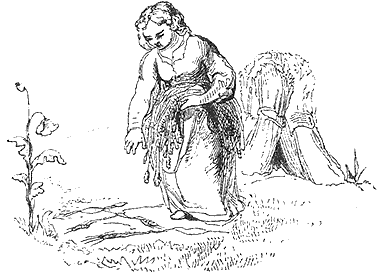
|
I SELL you the key of the king's garden : I sell you the string that ties the key, &c. I sell you the rat that gnawed the string, &c. I sell you the cat that caught the rat, &c. I sell you the dog that bit the cat. &c.
|
/ p.174 /
| [Traditional pieces are frequently so ancient, that possibility will not be outraged by conjecturing the John Ball of the following piece to be the priest who took so distinguished a part in the rebellion temp. Richard II.] |
|
JOHN BALL
shot them all ; John Scott made the shot, But John Ball shot them all.
John Wyming made the priming,
John Block made the stock,
John Crowder made the powder,
John Puzzle made the muzzle, |
|
John Clint made the flint, And John Puzzle made the muzzle, And John Crowder made the powder, And John Block made the stock, And John Wyming made the priming, And John Brammer made the rammer, And John Scott made the shot, But John Ball shot them all.
John Patch made the match,
|
| 1. |
THIS is the house that Jack built.
|
| 2. | This is the malt That lay in the house that Jack built.
|
| 3. |
This is the rat, That ate the malt That lay in the house that Jack built. |
| 4. |
This is the cat, | That kill'd the rat, That ate the malt That lay in the house that Jack built.
5. |
This is the dog, | That worried the cat, That kill'd the rat, That ate the malt That lay in the house that Jack built.
6. |
This is the cow with the crumpled horn, | That tossed the dog, That worried the cat, That kill'd the rat, That ate the malt That lay in the house that Jack built.
7. |
This is the maiden all forlorn, | That milk'd the cow with the crumpled horn, That tossed the dog, That worried the cat, That kill'd the rat, That ate the malt That lay in the house that Jack built. |
| 8. |
This is the man all tatter'd and torn, | That kissed the maiden all forlorn, That milk'd the cow with the crumpled horn, That tossed the dog, That worried the cat, That kill'd the rat, That ate the malt That lay in the house that Jack built. 9. |
This is the priest all shaven and shorn, | That married the man all tatter'd and torn, That kissed the maiden all forlorn, That milk'd the cow with the crumpled horn, That tossed the dog, That worried the cat, That killed the rat, That ate the malt That lay in the house that Jack built. 10. |
This is the cock that crow'd in the morn, | That waked the priest all shaven and shorn, That married the man all tatter'd and torn, That kissed the maiden all forlorn, That milk'd the cow with the crumpled horn, That tossed the dog, That worried the cat, That killed the rat, That ate the malt That lay in the house that Jack built. |
| 11. |
This is the farmer sowing his corn, | That kept the cock that crow'd in the morn, That waked the priest all shaven and shorn, That married the man all tatter'd and torn, That kissed the maiden all forlorn, That milk'd the cow with the crumpled horn, That tossed the dog, That worried the cat, That killed the rat, That ate the malt That lay in the house that Jack built.
|
| [The original of 'The house that Jack built' is presumed to be a hymn in Sepher Haggadah, fol.23, a translation of which is here given. The historical interpretation was first given by P. N. Leberecht, at Leipsic, in 1731, and is printed in the 'Christian Reformer,' vol. xvii, p.28. The original is in the Chaldee language, and it may be mentioned that a very fine Hebrew manuscript of the fable, with illuminations, is in the possession of George Offor, Esq. of Hackney.] |
| 1. |
A kid, a kid, my father brought For two pieces of money : A kid, A kid. |
| 2. |
Then came the cat, and ate the kid That my father bought For two pieces of money : A kid, A kid. |
| 3. |
Then came the dog, and bit the cat, That ate the kid, That my father bought For two pieces of money : A kid, A kid. |
| 4. |
Then came the staff, and beat the dog, That bit the cat, That ate the kid, That my father bought For two pieces of money : A kid, A kid. |
| 5. |
Then came the fire, and burned the staff, That beat the dog, That bit the cat, That ate the kid, That my father bought For two pieces of money : A kid, A kid. |
| 6. |
Then came the water, and quenched the fire, That burned the staff, That beat the dog, That bit the cat, That ate the kid, That my father bought For two pieces of money : A kid, A kid.
|
| 7. |
Then came the ox, and drank the water, That quenched the fire, That burned the staff, That beat the dog, That bit the cat, That ate the kid, That my father bought For two pieces of money : A kid, A kid. |
| 8. |
Then came the butcher, and slew the ox, That drank the water, That quenched the fire, That burned the staff, That beat the dog, That bit the cat, That ate the kid, That my father bought For two pieces of money : A kid, A kid. |
| 9. |
Then came the angel of death and killed the butcher, That slew the ox, That drank the water, That quenched the fire, That burned the staff, That beat the dog, That bit the cat, |
|
That ate the kid, That my father bought For two pieces of money : A kid, A kid. | |
| 10. |
Then came the Holy One, blessed be He ! And killed the angel of death, That killed the butcher, That slew the ox, That drank the water, That quenched the fire, That burned the staff, That beat the dog, That bit the cat, That ate the kid, That my father bought For two pieces of money : A kid, A kid.
|
|
The following is the interpretation : 1. The kid, which was one of the pure animals, denotes the Hebrews. The father, by whom it was purchased, is Jehovah, who represents himself as sustaining this relation to the Hebrew nation. The two pieces of money signify Moses and Aaron, through whose mediation the Hebrews were brought out of Egypt. 2. The cat denotes the Assyrians, by whom the ten tribes were carried into captivity. 3. The dog is symbolical of the Babylonians. 4. The staff signifies the Persians. 5. The fire indicates the Grecian empire under Alexander the Great. 6. The water betokens the Roman, or the fourth of the great monarchies to whose dominions the Jews were subjected. 7. The ox is a symbol of the Saracens, who subdued Palestine, and brought it under the caliphate. |
|
8. The butcher that killed the ox denotes the crusaders, by whom the Holy Land was wrested out of the hands of the Saracens. 9. The angel of death signifies the Turkish power, by which the land of Palestine was taken from the Franks, and to which it is still subject. 10. The commencement of the tenth stanza is designed to show that God will take signal vengeance on the Turks, immediately after whose overthrow the Jews are to be restored to their own land, and live under the government of their long-expected Messiah.
|
|
"AN old woman was sweeping her house, and she found a little crooked sixpence, 'What,' said she, 'shall I do with this little sixpence ? I will go to market, and buy a little pig.' As she was coming home, she came to a stile : the piggy would not go over the stile. "She went a little further, and she met a dog. So she said to the dog, 'Dog ! bite pig ; piggy won't go over the style ; and I shan't get home to night.' But the dog would not. "She went a little further, and she met a stick. So she said, 'Stick ! stick ! beat dog ; dog won't bite pig ; piggy won't get over the stile ; and I shan't get home to night.' But the stick would not.
"She went a little further, and she met a fire. So she said, 'Fire ! fire ! burn stick ; stick won't beat dog ; dog won't bite pig,' (and so forth, always repeating the foregoing words.) But the fire would not. |
|
"She went a little further ; and she met some water. So she said, 'Water ! water ! quench fire ; fire won't burn stick.' But the water would not. "She went a little further, and she met an ox. So she said, 'Ox ! ox ! drink water ; water won't quench fire,' &c. But the ox would not. "She went a little further, and she met a butcher. So she said, 'Butcher ! butcher ! kill ox ; ox won't drink water,' &c. But the butcher would not. "She went a little further, and she met a rope. So she said, 'Rope ! rope ! hang butcher ; butcher won't kill ox,' &c. But the rope would not. "She went a little further, and she met a rat. So she said, 'Rat ! rat ! gnaw rope ; rope won't hang butcher,' &c. But the rat would not. "She went a little further, and she met a cat. So she said, 'Cat ! cat ! kill rat; rat won't gnaw rope,' &c. But the cat said to her, If you will go to yonder cow, and fetch me a saucer of milk, I will kill the rat.' So away went the old woman to the cow. |
|
But the cow said to her, 'If you will go to yonder haystack,* and fetch me a handful of hay, I'll give you the milk.' So away went the old woman to the haystack; and she brought the hay to the cow. "As soon as the cow had eaten the hay, she gave the old woman the milk ; and away she went with it in a saucer to the cat. "As soon as the cat had lapped up the milk, the cat began to kill the rat ; the rat began to gnaw the rope ; the rope began to hang the butcher ; the butcher began to kill the ox; the ox began to drink the water; the water began to quench the fire ; the fire began to burn the stick ; the stick began to beat the dog ; the dog began to bite the pig ; the little pig in a fright jumped over the stile ; and so the old woman got home that night." Or haymakers, proceeding thus in the stead of the rest of this paragraph :—"and fetch me a wisp of hay, I'll give you the milk.—So away the old woman went, but the haymakers said to her,—If you will go to yonder stream, and fetch us a bucket of water, we'll give you the hay. So away the old woman went, but when she got to the stream, she found the bucket was full of holes. So she covered the bottom with pebbles, and then filled the bucket with water, and away she went back with it to the haymakers ; and they gave her a wisp of hay." |
[ p.185 ]
|
THERE was a little nobby colt, His name was Nobby Gray; His head was made of pouce straw, His tail was made of hay ; He could ramble, he could trot, He could carry a mustard-pot, Round the town of Woodstock. Hey, Jenny, hey !
|
/ p.186 /
|
KING'S SUTTON is a pretty town, And lies all in a valley ; There is a pretty ring of bells, Besides a bowling-alley : Wine and liquor in good store, Pretty maidens plenty ; Can a man desire more ? There ain't such a town in twenty.
|
|
THE
little priest of Felton, The little priest of Felton, He kill'd a mouse within his house, And ne'er a one to help him.
|
| [The following verses are said by Aubrey to have been in his time sung by the girls of Oxfordshire in a sport called Leap Candle, which is now obsolete. See Thoms's 'Anecdotes and Traditions,' p.96.] |
|
THE
tailor of Bicester, He has but one eye ; He cannot cut a pair of green galagaskins, If he were to try.
|
|
DICK
and Tom, Will and John, Brought me from Nottingham.
|
/ p.187 /
|
DRIDDLETY drum, driddlety drum, There you see the beggars are come ; Some are here and some are there, And some are gone to Chidley fair.
|
|
MY
father and mother My uncle and aunt, Be all gone to Norton, But little Jack and I.
A little bit of powdered beef,
|
|
I LOST
my mare in Lincoln lane, And couldn't tell where to find her, Till she came home both lame and blind, With never a tail behind her.
|
|
CRIPPLE
Dick upon a stick, And Sandy on a sow, Riding away to Galloway, To buy a pound o'woo.
|
|
AT
Brill on the Hill, The wind blows shrill, The cook no meat can dress ; At Stow in the Wold The wind blows cold,— I know no more than this.
|
|
A MAN
went a hunting at Reigate, And wished to leap over a high gate ; Says the owner, "Go round, With your gun and your hound, For you never shall leap over my gate."
|
[ p.189 ]
|
THE girl in the lane, that couldn't speak plain, Cried, "gobble, gobble, gobble :" The man on the hill, that couldn't stand still, Went hobble, hobble, hobble.
|
|
GOOSY
goosy gander, Who stands yonder ? Little Betsy Baker ; Take her up, and shake her.
|
/ p.190 /
|
GOOSEY
goosey gander, Where shall I wander ? Up stairs, down stairs, And in my lady's chamber ; There I met an old man That would not say his prayers ; I took him by the left leg, And threw him down stairs.
|
|
BABY and I Were baked in a pie, The gravy was wonderful hot : We had nothing to pay To the baker that day, And so we crept out of the pot.
|
|
WHAT
are little boys made of, made of, What are little boys made of ? Snaps and snails, and puppy-dog's tails ; And that's what little boys are made of, made of. What are little girls made of, made of, made of, What are little girls made of ? Sugar and spice, and all that's nice ; And that's what little girls are made of, made of.
|
/ p.191 /
|
BLOW,
wind, blow ! and go, mill, go ! That the miller may grind his corn ; That the baker may take it, And into rolls make it, And send us some hot in the morn.
|
|
WHEN
Jacky's a very good boy, He shall have cakes and a custard ; But when he does nothing but cry, He shall have nothing but mustard.
|
|
THE
quaker's wife got up to bake, Her children all about her, She gave them every one a cake, And the miller wants his moulter.
|
|
WHO comes here ? A grenadier. What do you want ? A pot of beer. Where is your money ? I've forgot. Get you gone, You drunken sot!
|
/ p.192 /
|
THE
barber shaved the mason, As I suppose Cut off his nose, And popp'd it in the basin.
|
|
PEG,
Peg, with a wooden leg, Her father was a miller : He tossed the dumpling at her head, And said he could not kill her.
|
|
PARSON
Darby wore a black gown, And every button cost half-a-crown; From port to port, and toe to toe, Turn the ship and away we go!
|
| [In the following, the various parts of the countenance are touched as the lines are repeated ; and at the close the chin is struck playfully, that the tongue may be gently bitten.] |
|
EYE
winker, Tom Tinker, Nose dropper. Mouth eater, Chin chopper, Chip chopper.
|
/ p.193 /
|
I HAD
a little moppet, I put it in my pocket, And fed it with corn and hay ; Then came a proud beggar, And swore he would have her, And stole little moppet away.
|
|
LITTLE
Tommy Tacket, Sits upon his cracket; Half a yard of cloth will make him coat and jacket ; Make him coat and jacket, Breeches to the knee. And if you will not have him, you may let him be.
|
|
BARBER,
barber, shave a pig, How many hairs will make a wig ? "Four and twenty, that's enough." Give the poor barber a pinch of snuff.
|
|
I'LL
buy you a tartan bonnet, And some feathers to put on it, Tartan trews and a phillibeg, Because you are so like your daddy.
|
/ p.194 /
|
|
|
THE man in the moon drinks claret, But he is a dull Jack-a-Dandy ; Would he know a sheep's head from a carrot, He should learn to drink cider and brandy.
|
|
DARBY
and Joan were dress'd in black, Sword and buckle behind their back ; Foot for foot, and knee for knee, Turn about Darby's company.
|
|
IF
all the seas were one sea, What a great sea that would be ! And if all the trees were one tree, What a great tree that would be ! And if all the axes were one axe, What a great axe that would be ! And if all the men were one man, What a great man he would be ! And if the great man took the great axe, And cut down the great tree, And let it fall into the great sea, What a splish splash that would be !
|
/ p.195 /
|
MY
little old man and I fell out, I'll tell you what 'twas all about : I had money and he had none, And that's the way the row begun.
|
|
AROUND
the green gravel the grass grows green, And all the pretty maids are plain to be seen ; Wash them with milk, and clothe them with silk, And write their names with a pen and ink.
|
|
WHEN
I went up sandy hill, I met a sandy boy ; I cut his throat, I sucked his blood, And left his skin a hanging-o.
|
|
I HAD
a little castle upon the sea-side, One half was water, the other was land ; I open'd my little castle door, and guess what I found ; I found a fair lady with a cup in her hand. The cup was gold, filled with wine ; Drink, fair lady, and thou shalt be mine !
|
/ p.196 /
|
AS
I went over the water, The water went over me, I heard an old woman crying, Will you buy some furmity ?
|
|
GO
to bed, Tom ! Go to bed, Tom ! Drunk or sober, Go to bed, Tom !
|
|
I HAD
a little pony, His name was Dapple-gray, I lent him to a lady, To ride a mile away; She whipped him, she slashed him, She rode him through the mire ; I would not lend my pony now For all the lady's hire.
|
|
OLD
father Graybeard, Without tooth or tongue ; If you'll give me your finger, I'll give you my thumb.
|
/ p.197 /
|
BAH,
bah, black sheep, Have you any wool ? Yes, marry, have I, Three bags full : One for my master, And one for my dame, But none for the little boy Who cries in the lane.
|
|
ROWSTY
dowt, my fire's all out, My little dame is not at home ! I'll saddle my cock, and bridle my hen, And fetch my little dame home again ! Home she came, tritty trot, She asked for the porridge she left in the pot ; Some she ate and some she shod, And some she gave to the truckler's dog ; She took up the ladle and knocked its head, And now poor Dapsy dog is dead !
|
|
WASH hands, wash, Pussey's gone to plough ; If you want your hands washed, Have them washed now.
|
|
HOW
many days has my baby to play ? Saturday, Sunday, Monday, Tuesday, Wednesday, Thursday, Friday, Saturday, Sunday, Monday.
|
|
DAFFY-DOWN-DILLY has come up to town, In a yellow petticoat, and a green gown.
|
|
I CAN
weave diaper thick, thick, thick, And I can weave diaper thin, I can weave diaper out of doors, And I can weave diaper in.
|
|
LITTLE
Tom Tucker Sings for his supper ; What shall he eat ? White bread and butter. How shall he cut it Without e'er a knife ? How will he be married Without e'er a wife ?
|
/ p.199 /
|
COME,
let's to bed, Says Sleepy-head ; Tarry a while, says Slow : Put on the pot, Says Greedy-gut, Let's sup before we go.
|
|
TO
market, to market, a gallop, a trot, To buy some meat to put in the pot ; Threepence a quarter, a groat a side, If it hadn't been kill'd, it must have died.
|
|
HIGH
diddle doubt, my candle's out, My little maid is not at home : Saddle my hog, and bridle my dog, And fetch my little maid home.
|
|
AS
I was going to sell my eggs, I met a man with bandy legs, Bandy legs and crooked toes, I tripped up his heels, and he fell on his nose.
|
/ p.200 /
|
HUSSY,
hussy, where's your horse ? Hussy, hussy, gone to grass ! Hussy, hussy, fetch him home, Hussy, hussy, let him alone.
|
|
SHAKE
a leg, wag a leg, when will you gang ? At midsummer, mother, when the days are lang.
|
|
LITTLE
boy, pretty boy, where was you born ? In Lincolnshire, master: come blow the cow's horn. A half-penny pudding, a penny pie, A shoulder of mutton, and that love I.
|
|
WILLY
boy, Willy boy, where are you going ? I'll go with you, if I may. I'm going to the meadow to see them a mowing, I'm going to help them make hay.
|
|
WHEN
I was a little boy, I had but little wit, It is some time ago, and I've no more yet ; Nor ever ever shall, until that I die, For the longer I Iive, the more fool am I.
|
/ p.201 /
|
WE'RE
all in the dumps, For diamonds are trumps ; The kittens are gone to St. Paul's ! The babies are bit, The moon's in a fit, And the houses are built without walls.
|
|
RAIN,
rain, go away, Come again another day ; Little Arthur wants to play.
|
|
WHAT'S
the news of the day, Good neighbour, I pray ? They say the balloon Is gone up to the moon.
|
|
LITTLE
Mary Ester, Sat upon a tester, Eating of curds and whey ; There came a little spider, And sat him down beside her, And frightened Mary Ester away.
|
/ p.202 /
|
LEG
over leg, As the dog went to Dover ; When he came to a stile, Jump he went over.
|
|
A LITTLE
old man and I fell out ; How shall we bring this matter about ? Bring it about as well as you can, Get you gone, you little old man !
|
|
LITTLE
girl, little girl, where have you been ? Gathering roses to give to the queen. Little girl, little girl, what gave she you ? She gave me a diamond as big as my shoe.
|
|
HARK,
hark, The dogs do bark, Beggars are coming to town ; Some in jags, Some in rags, And some in velvet gowns.
|
/ p.203 /
|
CHARLEY
wag, Eat the pudding and left the bag.
|
|
HINK,
minx ! the old witch winks, The fat begins to fry : There's nobody at home but jumping Joan, Father, mother, and I.
|
|
GIRLS
and boys, come out to play, The moon doth shine as bright as day ; Leave your supper, and leave your sleep, And come with your playfellows into the street. Come with a whoop, come with a call, Come with a good will or not at all. Up the ladder and down the wall, A halfpenny roll will serve us all. You find milk, and I'll find flour, And we'll have a pudding in half an hour.
|
|
IF
a body meet a body, In a field of fitches ; Can a body tell a body Where a body itches?
|
/ p.204 /
|
LITTLE
boy blue, come blow up your horn, The sheep's in the meadow, the cow's in the corn ; Where's the little boy that looks after the sheep ? He's under the haycock fast asleep. Will you wake him ? No, not I ; For if I do, he'll be sure to cry. |
[ p.205 ]
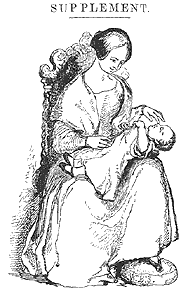
| HERE sits the Lord Mayor........ | forehead. |
| Here sit his two men.............. | eyes. |
| Here sits the cock....................... | right cheek. |
| Here sits the hen.................... | left cheek. |
| Here sit the little chickens......... | tip of nose. |
| Here they run in.................... | mouth. |
|
Chinchopper, chinchopper, Chinchopper, chin !............... |
chuck the chin. |
/ p.206 /
|
TRIP
and go, heave and hoe, Up and down, to and fro ; From the town to the grove Two and two let us rove, A-maying, a-playing ; Love hath no gainsaying ; So merrily trip and go, Merrily trip and go !
|
|
ARTHUR
O'Bower has broken his band, He comes roaring up the land ;— The King of Scots, with all his power, Cannot turn Arthur of the Bower !
|
|
MAKE
three-fourths of a cross, And a circle complete ; And let two semicircles On a perpendicular meet : Next add a triangle That stands on two feet; Next two semicircles, And a circle complete.
|
/ p.207 /
|
AS
I was going o'er Tipple Tine, I met a flock of bonny swine ; Some green-lapp'd, Some green-back'd ; They were the very bonniest swine That e'er went over Tipple Tine.
|
|
HICK-a-more Hack-a-more, Hung on a kitchen-door ; Nothing so long, And nothing so strong, As Hick-a-more Hack-a-more Hung on the kitchen-door !
|
|
O WHERE
are you going, My pretty maiden fair, With your red rosy cheeks And your coal-black hair ?—
I'm going a-milking—
|
/ p.208 /
|
AS
I was going o'er London Bridge, And peep'd through a nick, I saw four and twenty ladies Riding on a stick !
|
|
THERE
was a man and he was mad, And he jump'd into a pea-swad ;* The pea-swad was over-full, So he jump'd into a roaring bull ; The roaring bull was over-fat, So he jump'd into a gentleman's hat ; The gentleman's hat was over-fine, So he jump'd into a bottle of wine ; The bottle of wine was over-dear, So he jump'd into a bottle of beer ; The bottle of beer was over-thick, So he jump'd into a club-stick ; The club-stick was over-narrow, So he jump'd into a wheel-barrow ; The wheel-barrow began to crack, So he jump'd on to a hay-stack ; The hay-stack began to blaze, So he did nothing but cough and sneeze !
-----------
|
/ p.209 /
|
HUMPTY
Dumpty lay in a beck,* With all his sinews round his neck ; Forty doctors and forty wrights Couldn't put Humpty Dumpty to rights !
----------
|
|
I LOV'D
a lad, a handsome lad, I lov'd him so sincerely ; He play'd his part that won my heart, I lov'd him too right dearly : O you may laugh, but I could cry— O is it not a pity, O is it not a pity, O is it not a pity !
My cruel aunt would laugh and taunt,
|
|
FOR
every evil under the sun, There is a remedy, or there is none. If there be one, try and find it ; If there be none, never mind it.
|
/ p.210 /
|
A PRETTY
little girl in a round-eared cap I met in the streets t'other day ; She gave me such a thump, That my heart it went bump ; I thought I should have fainted away ! I thought I should have fainted away !
|
|
I SAW
a ship a-sailing, A-sailing on the sea ; And, oh ! it was all laden With pretty things for thee !
There were comfits in the cabin
The four-and-twenty sailors,
The captain was a duck,
|
/ p.211 /
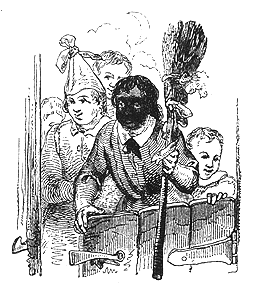
| [A Christmas custom in Lancashire. The boys dress themselves up with ribands, and perform various pantomimes, after which one of them, who has a blackened face, a rough skin coat, and a broom in his hand, sings as follows.] |
|
HERE
come I, Little David Doubt ; If you don't give me money, I'll sweep you all out. Money I want, And money I crave ; If you don't give me money, I'll sweep you all to the grave !
|
/ p.212 /
|
NATURE
requires five, Custom gives seven ! Laziness takes nine, And Wickedness eleven.
|
|
I SAW
a peacock with a fiery tail, I saw a blazing comet drop down hail, I saw a cloud wrapped with ivy round, I saw an oak creep upon the ground, I saw a pismire swallow up a whale, I saw the sea brimful of ale, I saw a Venice glass full fifteen feet deep, I saw a well full of men's tears that weep, I saw red eyes all of a flaming fire, I saw a house bigger than the moon and higher, I saw the sun at twelve o'clock at night, I saw the man that saw this wondrous sight.
|
|
LITTLE
Polly Flinders Sate among the cinders, Warming her pretty little toes ; Her mother came and caught her, And whipp'd her little daughter For spoiling her nice new clothes.
|
/ p.213 /
|
AS
I was going over London Bridge, I saw something under a hedge ; 'Twas neither fish, flesh, feather nor bone, And yet in three weeks it runned alone.
|
|
O RARE
Harry Parry, When will you marry ? When apples and pears are ripe. I'll come to your wedding, Without any bidding, And dance with your bride all night.
|
|
HICKUP,
snicup, Rise up, right up ! Three drops in the cup Are good for the hiccup.
|
|
UP
at Piccadilly oh ! The coachman takes his stand, And when he meets a pretty girl, He takes her by the hand ; Whip away for ever oh ! Drive away so clever oh ! All the way to Bristol oh ! He drives her four-in-hand.
|
/ p.214 /
|
IF
a man who turnips cries Cries not when his father dies, It is proof that he would rather Have a turnip than his father.
|
|
BOW,
wow, wow, Whose dog art thou ? Little Tom Tinker's dog, Bow, wow, wow.
|
|
WHEN
little Sammy Soapsuds Went out to take a ride ; In looking over London Bridge He fell into the tide.
His parents never having taught
|
|
ONE
a penny, two a penny, hot cross-buns ; If your daughters do not like them give them to your sons. But if you should have none of these pretty little elves, You cannot do better than to eat them yourselves.
|
/ p.215 /
|
Amo, amas, I love a lass, As a cedar tall and slender ; Sweet cowslips grace her nominative case, And she's of the feminine gender.
|
|
WHEN
shall we be married, My dear Nicholas Wood? We will be married on Monday, And will not that be very good ? What shall we be married no sooner ? Why sure the man's gone wood !*
What shall we have for our dinner,
Who shall we have at our wedding, |
|
* Mad. This sense of the word has long been obsolete; and exhibits, therefore, the antiquity of these lines.
|
/ p.216 /
|
PIT,
Pat, well-a-day, Little Robin flew away ; Where can little Robin be ? Gone into the cherry tree.
|
|
LAVENDERS
blue, dilly, dilly, lavenders green, When I am king, dilly, dilly, you shall be queen ; Call up your men, dilly, dilly, set them to work, Some to the plough, dilly, dilly, some to the cart ; Some to make hay, dilly, dilly, some to thresh corn, Whilst you and I, dilly, dilly, keep ourselves warm.
|
| [This should be accompanied by a kind of pantomimic dance, in which the motions of the body and arms express the process of weaving; the motion of the shuttle, &c.] |
|
WEAVE
the diaper tick-a-tick tick, Weave the diaper tick— Come this way, come that, As close as a mat. Athwart and across, up and down, round about, And forwards, and backwards and inside, and out ; Weave the diaper thick-a-thick thick, Weave the diaper thick !
|
/ p.217 /
|
FATHER SHORT came down the lane, Oh ! I'm obliged to hammer and smite From four in the morning till eight at night, For a bad master, and a worse dame.
|
|
IF wishes were horses, Beggars would ride ; If turnips were watches, I would wear one by my side.
|
|
A LITTLE
boy went into a barn, And lay down on some hay ; An owl came out and flew about, And the little boy ran away !
|
|
HANNAH
Bantry in the pantry, Eating a mutton bone ; How she gnawed it, how she clawed it, When she found she was alone !
|
|
OLD
Sir Simon the king, And young Sir Simon the 'squire, And old Mrs. Hickabout Kicked Mrs. Kickabout Round about our coal fire !
|
/ p.218 /
|
ON New Year's-day, as I've heard say, Richard he mounted his dapple grey ; He put on his roast-beef clothes, His shoes, his buckles, and his hose, Likewise his hat upon his head, Stuck all round with ribands red ! Thus rode Richard of Dalton Dale To the parson's house to court Mrs. Jane. Richard he rode across the moor, Until he came to the parson's door, Where he did knock both loud and fast, Till he made the company amazed at last ; A trusty servant let him in, His pleasant courtship to begin. Richard he strutted about the hall, And aloud for Mrs. Jane did call : Mrs. Jane came down straightway To hear what Richard had got to say ; He scraped his leg and kissed his hand, I am, said he—don't you understand ? Mrs. Jane I fain would know Whether you'll be my bride or no ! Richard, if I'm to be your bride, Pray what for a living will you provide, For I can neither card nor spin, Nor e'er in my life could do any such thing ? |
|
Sometimes I reap, sometimes I mow, And, sometimes, I to the market go ; With Goodman's hogs, or corn, or hay, I addle* my ninepence every day, Ninepence a day will never do, For I wear silks and satins too ; Ninepence a day won't keep us with meat, Odd zooks! could you think of a crown a week ? There is an old house that stands hard by, It'll be all my own when my grandfather die, And if you'll consent to marry me now, I'll feed you as fat as my grandfather's sow. Richard's compliments did so delight, That the company set up a laugh outright ; So Richard having no more to say, Mounted his keffin† and rode away.
-------------
|
|
WHISTLE,
daughter, whistle, whistle daughter dear ; I cannot whistle, mammy, I cannot whistle clear. Whistle, daughter, whistle, whistle for a pound ; I cannot whistle, mammy, I cannot make a sound. Whistle, daughter, whistle, whistle for a cradle, I cannot whistle, mammy, 'deed I am not able; |
|
Whistle, daughter, whistle, whistle for a cow, I cannot whistle, mammy, 'deed I know not how. Whistle, daughter, whistle, whistle for a man, I cannot whistle, mammy; whew! yes, I believe I can !
|
|
I WENT
out in the garden to water my knot,* I saw a young lady a riding a trot; With her yellow heels and her gibby hose, If you tell me the riddle I'll give you my nose.
------------ |
|
LEND
me thy mare to ride a mile ? She is lamed, leaping over a stile. Alack! and I must keep the fair ! I'll give thee money for thy mare. Oh, oh ! say you so ? Money will make the mare to go ! |
|
ST.
Thomas's-day is past and gone, And Christmas is a-most a-come, Maidens arise, And make your pies, And save poor tailor Bobby some.
|
/ p.221 /
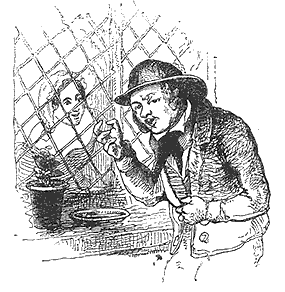
|
YOUNG
Roger came tapping at Dolly's window, Thumpaty, thumpaty, thump ! He asked for admittance, she answered him "No !" Frumpaty, frumpaty, frump ! "No, no, Roger, no! as you came you may go!" Stumpaty, stumpaty, stump !
|
/ p.222 /
|
BRAVE
news is come to town, Brave news is carried ; Brave news is come to town, Jemmy Dawson's married.
First he got a porridge-pot,
|
| YOU shall have an apple, You shall have a plum, You shall have a rattle-basket, When your dad comes home.
|
| HIGHER than a house, higher than a tree ; Oh, whatever can that be ?
|
| AS I look'd out o' my chamber window, I heard something fall ; I sent my maid to pick it up, But she couldn't pick it all.
|
/ p.223 /
|
WHERE
are you going, my pretty maid ? I'm going a-milking, sir, she said. May I go with you, my pretty maid ? You're kindly welcome, sir, she said. What is your father, my pretty maid ? My father's a farmer, sir, she said. Say, will you marry me, my pretty maid ? Yes, if you please, kind sir, she said. Will you be constant, my pretty maid ? That I can't promise you, sir, she said. Then I won't marry you, my pretty maid ! Nobody asked you, sir ! she said.
|
|
SYLVIA, sweet as morning air, Do not drive me to despair : Long have I sighed in vain, Now I am come again, Will you be mine or no, no-a-no— Will you be mine or no ?
Simon pray leave off your suit,
|
/ p.224 /
|
I would if I cou'd, If I cou'dn't, how cou'd I ? I cou'dn't, without I cou'd, cou'd I ? Cou'd you, without you cou'd, cou'd ye ? Cou'd ye, cou'd ye ? Cou'd you, without you cou'd, cou'd ye ?
|
| DOODLE, doodle, doo, The princess lost her shoe ; Her highness hopp'd, The fidler stopped, Not knowing what to do.
|
| HIGH, ding, cockatoo-moody, Make a bed in a barn, I will come to thee ; High, ding, straps of leather, Two little puppy dogs tied together ; One by the head, and one by the tail, And over the water these puppy-dogs sail.
|
|
MERRY are the bells, and merry would they ring, Merry was myself, and merry could I sing ; With a merry ding-dong, happy, gay and free, And a merry sing-song, happy let us be ! |
|
Waddle goes your gait, and hollow are your hose, Noddle goes your pate, and purple is your nose ; Merry is your sing-song, happy, gay, and free, With a merry ding-dong, happy let us be ! Merry have we met, and merry have we been, Merry let us part, and merry meet again ; With our merry sing-song, happy, gay, and free, And a merry ding-dong, happy let us be !
|
| WILLY, Willy Wilkin, Kissed the maids a-milking, Fa, la la ! And with his merry daffing, He set them all a laughing, Ha, ha, ha !
|
| SHOE the colt, shoe ! Shoe the wild mare ; Put a sack on her back, See if she'll bear. If she'll bear, We'll give her some grains ; If she won't bear, We'll dash out her brains !
|
/ p.226 /
|
THREE straws on a staff, Would make a baby cry and laugh.
|
|
HOW does my lady's garden grow ? How does my lady's garden grow ? With cockle shells, and silver bells, And pretty maids all of a row.
|
|
DIDDLE, diddle, dumpling, my son John ! He went to bed with his breeches on ; One shoe off, t'other shoe on, Diddle, diddle, dumpling, my son John.
|
|
HICKERY, dickery, 6 and 7, Alabone Crackabone 10 and 11, Spin span muskidan ; Twiddle 'um twaddle 'um, 21.
|
|
I'LL tell you a story about Joll M'Rory ; He went to the wood and shot a tory ; Then he came back and told his brother, And went to the wood and shot another.
|
/ p.227 /
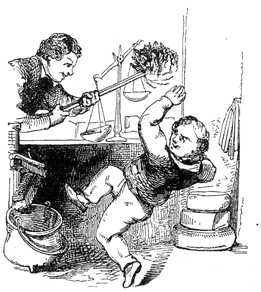
|
TOMMY kept a chandler's shop, Richard went to buy a mop, Tommy gave him such a knock, That sent him out of his chandler's shop.
|
|
|
Lock the dairy door, Lock the dairy door ! |
|
The Hen. |
Chickle, chackle, chee, I haven't got the key !
|
/ p.228 /
| A GOOD child, a good child, As I suppose you be, Never laughed nor smiled At the tickling of your knee.
|
|
CURR dhoo, curr dhoo, Love me, and I'll love you !
|
|
WHERE have you been to-day, Billy, my son ? Where have you been to-day, my only man ! I've been a-wooing, mother ; make my bed soon, For I'm sick at heart, and fain would lay down.
What have you ate to-day, Billy, my son ?
|
|
HICKUP, hickup, go away ! Come again another day ; Hickup, hickup, when I bake, I'll give to you a butter-cake.
|
/ p.229 /
|
OH, madam, I will give you the keys of Canterbury, To set all the bells ringing when we shall be merry, If you will but walk abroad with me, If you will but walk with me.
Sir, I'll not accept of the keys of Canterbury,
Oh, madam, I will give you a fine carved comb,
Oh, madam, I will give you a pair of shoes of cork,*
Madam, I will give you a sweet silver bell,†
|
|
------------ * This proves the song was not later than the era of chopines, or high cork shoes. † Another proof of antiquity. It must probably have been written before the invention of bell-pulls. ------------ |
|
Oh, my man John, what can the matter be ? I love the lady and the lady loves not me ! Neither will she walk abroad with me, Neither will she talk with me.
Oh, master dear, do not despair,
Oh, madam, I will give you the keys of my chest,
Oh, sir, I will accept of the keys of your chest,
|
|
PUSSEY cat sits by the fire, How did she come there ? In walks the little dog, Says "Pussey ! are you there ? How do you do, Mistress Pussey ? Mistress Pussey, how d'ye do ?" "I thank you kindly, little dog, I fare as well as you !"
|
/ p.231 /
| BLACK within, and red without ; Four corners round about.
|
|
THERE was a man rode through our town, Gray Grizzle was his name ; His saddle-bow was gilt with gold, Three times I've named his name.
|
|
PEMMY was a pretty girl, But Fanny was a better ; Pemmy looked like any churl, When little Fanny let her.
Pemmy had a pretty nose,
Pemmy had a pretty doll, |
|
Pemmy had a pretty song, But Fanny had a better ; Pemmy would sing all day long, But Fanny would not let her.
Pemmy lov'd a pretty lad,
|
|
WHEN I was a little girl, about seven years old, I hadn't got a petticoat, to cover me from the cold ; So I went into Darlington, that pretty little town, And there I bought a petticoat, a cloak, and a gown. I went into the woods and built me a kirk, And all the birds of the air, they helped me to work ; The hawk with his long claws, pulled down the stones, The dove, with her rough bill, brought me them home : The parrot was the clergyman, the peacock was the clerk, The bullfinch play'd the organ, and we made merry work.
|
/ p.233 /
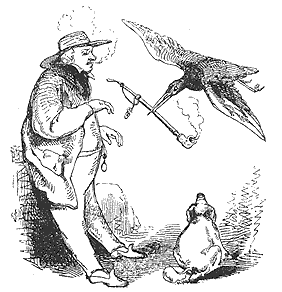
|
THERE was a fat man of Bombay, Who was smoking one sunshiny day, When a bird, called a snipe, Flew away with his pipe, Which vex'd the fat man of Bombay.
|
|
THIS pig went to market, Squeak mouse, mouse, mousey ; Shoe, shoe, shoe the wild colt, And here's my own doll, Dowsy.
|
/ p.234 /
|
HERE goes my lord A trot, a trot, a trot, a trot, Here goes my lady A canter, a canter, a canter, a canter ! Here goes my young master Jockey-hitch, Jockey-hitch, Jockey-hitch, Jockey-hitch : Here goes my young miss, An amble, an amble, an amble, an amble ! | |
|
The footman lays behind to tipple ale and wine, And goes gallop, a gallop, a gallop, to make up his time.
| |
|
A LITTLE cock-sparrow Sat on a tree, Looking as happy As happy could be ; 'Till a boy came by, With his bow and arrow, Says he "I will shoot The little cock-sparrow." His body will make me A nice little stew, And his giblets will make me A little pie too : |
|
Says the little cock-sparrow, "I'll be shot if I stay ;" So he clapt his wings, And flew away.
|
|
CLAP hands, clap hands ! Till father comes home ; For father's got money, But mother's got none. Clap hands, &c. Till father, &c. |
|
BARNEY BODKIN broke his nose, Without feet we can't have toes ; Crazy folks are always mad, Want of money makes us sad.
|
|
IT'S once I courted as pretty a lass, As ever your eyes did see ; But now she's come to such a pass, She never will do for me. She invited me to her own house, Where oft I'd been before, And she tumbled me into the hog-tub, And I'll never go there any more.
|
/ p.236 /
|
MY dear, do you know How a long time ago, Two poor little children, Whose names I don't know, Were stolen away on a fine summer's day, And left in a wood, as I've heard people say.
And when it was night,
And when they were dead,
|
[ p.205 ]
LIFE AND DEATH OF TOM THUMB.
FROM
A BLACK LETTER COPY, PRINTED IN 1630,
IN
The Bodleian Library.
[ p.207 ]
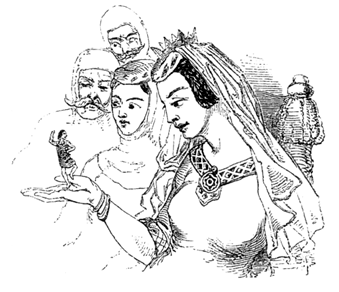
|
IN Arthur's court Tom Thumb did live, A man of mickle might ; The best of all the table round, And eke a doughty knight.
His stature but an inch in height, |
|
His father was a ploughman plain, His mother milk'd the cow, Yet how that they might have a son They knew not what to do :
Until such time this good old man
How in his heart he wish'd to have
Of which old Merlin thus foretold,
No blood nor bones in him should be,
But so unseen to go or come,— |
|
And in four minutes grew so fast That he became so tall As was the ploughman's thumb in height, And so they did him call— T OM THUMB, the which the fairy queenThere gave him to his name, Who, with her train of goblins grim, Unto his christening came.
Whereas she cloth'd him richly brave,
His hat made of an oaken leaf,
His hose and doublet thistle-down,
His garters were two little hairs |
|
Thus like a lusty gallant, he Adventured forth to go, With other children in the streets, His pretty tricks to show.
Where he for counters, pins, and points,
Yet could he soon renew the same,
Unseen or felt by any one,
Of whom to be reveng'd he took,
The other boys to do the like |
|
And so Tom Thumb restrained was, From these his sports and play ; And by his mother after that, Compell'd at home to stay.
Whereas about a Christmas time,
He sate upon the pudding-bole,
For Tom fell in, and could not be
Where searching long, but all in vain,
Which pudding of the largest size, |
|
For so it tumbled up and down, Within the liquor there, As if the devil had been boil'd,— Such was his mother's fear,
That up she took the pudding straight,
But as the tinker climb'd a stile,
At which the tinker 'gan to run,
From which Tom Thumb got loose at last,
Until such time his mother went |
|
A thread that held him to the same, For fear the blustering wind Should blow him hence,—that so she might Her son in safety find.
But mark the hap ! a cow came by,
Who, being miss'd, his mother went
Within the red cow's stomach here,
Meanwhile the cow was troubled much,
Now after this, in sowing time, |
|
A whip made of a barley-straw, To drive the cattle on ; Where, in a furrow'd land new sown, Poor Tom was lost and gone.
Now by a raven of great strength,
Unto a giant's castle top,
But soon the giant spat him out,
Which lusty fish was after caught,
Long time in lively jollity, |
|
Amongst his deeds of courtship done, His highness did command, That he should dance a galliard brave Upon his queen's left hand.
The which he did, and for the same
How, after this, the king would not
Whereon a time when, as it rain'd,
And being near his highness' heart,
For to relieve his father's wants, |
|
And so away goes lusty Tom, With threepence on his back, A heavy burthen, which might make His wearied limbs to crack.
So travelling two days and nights,
Which was but half a mile in space
But coming to his father's door,
His mother in her apron took
Whereas they feasted him three days |
|
And thereupon grew wond'rous sick, Through eating too much meat, Which was sufficient for a month For this great man to eat.
But now his business call'd him forth
But yet a few small April drops
Until his careful father took
Now he with tilts and tournaments
As good Sir Lancelot du Lake, |
|
In honour of which noble day, And for his lady's sake, A challenge in king Arthur's court Tom Thumb did bravely make.
'Gainst whom these noble knights did run,
At last Sir Lancelot du Lake
Which made the courtiers all aghast,
Yea, horse and all, with spear and shield,
Who from her finger took a ring, |
|
He likewise cleft the smallest hair From his fair lady's head Not hurting her whose even hand Him lasting honours bred.
Such were his deeds and noble acts
Now at these sports he toil'd himself,
When lying on his bed sore sick,
His body being so slender small,
Into his sickened body down, |
|
His arms and legs consum'd as small As was a spider's web, Through which his dying hour grew on, For all his limbs grew dead.
His face no bigger than an ant's,
And so with peace and quietness
Whereas the fairy-queen receiv'd,
For with her dancing nymphs in green,
For whom king Arthur and his knights |
|
He built a tomb of marble gray, And year by year did come To celebrate ye mournful death And burial of Tom Thumb.
Whose fame still lives in England here,
|
[ p.223 ]
| A, B, C, and D....... | |
| A, B, C, tumble down D......... | |
| A carrion crow sat on an oak....... | |
| A cat came fiddling out of a barn...... | |
| A cow and a calf....... | |
| A diller, a dollar....... | |
| A donkey walks on four legs....... | |
| A duck and a drake..... | |
| A kid, a kid, my father bought..... | |
| A little old man and I fell out.... | |
| A little old man of Derby...... | |
| A long-tail'd pig, or a short-tail'd pig....... | |
| A man of words and not of deeds...... | |
| A man went a hunting at Reigate...... |
| A pie sate on a pear-tree...... | |
| A riddle, a riddle, as I suppose..... | |
| A swarm of bees in May...... | |
| A thatcher of Thatchwood....... | |
| A was an apple-pie...... | |
| A was an archer, and shot at a frog..... | |
| About the bush, Willy..... | |
| All of a row..... | |
| An old woman was sweeping her house... | |
| Apple-pie, pudding, and pancake...... | |
| Around the green gravel the grass grows green | |
| As I was going along, long, long...... | |
| As I was going by Charing Cross....... | |
| As I was going o'er Westminster bridge ... | |
| As I was going to sell my eggs..... | |
| As I was going to St. Ives....... | |
| As I was going up Pippen hill..... | |
| As I was going up the hill...... | |
| As I was walking o'er little Moorfields....... | |
| As I went over Lincoln-bridge...... | |
| As I went over the water..... | |
| As I went to Bonner...... | |
| As I went through the garden gap...... | |
| As round as an apple, as deep as a cup..... | |
| As titty mouse sat in the witty to spin..... | |
| As Tommy Snooks and Bessy Brooks....... | |
| At Brill on the hill...... | |
| At the siege of Belle-isle......... | |
| Awa' birds, away...... |
| Baby and I......... | |
| Barnaby Bright he was a sharp cur...... | |
| Barber, barber, shave a pig...... | |
| Bah, bah, black sheep...... | |
| Bat, bat.... | |
| Bessy Bell and Mary Gray...... | |
| Betty Pringle had a little pig..... | |
| Birds of a feather flock together.... | |
| Black we are, but much admired....... | |
| Blow, wind, blow; and go, mill, go...... | |
| Bounce Buckram, velvet's dear...... | |
| Bryan O'Lin, and his wife, and wife's mother | |
| Buff says Buff to all his men..... | |
| Burnie bee, burnie bee..... | |
| Buz, quoth the blue fly..... | |
| Bye, baby bumpkin..... | |
| Bye, baby bunting...... | |
|
Bye, O my baby ! ...... |
|
| Can you make me a cambric shirt...... | |
| Catch him, crow, carry him, kite..... | |
| Charley wag...... | |
| Clap hands, clap hands.... | |
| Cock a doodle doo ! ........ | |
| Come, butter, come...... | |
| Come dance a jig..... | |
| Come, let's to bed........ | |
| Congeal'd water and Cain's brother..... | |
| Cripple Dick upon a stick..... |
| Cross patch......... | |
| Cry, baby, cry....... | |
| Cuckoo, cherry tree...... | |
| Cuckoo, cuckoo...... | |
| Curly locks, curly locks, wilt thou be mine . | |
| Cushy cow bonny, let down thy milk .... | |
| Daffy-down-dilly has come up to town .... | |
| Dame, what makes your ducks to die ? .... | |
| Dance, little baby, dance up high.... | |
| Dance to your daddy..... | |
| Dance, Thumbkin, dance .... | |
| Danty, baby, diddy ...... | |
| Darby and Joan were dressed in black ... | |
| Deedle, deedle, dumpling, my son John ... | |
| Dibbity, dibbity, dibbity, doe ...... | |
| Dick and Tom, Will and John .... | |
| Dickery, dickery, dare ..... | |
| Did you see my wife ..... | |
| Ding, dong, bell ..... | |
| Ding, dong, darrow ..... | |
| Doctor Faustus was a good man .... | |
| Doctor Foster went to Glo'ster ..... | |
| Doodledy, doodledy, doodledy, dan .... | |
| Draw a pail of water ..... | |
| Driddlety drum, driddlety drum .... | |
| Dusty was the coat ..... | |
| Eggs, butter, cheese, bread ... |
| Eighty-eight wor Kirby feight .... | |
| Elizabeth, Elspeth, Betsy, and Bess .... | |
| Every lady in this land ... | |
| Eye winker ..... | |
| F for fig, J for jig .... | |
| Feedum, fiddledum, fee .... | |
| Fiddle-de-dee, fiddle-de-dee .... | |
| Fiddle [lit], liddle, lightum ... | |
| Flour of England, fruit of Spain .... | |
| Formed long ago, yet made to-day ... | |
| Four and twenty tailors went to kill a snail . | |
| Gay go up and gay go down .... | |
| Giles Collins he said to his old mother .. | |
| Gilly Silly Jarter ..... | |
| Girls and boys, come out to play .... | |
| Give me a blow, and I'll beat 'em ... | |
| Good horses, bad horses .... | |
| Good morning, father Francis .... | |
| Good morrow to you, father .... | |
| Goosey, goosey, gander .... | |
| Goosy, goosy, gander .... | |
| Go to bed first, a golden purse ..... | |
| Go to bed, Tom ..... | |
| Gray goose and gander .... | |
| Great A, little a ..... | |
| Green cheese, yellow laces .... | |
| Handy Spandy Jack-a-dandy ..... |
| Hark, hark ...... | |
| Hemp-seed I set .... | |
| Here am I, little jumping Joan ..... | |
| Here comes a lusty wooer ..... | |
| Here comes a poor woman from baby-land . | |
| Here we come a piping ..... | |
| He that would thrive .... | |
| Hey ! diddle diddle .... | |
| Hey diddle, dinkety, poppety, pet ... | |
| Hey ding a ding, what shall I sing .... | |
| Hey, dorolot, dorolot ! ..... | |
| Hey, my kitten, my kitten .... | |
| Hey, the dusty miller .... | |
| Hic, hoc, the carrion crow .... | |
| Hickety, pickety, my black hen ... | |
| Hickory, dickory, dock .... | |
| Hie, hie, says Anthony .... | |
| Higgledy, piggledy ..... | |
| High diddle ding .... | |
| High diddle doubt, my candle's out .... | |
| High ding a ding, and ho ding a ding ... | |
| Highty cock O ! ... | |
| Highty, tighty, paradighty clothed in green . | |
| Hinx, minx, the old witch winks ... | |
| How d'ye dogs, how .... | |
| How many days has my baby to play ? ..... | |
| How many miles is it to Babylon ? ... | |
| Hub a dub dub .... | |
| Humpty dumpty sate on a wall .... |
| Hush a bye, a ba lamb..... | |
| Hush a bye, baby, on the tree top .... | |
| Hush baby, my doll, I pray you don't cry .... | |
| Hush, hush, hush, hush .... | |
| Hush thee, my babby...... | |
| Hussy, hussy, where's your horse ..... | |
| Hyder iddle diddle dell .... | |
| I am a gold lock .... | |
| I am a pretty wench .... | |
| I can make diet-bread ... | |
| I can weave diaper thick, thick, thick .... | |
| If a body meet a body .... | |
| If all the seas were one sea .... | |
| If all the world was apple-pie .... | |
| If I'd as much money as I could spend ...... | |
| If you love me, pop and fly ..... | |
| I had a little castle upon the sea-side .... | |
| I had a little dog, and his name was Blue Bell | |
| I had a little dog, and they called him Buff . | |
| I had a little hobby-horse, and it was well shod | |
| I had a little husband ... | |
| I had a little moppet .... | |
| I had a little nut tree, nothing would it bear . | |
| I had a little pony.... | |
| I have a little sister, they call her peep, peep | |
| I'll buy you a tartan bonnet ... | |
| I'll sing you a song ... | |
| I'll tell you a story .... | |
| I'll tell you a story .... |
| I lost my mare in Lincoln lane .... | |
| I love sixpence, pretty little sixpence .... | |
| In Arthur's court, Tom Thumb did live... | |
| In fir tar is...... | |
| In marble walls as white as milk.... | |
| Intery, mintery, cutery-corn .... | |
| I sell you the key of the king's garden.... | |
| Is John Smith within ? .... | |
| I went to the toad that lies under the wall . | |
| I went up one pair of stairs.... | |
| I won't be my father's Jack .... | |
| Jack and Jill went up the hill... | |
| Jack be nimble ... | |
| Jack in the pulpit, out and in .... | |
| Jack Sprat could eat no fat .... | |
| Jack Sprat had a cat .... | |
| Jack Sprat's pig .... | |
| Jim and George were two great lords .... | |
| John Ball shot them all.... | |
| John, come sell thy fiddle .... | |
| John Cook had a little grey mare .... | |
| Johnny Armstrong kill'd a calf .... | |
| Johnny shall have a new bonnet .... | |
| King Charles walked and talked .. | |
| King's Sutton is a pretty town .... | |
| Lady-cow, lady-cow, fly thy way home ... |
| Leg over leg .... | |
| Let us go to the wood, says this pig . | |
| Little blue Betty lived in a den .... | |
| Little Bo-peep has lost her sheep .... | |
| Little boy blue, come blow up your horn . | |
| Little boy, pretty boy, where was you born ? . | |
| Little Dicky Dilver .... | |
| Little General Monk .... | |
| Little girl, little girl, where have you been ? . | |
| Little Jack Dandiprat [lit.] was my first suitor . | |
| Little Jack Horner sat in the corner .... | |
| Little Jack Jingle .... | |
| Little John Jiggy Jag... | |
| Little maid, pretty maid, whither goest thou ? | |
| Little Mary Ester .... | |
| Little Nancy Etticoat .... | |
| Little Robin Red-breast .... | |
| Little Tee Wee .... | |
| Little Tom Dandy.... | |
| Little Tommy Tacket .... | |
| Little Tommy Tittlemouse .... | |
| Little Tom Tucker.... | |
|
[The '0' is modified to an '8' in pencil:] |
p.198 |
| London bridge is broken down .... | |
| Long legs, crooked thighs...... | |
| Madam, I am come to court you .... | |
| Margery Mutton-pie, and Johnny Bopeep . | |
| Master I have, and I am his man... | |
| Matthew, Mark, Luke, and John.... |
| Miss one, two, and three, could never agree . | |
| Mistress Mary, quite contrary ... | |
| Multiplication is vexation .... | |
| My father and mother ... | |
| My father he died, but I can't tell you how . | |
| My father he left me, just as he was able . | |
| My father was a Frenchman.... | |
| My lady Wind, my lady Wind.... | |
| My little old man and I fell out .... | |
| Needles and pins, needles and pins... | |
| Number number nine, this hoop's mine .... | |
| Of all the gay birds that e'er I did see ... | |
| Oh, dear, what can the matter be ? .... | |
| Oh ! mother, I shall be married to Mr. Punchinello | |
| O that I was where I would be.... | |
| O the little rusty, dusty, rusty miller ... | |
| Old Betty Blue ....... | |
| Old Boniface he loved good cheer ... | |
| Old Doctor Foster went to Glo'ster... | |
| Old father Graybeard ... | |
| Old King Cole ..... | |
| Old mother Goose .... | |
| Old mother Hubbard... | |
| Old mother Niddity Nod swore by the pudding-bag | |
| Old mother Twitchett had but one eye .... | |
| Old mother Widdle Waddle jumpt out of bed .... [The page number is inserted in pencil :] |
| Old woman, old woman, shall we go a shearing ? | |
| Once I saw a little bird .... | |
| On Christmas eve I turn'd the spit .... | |
| On Saturday night .... | |
| One's none .... | |
| One, two..... | |
| One, two, three .... | |
| One, two, three, four, five .... | |
| One misty moisty morning.... | |
| One moonshiny night .... | |
| One-ery, two-ery .... | |
| One-ery, two-ery, hickary, hum ..... | |
| One old Oxford ox opening oysters ... | |
| One to make ready .... | |
| Over the water, and over the lee .. | |
| Parson Darby wore a black gown .... | |
| Pat-a-cake, pat-a-cake, baker's man .... | |
|
[The '65' is crossed out and '15' written beside it in pencil:] |
p.15 |
| Pease-porridge hot, pease-porridge cold ... | |
| Pease-pudding hot ..... | |
| Peg, Peg, with a wooden leg ... | |
| Peter Piper picked a peck of pickled pepper | |
| Peter White will ne'er go right ... | |
| Pitty Patty Polt ... | |
| Please to remember .... | |
| Poor old Robinson Crusoe ...... | |
| Punch and Judy ..... | |
| Purple, yellow, red, and green .... | |
| Pussy cat eat the dumplings ..... |
| Pussy cat Mole .... | |
| Pussy cat, pussy cat, where have you been . | |
| Pussicat, wussicat, with a white foot..... | |
| Queen Anne, Queen Anne, you sit in the sun . | |
| Rain, rain, go away .... | |
| Riddle me, riddle me, ree ..... | |
| Ride a cock-horse to Banbury-Cross .... | |
| Ride a cock-horse to Banbury-Cross ..... | |
| Ride a cock-horse to Coventry-Cross ... | |
| Ride, baby, ride .... | |
| Ring me, ring me, ring me, rary .... | |
| Robert Barnes, fellow fine .... | |
| Robert Rowley rolled a round roll round . | |
| Robin and Richard were two pretty men . | |
| Robin Hood, Robin Hood .... | |
| Robin the Bobbin, the big-bellied Ben ... | |
| Rock-a-bye, baby, thy cradle is green ... | |
| Round about, round about .... | |
| Rowley Poley, pudding and pie .... | |
| Rumpty-iddity, row, row, row ... | |
| Rowsty dowt, my fire's all out ... | |
| St. Dunstan, as the story goes .... | |
| St. Swithin's day, if thou dost rain .... | |
| Says t'auld man tit oak tree ...... | |
| See a pin and pick it up .... | |
| See-saw, jack a daw .... | |
| See-saw, Margery Daw ... |
| See-saw, sack a day .... | |
| See-saw, sacradown ... | |
| See, see ! what shall I see ? .... | |
| Shake a leg, wag a leg, when will you gang ? . | |
| Shoe the colt ... | |
| Sieve my lady's oatmeal ... | |
| Simple Simon met a pieman .... | |
| Sing a song of sixpence ... | |
| Sing jigmijole, the pudding-bole ... | |
| Sing, sing, what shall I sing ? ... | |
| Snail, snail, come out of your hole ... | |
| Snail, snail, put out your horns ... | |
| Sneel, snaul ..... | |
| Solomon Grundy ... | |
| Some little mice sat in a barn to spin ... | |
| Some up and some down .... | |
| Swan swam over the sea .... | |
| Taffy was a Welshman, Taffy was a thief ... | |
| Tell tale, tit ..... | |
| The barber shaved the mason ... | |
| The bull's in the barn threshing the corn ... | |
| The cat sat asleep by the side of the fire ... | |
|
[In pen the '1' is modified to a '0':] |
p.160 |
| The cock doth crow .... | |
| The cuckoo's a fine bird ... | |
| The first day of Christmas ... | |
| The fox and his wife they had a great strife . | |
| The girl in the lane .... | |
| The king of France, and four thousand men . |
| The king of France, the king of France .... | |
| The king of France went up the hill .... | |
| The king of France with twenty thousand men | |
| The lion and the unicorn ... | |
| The little priest of Felton ... | |
| The man in the moon ... | |
| The man in the moon drinks claret .... | |
| The man in the wilderness, asked me ... | |
| The moon nine days old .... | |
| The north wind doth blow .... | |
| The quaker's wife got up to bake .... | |
| The Queen of Hearts ... | |
| The rose is red, the grass is green .... | |
| The sow came in with the saddle .... | |
| The tailor of Bicester .... | |
| The white dove sat on the castle wall... | |
| There once was a gentleman grand .. | |
| There was a crooked man, and he went a crooked mile .... | |
| There was a frog liv'd in a well ... | |
| There was a girl in our towne ... | |
| There was a jolly miller ... | |
| There was a king and he had three daughters | |
| There was a king met a king .... | |
| There was a lady all skin and bone ... | |
| There was a little boy and a little girl ... | |
| There was a little guinea-pig .... | |
| There was a little maid and she was afraid . | |
| There was a little man ... | |
| There was a little nobby colt .... |
| There was a little one-eyed gunner ... | |
| There was a little pretty lad .. | |
| There was a man in our toone .. | |
| There was a man made a thing ... | |
| There was a man of Newington ... | |
| There was a man who had no eyes ... | |
| There was a monkey climb'd up a tree ... | |
| There was an old crow .... | |
| There was an old man .... | |
| There was an old man who liv'd in a wood . | |
| There was an old man who lived in Middle Row | |
| There was an old man of Tobago ... | |
| There was an old woman ... | |
| There was an old woman .... | |
| There was an old woman .... | |
| There was an old woman, and what do you think | |
| There was an old woman as I've heard tell . | |
| There was an old woman called Nothing-at-all | |
| There was an old woman had nothing .... | |
| There was an old woman had three sons ... | |
| There was an old woman, her name it was Peg | |
| There was an old woman in Surrey.... | |
| There was an old woman of Leeds .... | |
| There was an old woman of Norwich ... | |
| There was an old woman sat spinning... | |
| There was an old woman toss'd up in a basket | |
| There was an old woman who lived in a shoe . | |
| There was an owl lived in an oak... | |
| There was a piper, he'd a cow..... |
| There was a rat for want of stairs... | |
| There were three jovial Welshman.... | |
| There were three sisters in a hall .. | |
| There were two birds sat on a stone ... | |
| There were two blackbirds .. | |
| They that wash on Monday.. | |
| Thirty days hath September .... | |
| Thirty white horses upon a red hill.. | |
| This is the house that Jack built.... | |
| This is the key of the kingdom.... | |
| This pig went to market... | |
| Thomas a Tattamus took two T's ... | |
| Three blind mice, see how they run... | |
| Three children sliding on the ice.. | |
| Three wise men of Gotham... | |
| Thumbikin, Thumbikin, broke the barn.. | |
| Tiddle liddle lightum... | |
| Tip, top, tower .... | |
| To market, to market .. | |
| To market, to market, a gallop, a trot... | |
| To market, to market, to buy a fat pig... | |
| To market ride the gentlemen ... | |
| To make your candles last for a' .... | |
| Tom Browne's two little Indian boys... | |
| Tom he was a piper's son ... | |
| Tom shall have a new bonnet ... | |
| Tom, Tom, the piper's son ... | |
| Tommy Trot, a man of law ... | |
| Trip, trap, over the grass ... |
| Trip upon trenchers and dance upon dishes . | |
| 'Twas the twenty-ninth of May ... | |
| Twelve huntsmen with horns and hounds . | |
| Twelve pears hanging high .... | |
| Two broken tradesmen ... | |
| Two legs sat upon three legs ... | |
| Up hill and down dale .. | |
| Up street and down street ... | |
| Wash hands, wash .. | |
| We are three brethren out of Spain .... | |
| We make no spare .... | |
| We're all dry with drinking on't ... | |
| We're all in the dumps ... | |
| What are little boys made of ... | |
| What care I how black I be ... | |
| What do they call you ... | |
| What is the rhyme for porringer ... | |
| What shoe-maker makes shoes without leather | |
| What's the news of the day .... | |
| When a twister a twisting, will twist him a twist | |
| When good king Arthur ruled this land . | |
| When I was a little boy, I had but little wit . | |
| When I was a little boy, my mammy kept me in | |
| When I went up sandy hill... | |
| When Jacky's a very good boy... | |
| When the wind is in the east .. |
| Where have you been all the day .... |
[The '5' is overwritten with a '6' in pencil:] |
p.146 |
| Whiskum, whaskum. | |
| Who comes here ? ... | |
| Who goes round my house this night ... | |
| Who is going round my sheepfold..... | |
| Whoop, whoop, and hollow... | |
| William and Mary, George and Anne ... | |
| Willy boy, Willy boy, where are you going . | |
|
[The '1' is overwritten with a '2' in pencil:] |
p.200 |
| Wooley Foster has gone to sea .... |
 |