|
|
[ p.ii ]
NEVER BEFORE PUBLISHED,
BY
W I L L I A M B R O W N E,
OF
THE INNER TEMPLE, GENT.
OF
" BRITANNIA'S PASTORALS,"
1613.
[ p.1 Advertisement ] (image of Advertisement page 1.)
OF

 f my taste is not very erroneous, the following hitherto unpublished poems of a celebrated pastoral author will be deemed a very interesting treasure by the lovers of old English Poetry. It is not, however, my intention, before the whole, or the larger part, of them is printed, to enter into any long criticism on their merits; or to make more than a few brief statements and remarks, which perhaps the reader will expect, before he enters on a perusal of them.
WILLIAM BROWNE, son of Thomas Browne of Tavistock, in Devonshire, Gent. was born in that town, about 1590, and sent to Exeter College, Oxford, soon after King James I. ascended the English throne; and thence removed to the Inner Temple, where he published the First Part of his "Britannia's Pastorals," in folio, 1613; and the Second Part in 1616. These Two Parts were reprinted in 8vo. in 1625. He also published "The Shepherd's Pipe, in Seven Eclogues," in 1614, 8vo. In 1624, he returned to Exeter College, as tutor to Robert Dormer, afterwards Earl of Caernarvon, who was killed at the battle / p.2 Advertisement / of Newbury, Sept. 20, 1643. He then became a retainer to the Earl of Pembroke: and here, says Wood, "he got wealth, and purchased an estate, which is all that I know of him hitherto, only that, as he had a little body, so he had a great mind. In my searches I find one William Browne of Ottery St. Mary, in Devon, died in the winter time, 1645; whether the same with the poet, I am hitherto ignorant." a
--------------------------- --------------------------- The few slight facts thus recorded by Wood, will be amply confirmed by the contents of the following Poems. The University of Oxford, and the Pembroke family, make a conspicuous figure in them. All that we have heard, and conceived, of the character and moral habits of B ROWNE, without possessing the facts on which his cotemporaries [lit.] probably founded them, is here also amply established: and is a strong illustration of an opinion always entertained by me, that we ought to be very slow, and reluctant, in denying the praises bestowed on individuals, by those who were coeval with the subjects of them, merely because the particulars recorded do not seem to justify the fame conferred. Reputation is generally the result of a combination of qualities, and virtues, and performances, many of which having been omitted to be recorded, while familiar to every one, have gradually been effaced from memory. Thus the fame of BROWNE / p.3 Advertisement / which his known works never seemed to me to authorize, have been partly founded on the smaller poems, now recovered from oblivion. I will not hesitate to say, that I far prefer these latter to his more laboured compositions, which he gave to the world, as the formal efforts on which he chose to rest his honours. This likewise is in conformity with another favourite opinion, with which I have always been impressed. To me the very restraint and artificiality of a work, forced, and polished, and toiled upon, for the public eye, destroys much of the charm, of the ease, and freshness, and vigour, which a mind of high native powers would otherwise give to a composition. Break the natural and uncalled chain of ideas; wipe off, or dry up the dew with which the waters of Helicon sprinkle the first shoot of their plants; and the spell is gone!There is a simplicity, a chasteness, a grace, a facility, a sweetness in some of the present short poems, which to me is full of attraction and delight; and is the more surprising when it is contrasted with the corrupt and absurdly-metaphysical style of most of BROWNE's cotemporaries. George Wither had the same simplicity; and I have formerly, when I had not seen the present poems, set Wither above his friend BROWNE; but the present pieces prove, that Wither had not the same taste: he wanted selection, and compression. |
|
But I wander beyond the limits I had imposed on myself. I will at present expatiate no further on the genius of BROWNE. On that which seems to have given a colour to the course of his life, I may be allowed in this place to throw out a few sentiments. BROWNE's days were enlivened by a patronage, which must have been propitious to his poetical pursuits. Of William Herbert, Earl of Pembroke, whose favour it is apparent that he enjoyed, the character is drawn with such extraordinary brilliancy of language by Lord Clarendon, the great historian of human nature, that it must be familiar to every educated English reader. He, whose knowledge of our national story, and whose acquaintance with the biography of his country is enlivened by fancy and sentiment, cannot recall the classical bowers of Wilton, or the spacious galleries of Penshurst, without reviving an array of intellectual splendor and glory, that bursts upon the mind with melancholy enchantment. For my part, I have often gazed with a pensive transport, till I have forgot myself, on the full-length portrait, drawn by Cornelius Jansen, of this amiable nobleman, at Penshurst, faded as are its colours, and desolate and neglected as it hangs, amid numbers of illustrious companions, upon the walls of those magnificent, but now silent apartments! The well-known Epitaph of the celebrated Countess, this / p.5 Advertisement / Earl's mother, has been generally ascribed to Ben Jonson. The first stanza is printed in "Jonson's Poems." But it is to be found in the MS. volume of "BROWNE'S Poems" and on this evidence may, I think, be fairly appropriated to him. I repeat it here, in the words of the MS. that the reader may form his own opinion.
THE COUNTESS DOWAGER OF PEMBROKE.
Then follows a long Elegy on the Countess, beginning thus:

|
|
Her son, Earl William, has had the fame of a poet, but his right to the poems ascribed to him, has been questioned, as standing on no adequate authority. The following Song occurs, with his name subscribed to it, at the end of the MS. b of these Poems of BROWNE; and may, therefore, be taken to be his, on the authority of one who had the best means of ascertaining it.
b The same MS. appropriates to Sir Walter Raleigh the poem containing the famous stanza, beginning, |
It had been long supposed that some MS. Poems of BROWNE were among the Collections of Warburton, the Herald. The MS. from which the present Poems are copied, is in the British Museum, among the Lansdowne MSS. which contain a portion of Warburton's Papers; and thence, I take for granted, came this very valuable volume.
|
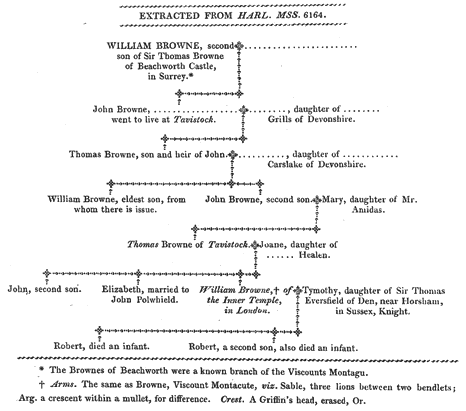
 t has been said that Anthony Wood, the original biographer of WILLIAM BROWNE, knew little of his private history or connections. A mere accident threw in my way, on April 4, 1816, while searching for other things, a record of his descent, if we admit, as I think it is impossible to question, his identity with William Browne of the Inner Temple, son of Thomas Browne of Tavistock, for whom the genealogy in the following Table is drawn. "And to what," it will be asked, "does this discovery amount? Is it more than the merest of trifles? Are you so weak, as to give it even the importance of a notice?" I am so weak : and not ashamed of my weakness ! But not so much because the Poet derives honour from the noble stem and once-flourishing branches of BROWNE, as because he reflects a lustre upon them. I could say much on this subject, if I had leisure; when I would attempt to give a momentary impulse to the cold blood and groveling minds of those ill-deserving members of the upper orders of society, who possess high birth, high rank, and large estates, without a correspondent loftiness and cultivation of intellect and of the heart ! / p.2 Appendix / Perhaps, however, the waste even of a few minutes' attention on such base wretches, is beneath the dignity of literature, or of the glowing ambition of any tolerably-eloquent pen.
|

[ p.3 ] (image of contents page)

| |||||||||||||||||||||||||||||||||||||||||||||||||||||||||||||||||||||||||||||||||||||||||||||||||||||||||||||||||||||||||||||||||||||||||||||||||||||||||||||||||||||||||||||||||||||||||||||||||||||||||||||||||||||||
[ p.1 ] (image of page 1.)
BY
WILLIAM BROWNE.
 WAKE, fair Muse; for I intend
These everlasting lines to thee ! And, honour'd Drayton, come and lend An ear to this sweet melody : For on my harp's most high and silver string, To those Nine Sisters whom I love, I sing.
This man through death and horror seeks |
|
But I, that serve the lovely Graces, Spurn at that dross, which most adore; And titles hate, like painted faces, And heart-fed Care for ever more. Those pleasures I disdain, which are pursu'd With praise and wishes by the multitude.
The bays, which deathless Learning crowns,
Through the fair skies I thence intend, |
|
From fair Aurora will I rear Myself unto the source of floods; And from the Ethiopian Bear, To him as white as snowy woods; Nor shall I fear, (for this day taking flight) To be wound up in any veil of night.
Of Death may I not fear the dart,
All costly obsequies inveigh; |
 EHOLD, O God! in rivers of my tears
I come to thee! bow down thy blessed ears To hear me, wretch, and let thine eyes (which sleep Did never close) behold a sinner weep: Let not, O God, my God, my faults through great, And numberless, between thy mercy's seat And my poor soul be thrown! since we are taught, Thou, Lord, remember'st thine, if thou be sought. I come not, Lord, with any other merit Than what I by my Saviour Christ inherit: Be then his wounds my balm; his stripes my bliss; My crown his thorns; my death be lost in his. And thou, my blest Redeemer, Saviour, God, Quit my accounts, withhold the vengeful rod! O beg for me! my hopes on thee are set; And Christ forgive, as well as pay the debt. |
|
The living fount, the life, the way, I know, And but to thee, O whither should I go? All other helps are vain: grant thine to me, For in thy cross my saving health must be. O hearken then what I with faith implore, Lest Sin and Death sink me for evermore. Lastly, O God! my ways direct and guide; In death defend me, that I never slide; And at the doom let me be raised then, To live with thee; sweet Jesus, say Amen!
|
 BLESSED man! who, homely bred,
In lowly cell can pass his days, Feeding on his well gotten bread; And hath his God's, not others' ways. |
|
That doth into a prayer wake, And rising (not to bribes or bands) The power that doth him happy make, Hath both his knees, as well as hands:
His threshold he doth not forsake,
By some sweet stream, clear as his thought,
He hath a table furnish'd strong, |
|
His afternoon (spent as the prime) Inviting where he mirthful sups; Labour, and seasonable time, Brings him to bed, and not his cups.
Yet, ere he takes him to his rest,
If then a loving wife he meets, |
/ p.8 /
 OW that the Spring hath fill'd our veins
With kind and active fire, And made green liveries for the plains, And every grove a choir.
Sing we a song of merry glee,
Nor Care nor Sorrow ere paid debt,
No wife at home to send for me, |
|
No suit at Law to pay a fee, Then round, old jockey round!
But see that no man 'scape To drink of the sherry, That makes us so merry, And plump as the lusty grape. |
|
OFT have heard of Lidford Law, How in the morn they hang and draw, And sit in judgment after: At first I wonder'd at it much; But now I find their reason such, That it deserves no laughter.
|
|
They have a castle on a hill; I took it for an old windmill, The vanes blown off by weather; To lie therein one night, 'tis guess'd, 'Twere better to be ston'd and press'd, Or hang'd, now choose you whether.
Ten men less room within this cave,
When I beheld it, Lord! thought I, |
|
The Prince a hundred pounds hath sent, To mend the leads and planchings rent, Within this living tomb: Some forty-five pounds more had paid, The debts of all that shall be laid There, 'till the day of Doom.
One lies there for a seam of malt, John Vaughan, or John Doble.c c Attorneys of the Court.
Near to the men that lie in lurch, |
|
Whereby you may consider well, That plain Simplicity doth dwell At Lidford, without bravery; For in that town, both young and grave Do love the naked truth, and have No cloaks to hide their knavery.
The people all, within this clime,
One told me in King Cæsar's time, |
|
Oh! Cæsar, if thou there did'st reign, While one house stands, come there again; Come quickly while there is one: If thou but stay a little fit, But five years more, they may commit The whole town into prison.
To see it thus, much griev'd was I,
Sure I believe it then did rain |
|
To nine good stomachs with our wig, At last we got a tything pig; This diet was our bounds: And that was just as if 'twere known, One pound of butter had been thrown Amongst a pack of hounds.
One glass of drink I got by chance,
I kiss'd the Mayor's hand of the town, |
|
At six o'clock I came away, And pray'd for those that were to stay, Within a place so arrant: Wild and ope, to winds that roar, By God's grace I'll come there no more, Unless by some Tin Warrant.
W. B.
|
|
T happened lately at a fair, or wake, (After a pot or two, or such mistake) Two iron-soled clowns, and bacon-sided, Grumbled: then left the farms which they bestrided, And with their crab-tree cudgels, as appears, Thrash'd (as they use) at one anothers' ears: A neighbour near, both to their house and drink, (Who though he slept at sermons) could not wink |
|
At this dissention, with a spirit bold As was the ale that arm'd them, strong and old, Stept in and parted them; but Fortune's frown Was such, that there our neighbour was knock'd down! For they, to recompence his pains at full, Since he had broke their quarrel, broke his scull! People came in, and rais'd him from his swound; A chirurgeon then was call'd to search the wound, Who op'ning it, more to endear his pains, Cry'd out, "Alas! look, you may see his brains!" "Nay," quoth the wounded man, "I tell you free, Good Master Surgeon, that can never be; For I should ne'er have meddled with this brawl, If I had had but any brains at all." |
 OVE! when I met her first, whose slave I am,
To make her mine, why had I not thy flame? Or else thy blindness not to see that day? Or if I needs must look on her rare parts, Love! why to wound her had I not thy darts? Since I had not thy wings to fly away! |
|
WINTER was gone, and by the lovely spring Each pleasant grove a merry choir became, Where day and night the careless birds did sing; Love! when I met her first, whose slave I am.
She sate and listen'd; for she loves the strain |
|
I vainly sought my passion to controul, And therefore since she loves the learned lay, Homer! I should have brought with me thy soul, Or else thy blindness not to see that day!
Yet would I not, mine eyes, my days out-run
Those, seen of one who every herb would try,
O Dædalus! the labyrinth fram'd by thee |
/ p.19 /
 AY, why on your hair yet stays
That snow, resembling white; Since the Sun's less powerful rays Thaw'd that, which fell last night?
Sure to hinder those extremes
Yet as on a cloth of gold, |
|
So sometimes the amorous air Doth with your fair locks play, And unclouds a golden hair; And then breaks forth the day.
On your cheeks the rosy morn
Now we all are at a stay,
If it should not fall amain,
|
|
OT long agone a youthful swain, Much wronged by a maid's disdain, Before Love's Altar came; and did implore That he might like her less, or she love more. The God him heard, and she began To doat on him, he (foolish man) Cloy'd with much sweets, thus chang'd his note before, O let her love one less, or I like more. |
|
OVE who will, for I'll love none, There's fools enough beside me: Yet if each woman have not one, Come to me where I hide me, And if she can the place attain, For once I'll be her fool again. |
|
It is an easy place to find, And women sure should know it; Yet thither serves not every wind, Nor many men can show it: It is the storehouse, where doth lie All women's truth and constancy.
If the journey be so long, |
|
HALL I love again, and try If I still must love to lose, And make weak mortality Give new birth unto my woes? |
|
No, let me ever live from Love's enclosing, Rather than love to live in fear of losing.
One, whom hasty Nature gives
With the Arabian Bird then be, |
 EEP are the wounds which strike a virtuous
name; Sharp are the darts Revenge still sets on wing: Consuming, Jealousy's abhorred flame! Deadly the frowns of an enraged King! Yet all these to Disdain's heart-searching string (Deep, sharp, consuming, deadly) nothing be, Whose darts, wounds, flames, and frowns, meet all in me! |
 ELL me, Pyrrha, what fine youth,
All perfum'd and crown'd with roses, To thy chamber thee pursu'th, And thy wanton arm encloses?
What is he thou now hast got, |
|
How much will he wail his trust, And (forsook) begin to wonder, When black winds shall billows thrust, And break all his hopes in sunder?
Fickleness of winds he knows,
I as one from shipwreck free |
 ET one day's rest for all my cries,
One hour among so many! Springs have their sabbaths, my poor eyes Yet never met with any.
He that doth but one woe miss, |
 OOR silly fool! thou striv'st in vain to know
If I enjoy, or love whom thou lov'st so; Since my affection ever secret tried, Blooms like the fern, and seeds still unespied.
And as the subtle flames of heaven, that wound |
|
My love wars on my heart, kills that within, When merry are my looks, and fresh my skin.
Of yellow jaundice lovers as you be,
His griefs are sweet, his joys (O) heavenly move,
This is my way, and in this language new |
|
EAR soul the time is come, and we must part, Yet, ere I go, in these lines read my heart; A heart so just, so loving, and so true, So full of sorrow and so full of you, That all I speak, or write, or pray, or mean, And (which is all I can) all that I dream, Is not without a sigh, a thought for you, And as your beauties are, so are they true. Seven summers now are fully spent and gone, Since first I lov'd, lov'd you, and you alone; And shall mine eyes as many hundreds see, Yet none but you shall claim a right in me; |
|
A right so plac'd that time shall never hear Of one so vow'd, or any lov'd so dear. When I am gone (if ever prayers mov'd you) Relate to none that I so well have lov'd you; For all that know your beauty and desert, Would swear that he ne'er lov'd, that knew to part. Why part we then? that spring which but this day Met some sweet river, in his bed can play, And with a dimple cheek smile at their bliss, Who never know what separation is. The amorous vine with wanton interlaces Clips still the rough elm in her kind embraces: Doves with their doves sit billing in the groves, And woo the lesser birds to sing their loves; Whilst hapless we in griefful absence sit, Yet dare not ask a hand to lessen it. |
 ELCOME, welcome, do I sing,
Far more welcome than the spring; He that parteth from you never, Shall enjoy a spring forever. |
|
Love, that to the voice is near, Breaking from your ivory pale, Need not walk abroad to hear The delightful nightingale.
Welcome, welcome, then I sing,
Love, that looks still on your eyes, |
|
Love, that still may see your cheeks, Where all rareness still reposes, Is a fool, if ere he seeks Other lillies, other roses. Welcome, welcome, &c.
Love, to whom your soft lips yields,
Love that question would anew |
|
E merry birds, leave off to sing, And lend your ears awhile to me; Or if you needs will court the spring With your enticing harmony, Fly from this grove, leave me alone; Your mirth cannot befit my moan.
But if that any be inclin'd
Ye Nymphs of Thames, if any swan |
|
O bring her hither, if ye can, And sitting by us in a ring, Spend each a sigh, while she and I Together sing, together die.
Alas! how much I err, to call
To me my griefs none other are, |
|
Then Sorrow, since thou wert ordain'd To be the inmate of my heart, Thrive there so long, till thou hast gain'd In it than life a greater part: And if thou wilt not kill, yet be The means that some one pity me!
Yet would I not that pity have |
S O N N E T S.
|
O I the man, that whilom lov'd and lost, Not dread my loss, do sing again of love; And like a man but lately tempest-tost, Try if my stars still inauspicious prove: |
|
Not to make good, that poets never can Long time without a chosen mistress be, Do I sing thus; or my affections ran Within the maze of mutability; What best I lov'd, was beauty of the mind, And that lodg'd in a temple truly fair, Which ruin'd now by death, if I can find The saint that liv'd therein some otherwhere, I may adore it there, and love the cell For entertaining what I lov'd so well. |
|
HY might I not for once be of that sect, Which hold that souls, when Nature hath her right, Some other bodies to themselves elect; And sun-like make the day, and license night? That soul, whose setting in one hemisphere Was to enlighten straight another part; |
|
In that horizon, if I see it there, Calls for my first respect and its desert; Her virtue is the same and may be more; For as the sun is distant, so his power In operation differs, and the store Of thick clouds interpos'd make him less our. And verily I think her climate such, Since to my former flame it adds so much. |
 AIREST, when by the rules of palmistry
You took my hand to try if you could guess, By lines therein, if any wight there be Ordain'd to make me know some happiness; I wish'd that those characters could explain, Whom will I never wrong with hope to win; Or that by them a copy might be seen, By you, O love, what thoughts I have within. |
|
But since the hand of Nature did not set (As provident though loath to have it known) The means to find that hidden alphabet, Mine eyes shall be th' interpreters alone; By them conceive my thoughts, and tell me, Fair, If now you see her, that doth love me there? |
|
O sat the Muses on the banks of Thames, And pleas'd to sing our heavenly Spenser's wit, Inspiring almost trees with powerful flames, As Cælia when she sings what I have writ: Methinks there is a Spirit more divine, And elegance more rare when ought is sung By her sweet voice, in every verse of mine, Than I conceive by any other tongue: So a musician sets what some one plays With better relish, sweeter stroke, than he |
|
That first compos'd: nay, oft the maker weighs, If what he hears, his own, or others' be. Such are my lines: the highest, best of choice, Become more gracious by her sweetest voice. |
|
ER'T not for you, here should my pen have rest, And take a long leave of sweet Poesy; Britannia's swains, and rivers far by west, Should hear no more mine oaten melody: Yet shall the song I sing of them, awhile Unperfect lie, and make no further known The happy loves of this our pleasant Isle; Till I have left some record of mine own. You are the subject now, and, writing you, I well may versify, not poetise: Here needs no fiction for the Graces true, And virtues clip not with base flatteries. |
|
Here should I write what you deserve of praise, Others might wear, but I should win the Bays. |
|
ING soft, ye pretty birds, while Cælia sleeps, And gentle gales play gently with the leaves; Learn of the neighbour brooks, whose silent deeps Would teach him fear, that her soft sleep bereaves Mine oaten reed devoted to her praise, (A theme that would befit the Delphian Lyre!) Give way, that I in silence may admire! Is not her sleep like that of innocents, Sweet as herself; and is she not more fair, Almost in death, than are the ornaments Of fruitful trees, which newly budding are? She is, and tell it, Truth, when she shall lie, And sleep for ever, for she cannot die! |
|
AIREST, when I am gone, as now the Glass Of Time is mark'd how long I have to stay, Let me intreat you, ere from hence I pass, Perhaps, from you for ever more away, Think that no common love hath fir'd my breast, No base desire, but Virtue truly known, Which I may love, and wish to have possest, Were you the highest as fairest of any one; 'Tis not your lovely eye enforcing flames, Nor beauteous red beneath a snowy skin, That so much binds me yours, or makes you flames, As the pure light and beauty shrin'd within: Yet outwards parts I must affect of duty, As for the smell we like the Rose's beauty. |
 S oft as I meet one that comes from you,
And ask your health, not as the usual fashion, Before he speaks, I doubt there will ensue, As oft there doth, the common commendation: |
|
Alas ! think I, did he but know my mind, (Though for the world I would not have it so) He would relate it in another kind, Discourse of it at large, and yet but slow He should th' occasion tell, and with it too Add how you charg'd him he should not forget; For this you might, as sure some lovers do, Though such a messenger I have not met: Nor do I care, since 'twill not further move me, Love me alone, and say, alone you love me. |
 ELL me, my thoughts (for you each minute fly,
And see those beauties which mine eyes have lost,) Is any worthier love beneath the sky? Would not the cold Norwegian mixt with frost (If in their clime she were) from her bright eyes, Receive a heat, so powerfully begun, |
|
In all his veins and numbed arteries, That would supply the lowness of the sun? I wonder at her harmony of words; Rare (and as rare as seldom doth she talk) That rivers stand not in their speedy fords, And down the hills the trees forbear to walk. But more I muse, why I should hope in fine, To get alone a beauty so divine. |
 O get a Love and Beauty so divine,
(In these so wary times) the fact must be, Of greater fortunes to the world than mine; Those are the steps to that felicity; For love no other gate hath than the eyes, And inward worth is now esteem'd as none; Mere outsides only to that blessing rise, Which Truth and Love did once account their own: |
|
Yet as she wants her fairer, she may miss The common cause of Love, and be as free From earth, as her composure heavenly is; If not, I restless rest in misery, And daily wish to keep me from despair, Fortune my Mistress, or you not so fair! |
|
AIR Laurel, that the only witness art To that discourse, which underneath thy shade Our grief-swoln breasts did lovingly impart, With vows as true as ere Religion made: If (forced by our sighs) the flame shall fly Of our kind love, and get within thy rind, Be wary, gentle Bay, and shriek not high! When thou dost such un'versal fervor find, Suppress the fire; for should it take thy leaves, Their crackling would betray us, and thy glory |
|
(Honour's fair symbol) dies, thy trunk receives But heat sufficient for our future story. And when our sad misfortunes vanquish'd lie, Embrace our fronts in sign of memory. |
 AD not the soil, that bred me, further done,
And fill'd part of those veins which sweetly do, Much like the living streams of Eden, run, Embracing such a Paradise as you; My Muse had fail'd me in the course I ran, But that she from your virtues took new breath, And from your eyes such fire, that, like a swan, She in your praise can sing herself to death. Now could I wish those golden hours unspent, Wherein my fancy led me to the woods, And tun'd soft lays of merriment, Of shepherd's loves and never-resting floods: |
|
For had I seen you then, though in a dream, Those songs had slept, and you had been my theme. |
|
IGHT, steal not on too fast! we have not yet Shed all our parting tears, nor paid the kisses, Which four days' absence made us run in debt, (O, who would absent be where grow such blisses?) The Rose, which but this morning spread her leaves, Kist not her neighbour flowers more chaste than we: Nor are the timely ears bound up in sheaves More strict than in our arms we twisted be; O who would part us then, and disunite Two harmless souls, so innocent and true, That were all honest love forgotten quite, By our example men might learn anew. Night severs us, but pardon her she may, And will once make us happier than the day. |
|
IVINEST Cælia, send no more to ask How I in absence do; your servant may Be freed from that unnecessary task: For you may know it by a shorter way. I was a shadow when I went from you; And shadows are from sickness ever free. My heart you kept (a sad one, though a true) And nought but Memory went home with me. Look in your breast, where now two hearts you have, And see if they agree together there: If mine want aid, be merciful and save, And seek not for me any other where: Should my physician question how I do, I cannot tell him, till I ask of you.
|
/ p.47 /
|
ITTING one day beside the banks of Mole, Whose sleepy stream, by passages unknown, Conveys the fry of all her finny shoal; (As of the fisher she were fearful grown;) I thought upon the various turns of time, And sudden changes of all human state; The fear-mixt pleasures of all such as climb To fortunes, merely by the hand of fate, Without desert. Then weighing inly deep The griefs of some whose nearness makes him mine; (Wearied with thoughts) the leaden god of sleep With silken arms of rest did me entwine: While such strange apparitions girt me round, As need another Joseph to expound. |
 SAW a silver swan swim down the Lee,
Singing a sad farewell unto the vale, While fishes leapt to hear her melody, And on each thorn a gentle nightingale; |
|
And many other birds forbore their notes, Leaping from tree to tree, as she along The panting bosom of the torrent floats, Rapt with the music of her dying song: When from a thick and all-entangled spring A neatherd rude came with no small ado, (Dreading an ill presage to hear her sing,) And quickly stroke her slender neck in two; Whereat the birds (methought) flew thence with speed, And inly griev'd for such a cruel deed. |
|
ITHIN the compass of a shady grove I long time saw a loving turtle fly, And lastly pitching by her gentle love, Sit kindly billing in his company: Till (hapless souls) a faulcon sharply bent, Flew towards the place where these kind wretches stood, And sev'ring them, a fatal accident, She from her mate flung speedy through the wood; |
|
And 'scaping from the hawk, a fowler set Close, and with cunning, underneath the shade, Entrapt the harmless creature in his net, And nothing moved with the plaint she made, Restrain'd her from the groves and deserts wide, Where overgone with grief, poor bird, she died! |
 ROSE as fair as ever saw the North,
Grew in a little garden all alone; A sweeter flower did Nature ne'er put forth, Nor fairer garden yet was never known: And maidens danc'd about it more and more, And learned Bards of it their ditties made; The nimble Fairies, by the pale-fac'd moon, Water'd the roots, and kiss'd her pretty shade. But well-a-day, the gard'ner careless grew; The maids and fairies both were kept away, |
|
And in a drought the caterpillars threw Themselves upon the bird and every spray: God shield the stock; if heaven send me supplies, The fairest blossom of the garden dies. |
|
OWN in a valley, by a forest side, Near where the crystal Thames rolls on her waves, |
|
I saw a mushroom stand in haughty pride, As if the lillies grew to be his slaves; The gentle daisy, with her silver crown, Worn in the breast of many a shepherd's lass; The humble violet, that lowly down, Salutes the gay nymphs as they trimly pass; Those, with a many more, methought complain'd That Nature should those needless things produce, Which not alone the Sun from others gain'd, But turn it wholely to their proper use: |
|
I could not choose but grieve, that Nature made Such glorious flowers to live in such a shade. |
|
GENTLE shepherd, born in Arcady, That well could tune his pipe, and deftly play The nymphs asleep, with rural minstrelsy, Methought I saw, upon a summer's day, Take up a little Satyr in a wood, All masterless forlorn, as none did know him, And nursing him with those of his own blood, On mighty Pan he lastly did bestow him; But with the God he long time had not been, Ere he the shepherd and himself forgot, And most ingrateful, ever stept between Pan, and all good, befell the poor man's lot: Whereat all good men griev'd, and strongly swore, They never would be foster-fathers more. |
|
HOU, who to look for Rome, to Rome art come, And in the midst of Rome find'st nought of Rome; Behold her heaps of walls, her structures rent, Her theatres o'erwhelm'd, of vast extent; Those now are Rome. See how those ruins frown, And speak the threats yet of so brave a town! By Rome (as once the world) is Rome o'ercome, Lest ought on earth should not be quell'd by Rome: Now conqu'ring Rome, doth conquer'd Rome inter; And she the vanquisht is, and vanquisher. To shew us where she stood, there rests alone Tiber; yet that too hastens to be gone. Learn hence what Fortune can! towns glide away; And rivers, which are still in motion, stay. |
 AIN Dreams, forbear! ye but deceivers be;
For as, in flattering glasses, women see More beauty than possess, so I in you |
|
Have all I can desire, but nothing true. Who would be rich, to be so but an hour, Eats a sweet fruit to relish more the sour; If, but to lose again, we things possess, Ne'er to be happy is a happiness. Men walking in the pitchy shades of night Can keep their certain way, but if a light O'ertake, and leave them, they are blinded more, And doubtful go, that went secure before: For this, though hardly I have oft forborn To see her face, fair as the rosy Morn; |
|
Yet mine own thoughts in night such traitors be, That they betray me to that misery. Then think no more of her! as soon I may Command the sun to rob us of a day; Or with a sieve repel a liquid stream, As lose such thoughts or hinder but a Dream. The lightsome air as easy hinder can, A glass to take the form of any man That stands before it, as, or time, or place, Can draw a veil between me and her face; Yet by such thoughts my torments hourly strive; For as a prisoner by his prospective, By them I am inform'd of what I want, I envy none, now, but the ignorant. He that ne'er saw of whom I dream'd last night, Is one born blind; that knows no want of light; He that ne'er kiss'd these lips, yet saw her eyes, Is Adam living still in Paradise. But if he taste those sweets (as hapless I) He knows his want and meets his misery: |
|
An Indian rude that never heard one sing A heavenly sonnet to a silver string, Nor other sounds, but what confused herds In pathless deserts make, or brooks, or birds, Should he hear Syms the sweet Pandora touch And lose his hearing, streight he would as much Lament his knowledge, as do I my chance, And wish he still had liv'd in ignorance. I am that Indian, and my soothing Dreams, In thirst, have brought me but to painted streams, Which not allay, but more increase desire. A man, near frozen with December's ire, Hath from a heap of glow-worms as much ease, As I can ever have by such as these. O leave me then! and, strongest Memory, Keep still with those that promise-breakers be: Go ! bid the debtor mind his payment day, Or help the ignorant-devout to say Prayers they understand not; lead the blind, And bid ingrateful wretches call to mind |
|
Their benefactors! and if virtue be, As still she is, trod down with misery, Shew her the rich, that they may free her want, And leave to nurse the fawning sycophant: Or if thou seest fair Honour careless lie Without a tomb, for after memory, Dwell by the grave, and teach all those that pass, To imitate, by shewing who it was! This way, Remembrance, thou mayst do some good, And have due thanks! but he that understood What throes thou bringst on me, would say I miss The sleep of him that did the pale moon kiss, And that it were a blessing thrown on me, Somtimes [lit.] to have the hated lethargy. Then, dark Forgetfulness, that only art The friend of lunatics, seize on that part Of memory which nightly shews her me, Or suffer still her waking fantasy, Even at the instant that I Dream of her, To Dream the like of me, that we may err |
|
In Pleasure's endless maze, without offence; And both connex, as souls in innocence! |
 O, and if thou chance to find
(That is southwards bent) a wind; Take it up on any hire, But be sure it do not tire: If with love-sighs mix'd it be, Be secure 't will carry thee; Spur it on, and make more haste, Than the fleet that went out last; Do not stay to curl a rill, Cleanse a corn, or drive a mill; Nor to crisp a lock, or turn it; Thou hast fire, and so may'st burn it. For thy lodging do not come In a bagpipe or a drum: |
|
In the belly of some lute That hath struck Apollo mute; Or a gentle Lady's ear, That might dream, whilst thou art there, Of such vows as thou dost carry, There for one night thou may'st tarry; Whisper there thy message to her; And if she have any wooer, In her sleep, perhaps, she may Speak what she denies the day; And instruct thee to reply, To my Cælia more than I. For thy lodging, the next day, Do not thankless go away; Give the lute a test of air, That a Poet's sigh lay there; And inform it with a soul, Of so high divine controul; That whoever hears it next, Shall be with a muse perplext; |
|
And a lawyer shall rehearse, His demurs and pleas in verse. In the Lady's labyrinth leave Not a sound that may deceive; Drive it thence; and after see Thou there leave some part of thee, By which she may well descry Any Lover's forgery: For it never will admit Ought that is not true as it. When that office thou hast done, And the Lady lastly won; Let the air thou leftst the girl, Twin a drop, and then a pearl; Which I wish that she would wear For a pendant in her ear; And its virtue still shall be, To detect all flattery. Could I give each monarch such, None would say I sigh'd too much. |
|
When thy largess thou hast given, (My best sigh next that for heaven) Make not any longer stay; Kiss thine hostess, and away. If thou meet, as thou dost stir, Any sigh a passenger, Stand upon thy guard, and be Jealous of a robbery; For the sighs that travel now, Bear not so much truth as thou; Those may rob thee to supply That defect of constancy, Which their masters left to be Fill'd by what was stolen from thee: Yet adventure, for in sooth, Few dare meddle now with truth; 'Tis a coin that will not pay For their meat or horse's hay; 'Tis cried down, and such a coin As no great thief will purloin. |
|
Petty foot-sighs thou mayst meet, From the Compter, or the Fleet, To a wife or mistress sent, That her Lover's means hath spent, Of such ones beware, for those, Much spent on their master's woes, May want of that store, which thou Carriest to my Cælia now: And so rob thee, and then spend thee, So as I did ne'er intend thee, With dishonour thou shalt move, To beg an alms, not get a love. Shun them, for they have no ruth, And know that few are hang'd for truth: Nay, the laws have been more brief To jail that theft, more than a thief; The hue-and-cry will not go post, For the worth which thou hast lost. Yet for Faith and Truth betray'd, Countries heretofore have paid. |
|
Ware be, and fearing loss, Like those of the Rosy Cross, Be not seen, but hie thee on, Like an inspiration; And as air, ascending higher, Turns to drops, or else to fire; So when thou art nearer come To my star, and to thy home, If thou meet a sigh, which she Hath but coldly sent to me, Kiss it, for thy warmer air Will dissolve into a tear; As the stream of roses will At the cold top of a still: Nor shall thou be lost; her eyes Have Apollo's faculties; Their fair rays will work amain, And turn thee to a sign again. What thou art yet closely shroud, Rise up like a fleecy cloud; |
|
And as thou dost so aspire, To her element of fire, (Which afar its forces dart, And exhal'd thee from my heart;) Make thine own shape, just as we Fashion clouds by phantasy; Be a Cupid, be a Heart Wounded, and her rays the dart; Have a chasma too, and there Only let our vows appear: Lastly, I would wish thee be Such a cloud resembling me; That, Ixion-like, she might Clasp thee with his appetite; Yet more temperate and chaste, And whilst thou art so embrac't, And afforded some sweet sips From her Muse-inspiring lips, Vanish ! and then slip by Art, Through those rubies to her heart. |
|
Wind it round, and let it be Thoughtless of all earth, but me; Grow acquainted with that air, Which doth to her heart repair; And so temper and so bliss it, And so fan it, and so kiss it, That the new-born rose may be, Not so truly chaste as she. With that Regent, from that hour, Leiger lie Embassador: Keep our truce unbroke, prefer All the suits I send to her: Get dispatches, that may stand With the good of either hand; So that you be bold and true, Never fear what may ensue; For there is no policy Like to that of honesty. Get into her minion thought, Howsoever dearly bought; |
|
And procure that she dispense To transport some kisses thence: These are rarities and dear, For like her's I meet none here. This thy charge is; then be gone With thy full commission: Make her mine, and clear all doubts; Kill each jealousy that sprouts; Keep the honour of thy place; Let no other sigh disgrace Thy just worth, and never sit To her, though he bribe for it. And when I shall call thee home, To send another in thy room; Leave these thoughts for agents there: First, I think her pure and chaste, As the ice congealed last; Next, as iron, though it glows, Never melts but once, and flows; |
|
So her love will only be, Fluent once; and that to me: Lastly, as the glow-worm's might Never kindled other light, I believe that fire, which she Haply shews in loving me, Never will encourage man, (Though his Love's meridian Heat him to it) once to dare To mention love, though unaware; Much less fire a sigh, that may Incorporate with my fair ray. I have read of two, ere-while, Enemies, burnt in one pile; That their flames would never kiss, But made a several pyramis. Let all sighs that come to thee, By thy Love enlighten'd be; If they join, and make one flame, Be secure from me they came. |
|
If they separate, beware, There is craft that would ensnare; Mine are rarified and just; Truth and Love the other's lust. With this charge, farewell, and try What must be my destiny: Woo; secure her; plead thy due; This sigh is not so long as true: And whoever shall incline To send another after mine, Though he have more cunning far, Than the juggler, Gondimar, All his sleights, and all his faults, Hollowness of heart, and halts; By thy chaster fire will all Be so wrought diaphanall; She shall look through them, and see How much he comes short of me: Then my sigh shall be approved, And bless that heart whom I have loved. |
|
THE truest Hour-Glass lies; for you'll confess, All holes grow bigger, and the sand grows less. |
 NOW thou, that tread'st on learned Smyth
inurn'd, Man is an Hour-Glass that is never turn'd; He is gone through; and we that stay behind, Are in the upper glass, yet unrefin'd; When we are fit, with him, so truly just, We shall fall down, and sleep with him in dust! |
|
HEN shall mine eyes be dry? I daily see Projects on foot; and some have fall'n on me: Yet (with my fortune) had they ta'en away The sense I have to see a friend turn clay; They had done something with the name of spite; And (as the grim and ugly veil of Night, Which hides both good and bad) their malice then Had made me, worthless, more the love of men Than are their manners; I had died with those, Who once entomb'd, shall scarce be read in prose: But whilst I have a tear to shed for thee, A star shall drop, and yet neglected be. For as a thrifty pismire, from the plain Busily dragging home some little grain, Is in the mid-way to her pretty chamber Fatally wept on by some drop of amber; Which straight congeal'd (to recompence her doom) The' instrument to kill becomes her tomb; |
|
And such a one, that she may well compare With Egypt's Monarchy for a sepulchre. So as I homewards wend to meet with dust, Bearing this grief along, and it is just; Each eye that knew, and knowing held thee dear, On these sad lines shall shed so true a tear: It shall beget a second; that, a third; And propagate so many, that the bird Of Araby shall lack a sun to burn her, Ere I shall want a tomb, or thou a mourner: For in those tears we will embalmed be; And prove such Remoras to memory, That some, malicious at our fame, grown sick Shall die, and have their dust made into brick; And only serve to stop some prison's holes, That hides as wretched bodies as their souls. When, though the earth benight us at our noon, We there will be like shadows in the moon; And every dust within our graves shall be A star to light us to posterity. |
|
But, hapless Muse, admit that this may come, And men may read, I wept upon his tomb; What comfort brings it me? Princes have tried To keep their names, yet scarce are known they died; So weak is brass and marble; and I pierce His memory, while that I write this verse; Since I (his living monument) indite, And moulder into dust the while I write. Such is the grief thy loss hath brought on me, I cut some life off in each line on thee: The cold stone that lies on thee I survey, And, looking on it, feel myself turn clay; Yet grieve not: but to think, when I am gone, The marble will shed tears, when I shed none; This vexeth me, that a dead stone shall be My rival, in thy loss and memory; That it should both out-weep me, and rehearse, When I am dust, thy glory in my verse. And much good may it do thee, thou dead stone, Though not so dead as he thou liest upon: |
|
Thou may'st instruct some after age to say, This was the last bed whereon Hopton lay; Hopton that knew to choose and keep a friend; That scorn'd as much to flatter as offend; That had a soul as perfect as each limb, That serv'd learn'd Pembroke, and did merit him; And to name Hopton with his master is More than a tomb, although a Pyramis. |
S H E D I E D A T T H E A G E O F S I X Y E A R S .
|
ATURE in this small volume was about To perfect what in woman was left out; Yet fearful least a piece so well begun Might want preservatives, when she had done; Ere she could finish what she undertook, Threw dust upon it, and shut up the book. |
 EADER, stay, and read a truth:
Here lies Hopton! Goodness, youth; Drop a tear, and let it be True as thou would'st wish for thee; Shed one more, thou best of souls; Those two tears shall be new poles: By the first we'll sail, and find Those lost jewels of his mind; By the latter we will swim Back again, and sleep with him. |
 HE pity'd fortune most men chiefly hate;
And rather think the envied fortunate: Yet I, if Misery did look as She, Should quickly fall in love with Misery. |
/ p.74 / (image of page 74)
|
FTER a march of twenty years, and more, I got me down on Yssel's warlike shore; There now I lie intrench'd, where none can seize me, Until an host of angels come to raise me: War was my Mistress, and I courted her, As Semele was by the Thunderer; The mutual tokens 'twixt us two allow'd, Were bullets wrapt in fire, sent in a cloud; One I receiv'd, which made me pass so far, That Honour laid me in the Bed of War. |
 AY! Be thou never grac'd with birds that sing,
Nor Flora's pride! In thee all flowers and roses spring. Mine only died. |
 TAY! this grave deserves a tear;
'Tis not a corse, but life lies here: May be thine own, at least some part, |
|
And thou the walking marble art. 'Tis Vaux! whom Art and Nature gave A power, to pluck men from the grave; When others' drugs made ghosts of men, His gave them back their flesh again; 'Tis he lies here, and thou and I May wonder he found time to die; So blessed was he, and so rife, Distributing both health and life. Honour his marble with your tears, You, to whom he hath added years; You, whose lifes' light he was about So careful, that his own went out. Be you his living Monument! or we Will rather think you in the grave, than he. |
|
ITHIN a fleece of silent waters drown'd, Before I met with death a grave I found; That which exil'd my life from her sweet home, For grief straight froze itself into a tomb. One only element my fate thought meet To be my death, grave, tomb, and winding sheet; Phœbus himself my Epitaph had writ; But blotting many, ere he thought one fit, He wrote until my tomb and grave were gone, And 't was an Epitaph, that I had none; For every man that pass'd along the way Without a Sculpture read, that there I lay. Here now, the second time, entomb'd I lie, And thus much have the best of Destiny: Corruption (from which only one was free) Devour'd my grave, but did not feed on me. My first grave took me from the race of men; My last shall give me back to life again. |
 ALMES and my friend, this night of Hal-
lantide, Left all alone, and no way occupied; Not to be idle, though I idle be, In writing verse, I send these lines to thee: Ask me not how I can be left alone, For all are here so in devotion, So earnest in their prayers for the dead, And with their De profundis so far led, And so transported (poor night-seeing fowls) In their orations for all Christian Souls! That knowing me for one but yesterday, May be, they dreamt me dead, and for me pray! This may conjectur'd be the reason why I have this night with me no company, |
|
I mean of that religion; for, indeed, But to consort with one that says his creed In his own mother-tongue, this day for them Were such a crime, that nor Jerusalem, Nor yet Rome's voyage (for which I am sorry) Could free those friends of mine from purgatory. And had I gone to visit them, may be They at my entrance might have taken me, (If that I spoke in English,) for some one Of their good friends, new come from Phlegeton; And so had put them to the pains to woo My friend Friar Guy, and Bonaventure too; To publish such a miracle of theirs, By wringing all the bells about mine ears. But peace be to their bells, say I, as is Their prayer every day pax defunctis; For I am sure all this long night to hear Such a charvary,a that if there were
|
|
All the Tom Tinkers since the world began, Inhabiting from Thule to Magellan; And those that beat their kettles, when the moon, Dark'ning the sun, brings on the night ere noon : I think all these together would not make Such a curs'd noise as these, for All Souls' sake. Honest John Helms,b now by my troth I wish, (Although my Popish Hostess hath with fish Fed me three days) that thou wert here with speed, And some more of thy crew, not without need, To teach their bells some time or tune in swinging, For sure they have no reason in their ringing. For mine own part, hearing so strange a coil, Such discord, such debate, and such turmoil, In a high steeple, when I first came hither, And had small language, I did doubt me whether Some had the Tower of Babel new begun, And God had plagued them with confusion:
|
|
For which I was not sorry, for I thought To catch some tongue among them, and for nought. But being much deceiv'd, good Lord, quoth I, What Pagan noise is this? One, that stood by, Sware I did wrong them, for he me advis'd The bells upon his knowledge were baptiz'd. My friend, quoth I, you're more to blame by far, To see poor Christian creatures so at jar, And seek not to accord them; as for me, Although they not of my acquaintance be, Nor though we never have shook hands as yet, Out of my love to peace, not out of debt, See there's eight sous, or ten, it makes not whether; Get them some wine, and see them drink together: Or if the Sexton cannot bring them to it, As he will sure have much ado to do it; Tell him he shall be thank'd, if so he strives, With special care to take away their knives; And for their cause of stir, that he record it, Until a general council do accord it. |
|
Till when, I'll hold, whate'er the Jesuits say: Although their church err not, their steeple may. W. B.
|
|
IME hath a long course run, since thou wert clay; Yet had'st thou gone from us but yesterday, We in no nearer distance should have stood, Than if thy fate had call'd thee ere the flood; And I that knew thee, shall no less cause have To sit me down, and weep beside thy grave. Many a year from hence then, in that hour, When, all amazed, we had scarce the power To say, that thou wert dead: my latest breath Shall be a sigh for thee; and when cold Death Shall give an end to my just woes, and me, I consecrate to thy dear memory |
|
So many tears; if on thy marble shed, Each hand might write with them, who there lies dead: And so much grief, that some, from sickness free, Would gladly die to be bewail'd like thee. Yet (could I choose) I would not any knew That thou wert lost; but as a pearl of dew, Which in a gentle evening, mildly cold, Fallen in the bosom of a marigold, Is in her golden leaves shut up all night, And seen again, when next we see the light. For should the world but know that thou wert gone, Our age too prone to irreligion, Knowing so much divinity in thee, Might thence conclude no immortality: And I believe the Puritans themselves Would be seduc'd to think, that ghosts and elves Do haunt us yet, in hope that thou would'st deign To visit us, as when thou liv'd'st again. But more, I fear, (since we are not of France, Whose gentry would be known by ignorance;) |
|
Such wits and noble as could merit thee, And should read this, spite of all penalty, Might light upon their studies, would become Magicians all, and raise thee from thy tomb! Nay, I believe, all are already so; And now half mad, or more, with inward woe, Do think great Drake maliciously was hurl'd, To cast a circle round about the world: Only to hinder the Magician's lore, And frustrate all our hopes to see thee more! Pardon, my sorrow is, that man alive, Who for us first found out a prospective To search into the Moon; and hath not he Yet found a further skill to look on thee? Thou good-man, who thou best that ere hast found The means to look on one, so good, so crown'd, For pity find me out! and we will trace Along together, to that holy place Which hides so much perfection; there will we Stand fix'd, and gaze on her felicity! |
|
And should thy glass a burning one become, And turn us both to ashes on her tomb; Yet to our glory, till the latter day, Our dust shall dance like atoms in her ray. And when the world shall in confusion burn, And kings with peasants scramble at an urn; Like tapers new-blown out, we, blessed then, Will at her beams catch fire, and live again! But this is sure, and some men (may be) glad That I so true a cause of sorrow had, Will wish all those whom I affect might die, So I might please him with an Elegy. O let there never line of wit be read To please the living, that doth speak the dead; Some tender-hearted mother, good and mild, Who on the dear grave of her only child So many sad tears hath been known to rain, As out of dust could mould him up again; And with her plaints enforce the worms, to place Themselves like veins so neatly on his face, |
|
And every limb; as if that they were striving, To flatter her with hope of his reviving. She should read this; and her true tears alone Should copy forth these sad lines on the stone, Which hides thee dead. And every gentle heart, That passeth by, should of his tears impart So great a portion, that (if after times Ruin more churches for the clergy's crime,) When any shall remove thy marble hence, Which is less stone than he that takes it thence; Thou shalt appear, within thy tearful cell, Much like a fair nymph bathing in a well: But when they find thee dead, so lovely, fair, Pity and Sorrow then shall straight repair, And weep beside thy grave, with cypress crown'd, To see the second world of beauty drown'd ! And add sufficient tears, as they condole, Would make thy body swim up to thy soul. Such eyes shall read the lines are writ on thee; But such a loss should have no Elegy. |
|
To palliate the wound, we took in her, Who rightly grieves, admits no comforter. He that hath ta'en to heart thy parting hence, Should have been chain'd in Bethlem two hours hence; And not a friend of his did shed a tear, To see him, for thy sake, distracted there; But hugg'd himself, for loving such as he, That could run mad with grief, for losing thee. I, hapless soul, that never knew a friend, But to bewail his too untimely end; Whose hopes, cropt in the bud, have never come, But to sit weeping on a senseless tomb, That hides not dust enough to count the tears, Which I have fruitless spent, in so few years! I, that have trusted these, that would have given, For our Dear Saviour, and the Son of Heaven, Ten times the value Judas had of yore, Only to sell him for three pieces more! I, that have lov'd, and trusted thus in vain, Yet weep for thee: and till the clouds shall deign |
|
To shower on Egypt, more than Nile ere swell'd, These tears of mine shall be conparallel'd. He that hath love enjoy'd, and then been crost, Hath tears at will to mourn for what he lost; He that hath trusted, and his hope appears Wrong'd but by Death, may soon dissolve in tears; But he, unhappy man, whose love and trust Ne'er met fruition, nor a promise just: For him, less (like thee) he deadly sleep, 'Tis easier to run mad, than 'tis to weep. And yet, I can! Fall then, ye mournful showers; And as old Time leads on the winged hours, Be you their minutes: and let men forget To count their ages from the plain of sweat: From eighty-eight, the Powder Plot, or when Men were afraid to talk of it again; And in their numeration, be it said, Thus old was I, when such a tear was shed! And when that other fell, a comet rose, And all the world took notice of my woes: |
|
Yet, finding them past cure, as doctors fly Their patients, past all hope of remedy, No charitable soul will now impart One word of comfort to so sick a heart; But as a hurt deer, beaten from the herd, Men of my shadow, almost now afear'd, Fly from my woes, that whilom wont to greet me, And well-nigh think it ominous to meet me. Sad lines, go ye abroad; go, sad-est Muse! And as some Nations formerly did use To lay their sick men in the streets, that those, Who of the same disease had 'scap'd the throes, Might minister relief, as they went by, To such as felt the self-same malady; So, hapless lines, fly through the fairest ladn; [lit.] And if ye light into some blessed hand, That hath a heart as merry as the shine Of golden days, yet wrong'd as much as mine; Pity may lead that happy man to me, And his experience work a remedy |
|
To those sad fits; which, spite of Nature's laws, Torture a poor heart that outlives the cause. But this must never be; nor is it fit, An ague, or some sickness less than it, Should glory in the death of such as he, That had a heart of flesh, and valued thee. Brave Roman! I admire thee, that would'st die At no less rate than for an empirie! Some massy diamond, from the centre drawn, For which all Europe were an equal pawn, Should (beaten into dust) be drunk by him, That wanted courage good enough to swim Through seas of woe for thee; and much despise To meet with death at any lower price. Whilst grief alone works that effect in me; And yet no grief, but for the loss of thee! Fortune! now do thy worst, for I have got By this her death so strong an antidote; That all thy future crosses shall not have, More than an angry smile. Nor shall the grave |
|
Glory in my last day. These lines shall give To us a second life; and we will live To pull the distaff from the hands of Fate; And spin our own threads for so long a date, That Death shall never seize upon our fame, Till this shall perish in the whole world's flame. |
|
ITHIN this grave there is a Grave entomb'd: Here lies a Mother and a Child inwomb'd; 'Twas strange that Nature so much vigour gave To one that ne'er was born to make a grave. Yet an injunction stranger Nature will'd her Poor Mother, to be tomb to that which kill'd her; And not with so much cruelty content, Buries the Child, the Grave, and Monument. |
|
Where shall we write the Epitaph? whereon? The Child, the Grave, the Monument is gone; Or if upon the Child we write a staff, Where shall we cut the Tomb's own Epitaph? Only this way is left; and now we must, As on a table carpeted with dust, Make chissels of our fingers, and engrave An Epitaph both on the Child and Grave Within the dust: but when some days are gone, Will not that Epitaph have need of one? I know it will; yet grave it there so deep, That those which know thee less, and truly weep, May shed their tears so justly in that place, Which we before did with a finger trace; That filling up the letters, they shall be As inlaid crystal to posterity. Where, as on glass, if any write another, Let him say thus: Here lies a hapless Mother, Whom cruel Fate hath made to be a tomb, And keeps in travel till the day of Doom. |
 ET no man walk near this tomb,
That hath left his grief at home. Here so much of goodness lies, We should not weep tears, but eyes; And grope homeward from this stone Blind; for contemplation How to live and die as he! Deane, to thy dear memory With this I would offer more, Could I be secur'd before They should not be frown'd upon At thy resurrection. Yet accept upon thy hearse My tears far better than my verse. They may turn to eyes, and keep Thy bed untouch'd, whilst thou dost sleep. |
|
O, gentle paper; happy (happier far, Than he that sends thee) with this character: God, in those blessed banks, enriched by A fair, but faithless maiden's company; And if comforted with my tears of brine, Which, gentle flood, add waves to those of thine, Thou chance to touch the sand in thy progression, Made valuable by her step's impression: Stay, stay thy course; and, fortunate from danger, Dwell there, where my ill fate makes me a stranger! If, faithful paper, which hold'st nought of Art, Thou come into her hands who kills my heart; And she demand thee, how I spend my hours, Tell her, O tell her! how in gloomy bowers; In caverns, yet unknown, even to the sun; And places free from all confession, Except my thoughts, there sit I girt with fears; Where day and night I turn myself to tears, |
|
Only to wash away that stain, which she Hath (careless) thrown upon her constancy; And if, touch'd with repentance, she bedew Thee with some crystal drops, I would she knew Her sorrows, or the breaking of the dart, Heals not her wounded faith, nor my slain heart. And my just griefs, of all redress bereaven, Shall ever witness before men and heaven, That as she is the fair'st, and most untrue, Of those that ever man, or read, or knew, So am I the most constant, without mate, Of all that breathe; and most affectionate; Although assur'd, that nor my love, nor faith, Shall reap one joy, but by the hand of Death. |
|
ERE lieth, in sooth, Honest John Tooth; Whom Death on a day, From us drew away. |
|
AIR Canace this little tomb doth hide, Who only seven Decembers told and died; O cruelty! O sin! yet no man here Must for so short a life let fall a tear; Then Death, the kind was worse, what did infect, First seiz'd her mouth, and spoil'd her sweet aspect: A horrid ill her kisses bit away, And gave her almost lipless to the clay. If Destiny so swift a flight did will her, It might have found some other way to kill her; But Death first struck her dumb, in haste to have her, Lest her smooth tongue should force the Fates to save her. |
 ETWEEN thee and thy kingdom, late with
force, Spain happily hath sued a divorce; And now thou may'st, as Christ did once of his, Say, that thy kingdom not of this world is. |
|
ATURE having seen the Fates Give some births untimely dates, And cut off those threads, before Half their web was twisted o'er, Which she chiefly had intended With just story should be friended, Under hand she had begun, From those distaffs half-way spun, To have made a piece to tarry, As our Edward should, or Harry. But the fatal Sisters spying What a fair work she was plying, Curstly cut it from the loom, And hid it underneath this tomb. |
|
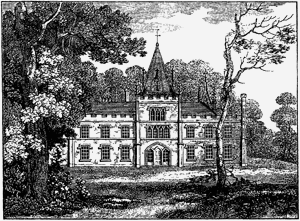
ASTEN, O hasten, for my Love's sake haste! The Spring already hath your Betchwortha grac'd. What need you longer stay to grace it more; Or add to that which had enough before. The Heavens admit no suns: why should your Seat Have two then, equal, good, and as complete? Hasten, O hasten then; for till I see Whom most I love, 'tis Winter still with me. I feel no Spring; nor shall I, till your light Repel my too, too long, and lonely Night. Till you have quicken'd with your happy shine A drooping, discontented heart of mine, No mirth, but what is forc'd, shall there be plac'd. Hasten, O hasten, then; for Love's sake haste. So longing Hero oftentimes was wont Upon the flowery banks of Hellespont a Betchworth Castle, near Dorking, in Surrey, then the seat of a branch of the noble family of BROWNE, whence the Poet was descended. Editor. |
/ p.98 /
|
To walk, expecting when her love should land, As I have done on silver Isis' strand. I ask the snowy swans, that swim along, Seeking some sad place for their sadder song, Whether they came from Mole; or heard her tell What worth doth near her wanton river dwell; And naming you, the gentle spotless birds, As if they understood the power of words, To bend their stately necks do straight agree; And honouring the name, so answer me. Those being gone, I ask the crystal brook, Since part of it unwillingly had took An ever-leave of that now happy place, Then pleasant Tempe, which the Gods did grace; The stream I ask'd, if when it lately left Those daisied banks, and griev'd to be bereft So sweet a channel, you did mean to stay Still on that vale, where they were forc'd away; Hereat the wave a little murmur makes; And then another wave that overtakes; |
|
And then a third comes on, and then another, Rolling themselves up closely each to other; (As little lads, to know their fellow's mind, While he is talking, closely steal behind;) I ask them all, and each like murmur keeps; I ask another, and that other weeps: What they should mean by this, I do not know, Except the mutterings and the tears they show, Be from the dear remembrance of that scite, Where, when they left you, they forsook delight. That this the cause was, I perceived plain; For going thence, I thither came again, What time it had been flood, a pretty while; And then the dimpled waters seem'd to smile; As if they did rejoice, and were full fain, That they were turning back to Mole again. In such like thoughts, I spend the tedious day; But when the night doth our half globe array In mournful black, I leave the curled stream; And, by the kindness of a happy dream, |
|
Enjoy what most I wish; yourself, and such, Whose worth, whose love, could I as highly touch, As I conceive, some hours should still be spent, To raise your more than earthly monument: In sleep I walk with you, and do obtain A seeming conference: but, alas! what pain Endures that man, which evermore is taking His joys in sleep, and is most wretched waking? To make me happy then, be you my sun; And with your presence clear all clouds begun; My mists of melancholy will out-wear, By your appearing in our hemisphere; Till which, within a vale, as full of woe, As I have ever sung, or eye can know, Or you can but imagine, reading this, Inthralled lies the heart of him that is, Careless of all others' love,
From an Inner Temple,without your respect, W. B. than the Inner Temple, May the third, 1615. |
|
OADEN with earth, as earth by such as I, In hopes of life, in Death's cold arms I lie; Laid up there, whence I came, as ships near spilt Are in the dock undone to be new built. Short was my course, and had it longer been, I had return'd but burthene'd more with sin. Tread on me he that list; but learn withal, As we make but one cross, so thou must fall, To be made one to some dear friend of thine, That shall survey thy grave, as thou dost mine. Tears ask I none, for those in death are vain, The true repentant showers which I did rain From my sad soul, in time to come will bring, To this dead root an everlasting spring. Till then, my soul with her creation keeps, To waken in fit time what herein sleeps. W. BROWNE.
1614 |
|
HOU need'st no tomb, my Wife, for thou hast one, To which all marble is but pumice stone. Thou art engrav'd so deeply in my heart, It shall out-last the strongest hand of art. Death shall not blot thee thence, although I must In all my other parts dissolve to dust; For thy dear name, thy happy memory, May so embalm it for eternity, That when I rise, the name of my dear Wife, Shall there be seen, as in the Book of Life. |
|
HOUGH we trust the earth with thee, We will not with thy memory; Mines of brass, or marble, shall Speak nought of thy funeral; They are verier dust than we, And do beg a history: In thy name there is a tomb, If the world can give it room; For a Vere, a Herbert's wife, Out-speaks a tomb, out-lives all life. |
 F there be a tear unshed,
On friend, or child, or parent, dead, Restore it here; for this sad stone, Is capable of such alone. |
|
Custom showers swell not our deeps, Such as those his marble weeps; Only they bewail his hearse, Who unskill'd in powerful verse, To bemoan him slight their eyes, And let them fall for elegies. All that sweetness, all that youth, All that virtue, all that truth Can, or speak, or wish, or praise, Was in him in his few days; His blood of Herbert, Sydney, Vere (Names great in either hemisphere,) Need not to lend him of their fame; He had enough to make a name; And to their glories he had come, Had heaven but given a later tomb. But the Fates his thread did spin, Of a sleave so fine and thin; Mending still a piece of wonder, It untimely broke in sunder; |
|
And we of their labours meet, Nothing but a winding sheet. What his mighty prince hath lost; What his father's hope and cost; What his sister, what his kin, Take too all the kingdom in: 'Tis a sea wherein to swim, Weary, faint, and die with him. O! let my private grief have room, Dear Lord, to wait upon thy tomb; And since my weak and saddest verse, Was worthy thought thy Grandam's hearse; Accept of this! just tears my sight, Have shut for thee: dear Lord, good night. |
 S some, too far inquisitive, would fain
Know how the Ark could so much life contain; Where the ewe fed, and where the lion lay, Both having den and pasture, yet all sea; When fishes had our constellations true, And how the hawk and partridge had one mew; So do I wonder, in these looser times, When men commit more villanies than rhymes, How honour'd Fishbourne, in his lesser ark, Could so much immortallity embark;a And take in man too. How his good thoughts lay, With wealth and hazard both of them at sea. How when his debtors thought of longer owing, His chiefest care was of that, sums bestowing In pious uses. But to question all; Did this rich man come to an hospital |
|
To curb the incomes, or to beg the leads? Or turn to straw more charitable beds? Or gaz'd he on a prison with pretence, More to inthral than for a prayer thence? Or on the Levite's part, the church's living, Did he ere look without the thought of giving? No: (as the Angel at Bethesda) he Came never in the cells of charity, Unless his mind by heaven had fraughted been, To help the next poor cripple that came in; And he came often to them; and, withal, Left there such virtue since his funeral, That as the ancient prophets' buried bones, Made one to know two resurrections; So after death it will be said of him, Fishbourne reviv'd this man, gave that a limb; Such miracles are done in this sad age, And yet we do not go in pilgrimage. When by the graves of men alive he trod, Prisons, where souls and bodies have abode, |
|
Before a judgment; and, as (there they lie,) Speak there own Epitaphs and Elogy: Had he a deaf ear then? threw he on more Irons or actions than they had before? Nay: wish'd he not he had sufficient worth To bid these men (dead to the world) come forth; Or since he had not, did not he anon Provide to keep them from corruption? Made them new shrouds (their clothes are sure no more, Such had the desert wanderers heretofore) Embalmed them? not with spice and gums, whereby We may less noisome, not more deadly lie; But with a charitable food; and then Hid him from thanks to do the like again. Methinks I see him in a sweet repair, Some walk (not yet infected with the air Of news or libel) weighing what may be, After all these, his next good legacy; Whether the church, that lies within his ken, With her revenues, feeds or beasts or men, |
|
Whether (though it equivocally keep A careful shepherd, and a flock of sheep) The patron have a soul? and doth intreat His friends more to a sermon than his meat? In fine, if church or steeple have a tongue, Bells by a sexton, or a weather rung? Or where depopulations were begun, An alms-house were for men by it undone? Those, Fishbourne, were thy thoughts; the pulse of these Thou felt'st, and hast prescrib'd for the disease. Some thou hast cur'd, and this thy Gilead Balm, Hath my præludium to thy Angel's psalm. And now the oracles of heaven, for whom He hath prepar'd a candle, stool, and room, That to St. Mary's, Paul's, or elsewhere come, To send us sighing, and not laughing home. Ye, that the hour may run away more free, Bribe not the clerk, but with your doctrine me; Keep ye on wing his ever honour'd fame, And though our learned Mother want his name, |
|
'T was modesty in him that his dear BROWNEb Might have place for his charity, and crown Their memories together. And though his The City got, the Universities Might have the other's name. You need not call A herald, to proclaim your funeral, Nor load your graves with marble, nor expend Upon a statue, more than on a friend; Or make stones tell a lie to after times, In prose inscriptions, or in hired rhymes. For whilst there shall a church, unruin'd, stand, And five blest souls, as yours, preserve the land; Whilst a good preacher in them hath a room, You live, and need nor Epitaph, nor Tomb.
|
|
AD not thy wrong, like to a wound ill cur'd, Broke forth in death, I had not been assur'd Of grief enough, to finish what I write; These lines, as those which do in cold blood fight, Had come but faintly on; for ever he That shrines a name within an Elegy. (Unless some nearer cause do him inspire,) Kindles his bright flame at the funeral fire; For passion, (after lessening her extent,) Is then more strong, and so more eloquent. |
|
S Goodness shortest liv'd? doth Nature bring Her choicest flowers but to adorn the Spring? Are all men but as tarriers? first begun, Made, and together put to be undone? |
|
Will all the rank of friends, in whom I trust, Like Sodom's trees, yield me no fruit but dust? Must all I love, as careless sparks that fly Out of a flint, but shew their worth and die? Will nature ever to things fleeting bow? Doth she but like the toiling hind at plough Sow to be - - - - ? a then I'll begin a lore Hard to be learn'd, love still, to wail no more; I ever will affect that good, which he Made the firm steps to his eternity. I will adore no other light than shines From my best thoughts, to read his life; the mines Of richest India shall not buy from me That book, one hour, wherein I study thee! A book, wherein men's lives so taxed been, That all men labour'd death to call it in. What now as licens'd is dispers'd about, Is no true copy, or the best left out.
|
|
No ornaments I'll love brought from the change, But what's in it, and in the court more strange, Virtue; which clad thee well, and I may have, Without the danger of a living grave. I will not wish fortune should make of me A worship'd golden calf (as most rich be); But let her (for all lands else) grant me this, To be an inmate in that house now his; One stone will serve, one Epitaph above, So one shall be our dust, as was our love. O, if privation be the greatest pain, Which wretched souls in endless night sustain, What mortal torments can be worse than his, That by enjoying, knows what losing is? Yet such is mine. Then, if with sacred fire A passion ever did a Muse inspire; Or if a grief-sick heart hath writ a line, Than Art or Nature could more genuine, More full of accents sad; let it appear In what I write, if any drop a tear, |
|
To this small payment of my latest debt, He witness is, that 't was not counterfeit. May this be never known to hearts of stone, That measure all mens sorrows by their own; And think no flood should ever drown an eye, That hath not issued from an injury Of some misfortune, tending more the loss Of goods, than goodness! Let this hapless cross Alone be read, and known by such as be Apt to receive that seal of misery, Which his untimely death prints on my heart. And if that fatal hand (which did the part That Fate should have perform'd) shall ever chance (Either of purpose or through ignorance) To touch this paper; may it rose-like wither! Or as the plant, Sentida, shrink together! Let him not read it; be the letters dim, Although the Ordinarie give it him! Or let the words transpose them and impart, A crying Anagram for his desert! |
|
Or may the ink (now dry) grow green again, As wounds (before the murderer of the slain) So these sad lines shall in the Judge's eye Be his accuser and mine Elegy. But vain are imprecations. And I fear Almost to shew him in a character, Lest some accursed hand the same should stain, Or by depraving murder him again. Sleep then, sweet soul; and if thy virtues be In any breast, by him we'll portrait thee. If thou had'st liv'd where heathen gods have reign'd, Thy virtues thee a Deity had gain'd. But now more blest. And though thy honour'd shrine Be unadorn'd by stone, or Indian mine; Yet whilst that any good to earth is lent, Thou canst not lie without a monument. |
|
ERE wither'd lies a flower, which blown, Was cropt as soon as it was known; The loss was great, and the offence, Since one unworthy took it hence. W. BROWNE.
|
 NDERNEATH this stone there lies
More of Beauty, than are eyes; Or to read that she is gone, Or alive to gaze upon.
She in so much fairness clad, |
|
ROSE, and coming down to dine, I Turner met, a learn'd divine; 'Twas the first time that I was blest With sight of him, and had possest His company not three hours space, But Oxford call'd him from that place. Our friendship was begun (for Arts, Or love of them, can marry hearts;) But see whereon we trust: eight days From thence, a friend of mine thus says, Turner is dead; amaz'd thought I, Could so much health so quickly die? And have I lost my hopes, to be Endear'd to so much industry? O man! behold thy strength, and know Like our first sight and parting, so Are all our lives, which I must say, Was but a dinner, and away. |
|
EE what we are! for though we often say, We are like guests that ride upon the way, Travel and lodge, and when the morn comes on, Call for a reckoning, pay, and so are gone; We err; and have less time to be possest, For see! the Host is gone before the guest. |
|
NDER an aged oak was Willy laid, Willy, the lad that whilom made the rocks To ring with joy, whilst on his pipe he play'd; And from their masters wooed the neighbouring flocks. a This forms the 4th Eclogue of The Shepherd's Pipe; and is to be found in Browne's printed poems. |
|
But now o'ercome with dolours deep, Which nigh his heart-strings rent, Ne car'd he for his silly sheep, Ne car'd for merriment. But chang'd his wonted walks for uncouth paths un- known, Where none but trees might hear his plaints, and echo out his moan.
Autumn it was, when droop'd the sweetest flowers, |
|
As was his seat, so was his gentle heart, Meek and dejected, but his thoughts as high As those aye wand'ring lights, which both impart Their beams on us, and heaven still beautify. Sad was his look! O heavy fate, That swain should be so sad, Whose merry notes the forlorn mate With greatest pleasure clad. Broke lay his tuneful pipe, that charm'd the crystal floods, And thus his grief took airy wings and flew about the woods.
Day ! thou art too officious in thy place, |
|
But ye have surely seen, whom we in sorrow miss, A swain whom Phœbe thought her love, and Titan deemed his.
But he is gone! then inwards turn your light:
Let not a shepherd on our hapless plains |
|
And if a fellow swain do live A niggard of his tears, The sheperdesses all will give, To store him, part of theirs. Or I would lend him some, but that the store I have, Will all be spent ere I have paid the debt I owe his grave.
O what is left can make me leave my moan: |
|
'Tis not a cypress bough nor count'nance sad; A mourning garment, wailing Elegy; A standing hearse in sable vesture clad; A tomb built to his name's eternity; (Though we poor shepherds all should strive By yearly obsequies, And vow to keep thy fame alive In spite of destinies,) That can suppress our griefs; all this and more may be; Yet all in vain to recompence our greatest loss of thee.
Cypress may fade, the countenance be chang'd; |
|
Yet shall our truest cause of sorrow firmly stay, When these effects the wings of Time shall fan and sweep away.
Look as a sweet rose, fairly budding forth,
Yet though so long he liv'd not as he might, |
|
Who ever doth the period see Of days by Heaven forth plotted, Dies full of age as well as he, That hath more years allotted. In sad tones then my verse shall with incessant tears Bemoan our hapless loss of him, and not his want of years.
In deepest passions of my grief-swoln breast, |
|
Then not for thee these briny tears are spent; But as the nightingale against the briar, 'Tis for myself I moan, and I lament; Not that thou left'st the world; but left'st me here: Here! where without thee all delights Fail of their pleasing power, And glorious days seem ugly nights, Methinks no April shower Embroider should the earth! no bird his ditty move; No pretty Spring smile on the vales; no shepherd on his love!
And ye, his sheep (in token of his lack) |
|
Ye nymphs of mighty woods, with flowers his grave betrim, And humbly pray the Earth he hath would gently cover him.
This said, he sigh'd; and with o'er-drowning eyes |
|
IKE to a silkworm of one year, Or like a wronged lover's tear, Or on the waves a rudder's dint, Or like the sparkles of a flint, Or like to little cakes perfum'd, Or fireworks made to be consum'd; Even such is man, and all that trust In weak and animated dust. The silkworm droops; the tear's soon shed; The ship's way lost; the sparkle dead; The cake is burnt; the firework done; And Man as these as quickly gone. |
 ÆLIA is gone, and now sit I
As Philomela, (on a thorn, Turn'd out of Nature's livery,) Mirthless, alone, and all forlorn; Only she sings not, while my sorrows can Afford such notes as fit a dying swan. So shuts the marigold her leaves At the departure of the sun; So from the honey-suckle sheaves The bee goes, when the day is done. So sits the turtle, when she is but one; So is all woe; as I, now she is gone. To some few birds, kind Nature hath Made all the summer as one day, Which once enjoy'd, cold winter's wrath, As night, they sleeping pass away: |
|
Those happy creatures are, that know not yet The pains to be depriv'd, or to forget. I oft have heard men say, there be Some, that with confidence profess The helpful art of memory; But could they teach forgetfulness, I'd learn, and try what further art could do, To make me love her, and forget her too. Sad melancholy that persuades Men from themselves, to think they be Headless, or other bodies shades, Hath long and bootless dwelt with me; For could I think She same idea were, I still might love forget, and have her here; But such she is not: nor would I, For twice as many torments more, As her bereaved company Hath brought to those I felt before; For then no future time might hap to know, That she deserv'd, or I did love her so. |
|
Ye hours then but as minutes be, (Though so I shall be sooner old,) Till I those lovely graces see, Which but in her can none behold! Then be an age that we may never try More grief in parting, but grow old and die. |
|
IVE me three kisses, Phillis; if not three, Give me as many as thy sweet lips be; You gave and took one, yet deny me twain, Then take back yours, or give me mine again. |
|
ERE lies kind Tom, thrust out of door, Nor high, nor low, nor rich, nor poor; He left the world with heavy cheer, And never knew what he made here. |
|
ITTING one day beside a silver brook, Whose sleepy waves unwillingly forsook The strict embraces of the flowery shore, |
|
As loathe to leave what they should see no more: I read (as Fate had turn'd it to my hand) Among the famous lays of fairy land, Belphæbe's fond mistrust, when as she met Her gentle squire with lovely Amorett; And lying by the brook, poor lad, quoth I, Must all thy joys, like Eve's posterity, Receive a doom not to be chang'd by suit, Only for tasting the forbidden fruit? Had fair Belphæbe licens'd thee some time To kiss her cherry lips, thou didst a crime; But since she for thy thirst no help would bring, Thou lawfully mightst seek another spring; And had those kisses stolen been melting sips, T'aen by consent from Amorett's sweet lips, |
|
Thou mightst have answer'd, if thy love had spied, How others gladly gave what she denied; But since they were not such, it did approve A jealously not meriting thy love, And an injustice offer'd by the maid, In giving judgment ere she heard thee plead. I have a love, (and then I thought of you, As Heaven can witness I each minute do,) So well assur'd of that once promis'd faith, Which my unmoved love still cherisheth, That should she see me private with a dame, Fair as her self, and of a house whose name, From Phæbus' rise, to Tagus where he sets, Hath been as famous as Plantagenet's, Whose eyes would thaw congealed hearts of ice, And as we now dispute of Paradise, And question where fair Eden stood of old, Among so many sweet plots we behold, Which by the arms of those brave rivers been, Embrac'd which of yore did keep it in: |
|
So were she one, who did so much abound In graces, more than ever mortal crown'd, That it might for a question pass, Where or wherein her most of beauty was. I surely could believe, nay, I durst swear, That your sweet goodness would not stoop to fear, Though she might be to any that should win it, A paradise without a serpent in it. Such were my thoughts of you, and thinking so, Much like a man, who running in the snow From the surprisal of a murderous elf, Beats out a path, and so betrays himself. I in security was further gone, And made a path for your suspicion To find me out. Time being nigh the same, When thus I thought, and when your letters came. But, oh! how far I err'd, how much deceiv'd Was my belief; yourself, that have bereav'd Me of that confidence, my love had got. Judge if I were an infidel or not; |
|
And let me tell you, Fair, the fault was thine, If I did misbelieve; and none of mine. That man which sees, as he along doth pass Some beaten way, a piece of sparkling glass, And deems far off that it a diamond is, Adds to the glass by such a thought of his; But when he finds it wants, to quit his pain, The value soon returns to him again. If, in the ruder north, some country clown, That stands to see the king ride through the town, Spying some gay and gold belaced thing, Should cry, See, neighbours, yonder comes the king! And much mistaken, both in state and age, Points at some lord, and for a lord, a page; Is not that lord or page beholding much To him that thinks them worthy to be such He took them for? And are not you to me Indebted much, since my credulity Made you the same I thought you? and from thence Raised an assurance of your confidence. |
|
These were the thoughts of you I still was in, Nor shall your letters so much of me win; I will not trust mine eyes so much, to think Your white hand wrote with such a staining ink; Or if I ever take it for your hand, I sure shall think I do not understand In reading as you meant! and fall from thence To doubt if points perverted not the sense! For such a constant faith I have in thee, That I could die e'en in that heresy! In this belief of you I stand as yet, And think as those that follow Mahomet, He merits much that doth continue still In his first faith, although that faith be ill. A vain inconstant Dame, that counts her loves By this enamelled ring, that pair of gloves, And with her chambermaid when closely set, Turning her letters in her cabinet, Makes known what tokens have been sent unto her, What man did bluntly, who did courtly woo her; |
|
Who hath the best face, neatest leg, most lands, Who for his carriage in her favour stands. Opening a paper then she shews her wit, In an epistle that some fool had writ; Then meeting with another which she likes, Her chambermaid's great reading quickly strikes That good opinion dead, and swears that this Was stol'n from Palmerin or Amadis. Next come her Sonnets, which they spelling, read, And say the man was very much afraid To have his meaning known, since they from thence (Save Cupid's darts) can pick no jot of sense; And in conclusion, with discretion small, Scoff this, scorn that, and so abuse them all. If I had thought you such an empty prize, I had not sought now to apologize, Nor had these lines the virgin paper stain'd, But, as my Love, unspotted had remain'd; And sure I think to what I am about, My ink than it was wont goes slower out, |
|
As if it told me I but vainly writ To her that should, but will not credit it. Yet go, ye hopeless lines, and tell that fair, Whose flaxen tresses, with the wanton air, Entrap the darling boy, that daily flies To see his sweet face in her sweeter eyes; Tell my Fidelia, if she do aver That I with borrowed phrases courted her, Or sung to her the lays of other men: And, like the cag'd thrush of a citizen, Tir'd with a note continually sung o'er The ears of one that knew that all before. If this she think, (as I shall ne'er be won Once to imagine she hath truly done,) Let her then know, though now a many be Parrots, which speak the tongue of Arcady, Yet in themselves not so much language know, Nor wit sufficient for a Lord Mayor's Show. I never yet but scorn'd a taste to bring Out of the channel when I saw the spring, |
|
Or like a silent organ, been so weak, That others' fingers taught me how to speak. The sacred Nine, whose powerful songs have made In wayless deserts trees of mighty shade, To bend in admiration, and allay The wrath of tigers, with the notes they play, Were kind in some small measure at my birth, And by the hand of nature to my earth Lent their eternal heat, by whose bright flame Succeeding time shall read and know your name, And pine in envy of your praises writ, Though now your brightness strive to lessen it. Thus have I done, and like an artist, spent My days to build another's monument; Yet you those pains so careless overslip, That I am not allow'd the workmanship. Some have done less, and have been more rewarded; None hath loved more, and hath been less regarded: Yet the poor silken worm and only I, Like parallels run on to work and die! |
|
Why write I then again, since she will think My heart is limned with another's ink? Or if she deem these lines had birth from me, Perhaps will think they but deceivers be: And as our flattering painters do impart A fair-made copy of a faithless heart; O, my Fidelia, if thou canst be won From that mistrust my absence hath begun, Be now converted, kill those jealous fears, Credit my lines, if not, believe my tears, Which will each word, nay, every letter strove, That in their number you might read my love; And where (for one distracted needs must miss) My language not enough persuasive is, Be that supplied with what each eye affords, For tears have often had the power of words. Grant this, fair Saint, since their distilling rain Permits me not to read it o'er again; For as a swan, more white than Alpine snow, Wandering upon the sands of silver Po, |
|
Hath his impression by a fuller sea, Not made so soon as quickly wash'd away. Such in my writing now the state hath been, For scarce my pen goes of the ink yet green, But floods of tears fall on it in such store, That I perceive not what I writ before. Can any man do thus, yet that man be Without the fire of love and loyalty? Know then in breach of Nature's constant laws, There may be an effect, and yet no cause. Without the Sun we may have April showers, And wanting moisture know no want of flowers; Causeless the elements could tease to war: The seaman's needle to the northern star, Without the loadstone, would for ever move, If all these tears can be and yet no love. If you still deem I only am the man, Which in the maze of love yet never ran; Or if in love I surely did pursue The favour of some other, not of you; |
|
Or loving you, would not be strictly tied To you alone, but sought a Saint beside: Know then by all the virtues we enthrone, That I have loved, loved, you, and you alone. Read o'er my lines where truthful passion moved, And hate itself will say that I have loved. Think on my vows which have been ever true, And know by them that I affected you. Recount my trials, and they will impart That none is partner with you in my heart. Lines, vows, and trials will conclude in one, That I have loved, loved, you, and you alone. Lines, seek no more then to that doubtful Fair, And ye, my vows, for evermore forbear: Trials, to her prove never true again; Since lines, vows, trials, strive all but in vain. Yet when I writ, the ready tongue of truth Did ever dictate not deceiving youth. When I have sworn my tongue did never err To be my heart's most true interpreter, |
|
And proof confirm'd when you examin'd both, Love caused those lines, and Constancy that oath; And shall I write, protest, (you prove) and then Be left the most unfortunate of men? Must Truth be still neglected? Faith forgot? And Constancy esteem'd as what is not? Shall dear Regard and Love for ever be Wrong'd with the name of Lust and Flattery? It must; for this your last suspicion tells, That you intend to work no miracles. |
|
S Death so great a gamester, that he throws Still at the fairest, and must I still lose? Are we all but as tarryers first begun, Made and together put to be undone? Will all the rank of friends, in whom I trust, Like Sodom's trees yield me no fruit but dust? |
|
Must all I love, as careless sparks that fly Out of a flint, but shew their worth and die? O, where do my for ever losses tend! I could already by some buried friend Count my unhappy years; and should the sun Leave me in darkness, as her loss hath done, (By those few friends I have yet to entomb,) I might, I fear, account my years to come. What need our Canons then be so precise In registers for our nativities? They keep us but in bonds, and strike with fears Rich parents, till their children be of years; For should they lose and mourn, they might, as I, Number their years by every elegy. These books, to sum our days, might well have stood In use with those that lived before the flood, When she indeed that forceth me to write, Should have been born, had Nature done her right; And at five hundred years been less decayed, Than now at fifteen is the fairest maid. |
|
But Nature had not her perfection then, Or being loath for such long-living men, To spend the treasure which she held most pure, She gave them women apter to endure; Or providently knowing there were more Countries and islands which she was to store, Nature was thrifty, and did think it well, If for some one part each one did expel: As this for her neat hand, that for her hair, A third for her sweet eyes, a fourth was fair: And 'tis approved by him, who could not draw The Queen of Love, till he a hundred saw. Seldom all beauties met in one, till She (All other lands else stor'd) came finally To people our sweet isle: and seeing now Her substance infinite, she 'gan to bow To lavishness in every nuptial bed, And she her fairest was that now is dead; Dead as a blossom forced from the tree, And if a maiden fair and good as she |
|
Tread on thy grave, O let her there profess Herself for evermore an anchoress. Let her be deathless! let her still be young: Without this means we have no verse nor tongue. To say how much I loved, or let us see How good our loss was in the loss of thee; Or let the purple violet grow there, And feel no revolution of the year; But full of dew with ever drooping head, Shew how I live since my lest hopes are dead. Dead! as the world to virtue! Murd'rous thieves Can have their pardons, or at least reprieves. The sword of justice hath been often won By letters from an execution; Yet vows nor prayers could not keep thee here, Nor shall I see, the next returning year, Thee with the roses spring, and live again. Th'art lost for ever! as a drop of rain Fall'n in a river! for as soon I may Take up that drop, or meet the same at sea, |
|
And know it there, as ere redeem thee gone, Or know thee in the grave when I have one. O! had that hollow vault, where thou dost lie, An echo in it, my strong phantasy Would draw me soon to think her words were thine, And I would hourly come, and to thy shrine Talk as I often used to talk with thee, And frame my words that thou mightst answer me As when thou liv'dst: I'd sigh, and say I love, And thou shouldst do so till we had moved (With our complaints) to tears each marble cell Of those dead neighbours which about thee dwell. And when the holy father came to say His orisons, I'd ask him if the day Of miracles were past, or whether he Knew any one whose faith, and piety, Could raise the dead; but he would answer, none Can bring thee back to life; though many one Our cursed days afford, that dare to thrust Their hands profane to raise the sacred dust |
|
Of holy saints out of their beds of rest. Abhorred days! O may there none molest Thy quiet peace! but in thy ark remain Untouch'd, as those the old one did contain, Till he that can reward thy greatest worth, Shall send the peaceful Dove to call thee forth. |
|
HO (but some one like thee) could ever say, He master'd Death, from robbing him a day? Or was Death ever yet so kind to any? One night she took from thee, from others many, And yet, to recompence it in thy tomb, Gives thee a longer, till the day of doom. |
|
NHAPPY Muse! that nothing pleasest me, But tirest thyself to reap another's bliss, She that as much forbears thy melody, As fearful maidens do the serpent's hiss, Doth she not fly away when I would sing? Or doth she stay, when I with many a tear Keep solemn time to my woe's uttering; And ask what wild birds grant to lend an ear? O, hapless Tongue, in silence ever live; And ye, my founts of tears, forbear supply: Since neither words, nor tears, nor muse, can give Ought worth the pitying such a wretch as I. Grieve to yourselves, if needs you will deplore, Till tears and words are spent for evermore. |
|
Unhappy I, in whom no joy appears, And but for sorrow of all else forlorn; Mishaps increasing faster than my years, As I to grieve and die were only born! Dark sullen night is my too tedious day; In it I labour when all others rest, And wear in discontent those hours away, Which make some less deserving greater blest. The rose-cheek'd morn I hate, because it brings A sad remembrance of my fairer Fair, From whose dear grave arise continual springs, Whose misty vapours cloud the lightsome air. And only now I to my love prefer Those clouds which shed their rain, and weep for her. |
|
ERE lies a man, much wrong'd in his hopes, Who got his wealth backwards by making of ropes; It was his hard chance, in his fortunes to falter, For he liv'd by the rope, and died by the halter. |
|
EATH! thou such a one hast smit, Any stone can cover it; 'Twas an envy more than sin, If he had not been a twin, To have kill'd him, when his hearse Hardly could contain a verse. |
|
Two fair sisters, fair and young; Minded as a prophet's tongue, Thou hadst kill'd, and since with thee Goodness had no amity: Nor could tears of parents save, So much sweetness from the grave; Sickness seem'd so small to fit him, That thou shouldst not see to hit him; And thou canst not truly say, If he be dead or flown away. |
|
The End of W. Browne's Poems. |

|