|
May 1st, 1850.
[Signed in handwriting:] Thomas Richards The present copy is No. 4 of those printed on thick paper. |
[ p.iii ]

New Boke
About Shakespeare
AND
Stratford=on=Avon
BY
J. O. Halliwell, F.R.S.

LONDON:
F O R P R I V A T E C I R C U L A T I O N.
M.DCCC.L.
[ p.v ]
|
Avenue Lodge, Brixton Hill, near London. |
[ p.vii ]
| PAGE | |
| 1. FRAGMENT OF THE EARLY ENGLISH POEM OF APPOLLONIUS OF TYRE (ILLUSTRATING PERICLES) FROM AN EARLY MANUSCRIPT . . . . | 1 |
| 2. DOCUMENTS RESPECTING THE ARDENS OF WILMECOTE, SHAKESPEARE'S MATERNAL ANCESTORS | 14 |
| 3. THE BALLAD OF THE NORTHERN LORD, ILLUSTRATING THE MERCHANT OF VENICE AND CYMBELINE . . . . . | 18 |
| 4. LIST OF THE ATTENDANCES OF SHAKESPEARE'S FATHER AT THE MEETINGS OF THE STRATFORD CORPORATION | 28 |
| 5. THE ROYAL COURTLY GARLAND, ILLUSTRATING THE WINTER'S TALE . . . . | 31 |
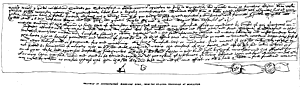
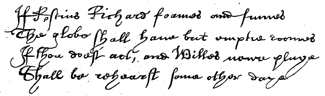
| 6. THE DOCUMENTS AT DULWICH COLLEGE WHICH NOTICE SHAKESPEARE, WITH FAC-SIMILES . . | 45 |
| 7. AN INEDITED DOCUMENT MENTIONING SHAKESPEARE AS THE PURCHASER OF A BOOK | 48 |
| 8. DOCUMENTS RELATING TO SHAKESPEARE'S AUNTS . | 51 |
/ p.viii /
| 9. WASHINGTON IRVING'S PAPER ON STRATFORD-ON-AVON, WITH NOTES AND ILLUSTRATIONS | 54 |
| 10. EXTRACT FROM AN EARLY MANUSCRIPT OF THE MERRY WIVES OF WINDSOR | 82 |
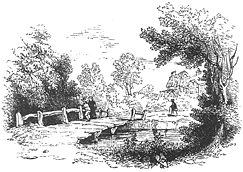
| 11. OLD WOODEN BRIDGE NEAR ANNE HATHAWAY'S COTTAGE, WITH A WOODCUT | 88 |
| 12. SHAKESPEARIAN RELICS, WITH WOODCUTS | 91 |
| 13. SHAKESPEARE'S WILL | 95 |
. . .
zaf gret huyre;
. . .
. . . .
. . . .
. . . .
Sche was fairest of alle,
The kyng . .
And on hys knees byfore hire falle;
. . . .
He offryde and alle that wit him were,
And afterw . .
. . drery chere;
Of Tire I Ar . .
. . myself there king,
Appolyn the . .
. . wit myn ofryng;
As sone as . .
. . upon my letterure,
The . ing . hedde
. . was ful suyre;
I scholde him . .
. . thulke cure,
Therfore he did
. .
. . he To Tarse y-fledde that deth to .
zt,
For hunger the cité was al nou
An hundred milianys they hadde of me
Bushcelles of whete, as y am by-thouzt.
Tho made they an ymage of bras,
A scheef of whete he helde an honde,
That to my licknes maad was;
Uppon a buschel they dyde hym stonde,
And wryte about the storye,
To Appolyn this hys y-do,
To have hym ever in memorye,
For he delyverede us fro woo.
Tho wente y unto Cirenen;
The kings douzter he me zaf,
I ledde here fro here kyn;
Azeyn ne brouzte hire nouzt saf,
Ffor sche deyzde amydde the see,
And ther sche bare this maide child,
That here stant byfore the;
Goude goddesse, be to hire myld !
Tho tok y the douzter in Tarse to kepe,
To Strangulion and dame Denyse,
Y couthe no . reed but ever wepe,
Sorwe me tok in ech wyse;I held me in the see ten and four
zeer
Wit sorwe, care, and wo;
I cam aze and fond hire nouzt ther,
Tho nyst y what was best to do.
But, grete goddesse, y thanke the
That evere sche deth so asterte,
That ever y myzhte that day y-seo,
To have this confort at my herte!
The whiles he expounede thus his lyf
Wit sorwe and stedfast thouzt,
He tolde hit to hys owene wyf;
Sche knew him wel, and he hire nouzt.
Heo cauzt him in hire armes two,
For joye sche ne myzte spek a word ;
The kyng was wroth, and pute hire fro,
Heo cryede loude, ze beth my lord!
I am zoure wyf, zoure leof y-core,
Archistrate ze lovede so!
The kynges douzter y was bore,
Archistrates he ne hadde na mo.
Heo clipte hym, and efter gan to kysse,
And tolde that was byfalle;
Sche clipte and keuste withouten lysse,
And saide thus byfore hem alle,—"
ze seeth Appolyn, the kyng,
My maister that tauzte me al my goud,
. . . .
. . . .
. . me out of my grace
Archistra . .
. . wham the other forsok,
And to my lord zou ches;
My lord that leide me on cheste,
Or y were cast into the see,
My lord that ofte me keuste,
And never wende me more y-see,
My lord that y have founde,
Y thanke God in Trinyté!"
Ure douzter on thys grounde,
ze, dame, par fay, this hys sche!
. . te he hire, me scholde nouzt knowe,
Ho was gladdest of the threo ;
. . they wepte alle arowe,
That ech of other hadde pité
. . Ephese hit was couth,
The goddesse had hire lord knowe,
. . an may no man telle wit mouth
The grete mirthe that was mad, y trowe;. . an song and made gleo
In gret confort of here goddesse,
. . thes y-strezyt over al that cité
An keverede for gret gladnesse:
They made a feste of gret plenté
And fedde the citesaynes alle at ones,
They made of him gret denté,
The feste was gret for the nones.
They made hym prest of the lawe,
Here norry that sche loved mest,
. . the maner by har dawe,
Wymmen dide that offys of prest.
. . the joye of that londe,
Sche dizte hire wit here lord to fare,
. . e cité brouzte hem at stronde,
For deel of blisse wexeth al bare.
. . nte hy to Antioche,
zutt was him kept that kyndom,
. . zt fro thennes hys passage
To his lond Tire he nom;
. . Made Anategora kyng,
Hys douzter quene that was his heir,
. . ne hit was at her likynge,
To schip hy wente alle y-fereTo Tarse they wente wit gret navye,
Wederynge fel at wille,
And alle the citesaynes gonne crye,
Welcome, lord, us tille:
. . yzte anon Strangulion take,
And hys wyf, Denyse, also,
. . ed hem alle for here sake
Wit hym to hare mothalle goo.
. . bet zif he hath trespased ouzt,
Other eny offense ageyn hem do,
. . yde alle nay lord ryzt nouzt,
ze beth oure lord for ever mo.
. . ge have to lorde y-core,
For evere love zou we mote,
. . hadde ze be we hadde before,
Of alle bales ze were bote;
An image of brass witnesse hys
That we schulle zow nevere disceyve,
. . ollet deye for zou y-wys
Rather than eny man schal zou greve;
. . Angulion, my douzter y tok,
And Denyse that hys hys wyf.
. . . .
. . . .. . . .
. . . .
That the citesaynes wit gret deol
Hadde write hit to-fore zowre eyze:
Appolyn gan to calle,
Tarse, douzter, wherevere you beo,
Schewe the forth byfore us alle,
Fro deth to lyf arys aze !
Sche pytte hire forthe in riche atir,
As fel to a quene,
To fulfille her fader desir;
"Denyse," sche seyth, "hail ze!"
I grete the out of my grave
Fro deth to lyve arered!
Wher hys Tiophele? him moste y have."
He stoud sire aferyd.
"Madame, y am her at zoure wille!"
He stod as he schulde sterve:
"Sche tok me the to spille,
Deonyse wham y serve."
The citesaynes Strangulion toke,
And hys wyf for hire trecherye,
Out of the cité drowe wit hoke
Into a place ther-inne to dye:They stened him wit stone,
And so hy wolde Teophele also;
Tarse bygan him defende sone,
To dethe he ne was nouzt do.
And saide, ze zaf me grace
To pray God Almyzt,
I schal him zeve lyves space,
Ellys ze ne hadde me never seye in sizt;
Appolyn dwellede ther fourty dayes,
And gaf grete giftes to alle men;
He made festes and noble lawes,
And thennes sailede to Cirenen:
zut was hys ffader-in-lawe alyve,
Archistrates the goud kyng,
ffolk come azeynes him so blyve,
As eny myzte by other thryng;
They songe, daunsede, and were blythe,
That evere hy myzte that day y-seo,
And thankede God a thousand sythe;
The kyng was gladdest, suyr be ze:
Tho he saw hem alle byfore,
His douzter and hys sone in lawe,
And hys douzter so fair y-core,
A kinges wyf, he was wel fawe:And her child ther also,
Al clene of kings blod;
He kuste them, he was glad tho;
But the olde king so goud,
He made hem dwelle al that zer,
And deyde in hys douzter arm,—
Wit gret gladnesse he deyde ther,
If God nolde hit was harm.
Tho nolde Appolyn nevere fyne
Ar he hadde the ffischere souzt,
That zaf him half hys sclaveyne,
Tho he was firste to londe y-brouzt;
Knyztes him fette of gret honour,
He was aferde to be slawe,
He zaf him londes and gret tresour,
And made him erl by al hys sawe:
Olde man, ne dred the nouzt,
For I am Appolyn of Tire,
That ones help of the bysouzt,
Tho I lay byfore the in the myre;
Thou gave me half thy sclaveyne,
And bed me y schulde thenke on the;
. . . .
. . . .. . . .
Brouzte hym dyeinge.
Antiochus his deth hadde swore,
He was marchaunt of many thynges;
. . the kyng to grete,
He tok him up and gan him to kusse;
. de he wolde him nevere lete,
He scholde be on of hem to wysse;
. im bothe lovde and lede,
And made him erl a lite ther byside;
. ful of wilde brede,
Casteles and tourys that were wyde,
He made him chef of hys consail,
For he fonde him ferst so..t fewe:
. as evere wit-oute fail,
He ne leet for no newe;
. the kyng goud lyf and clene
Wit hys wyf in gret solas,
. . . and fourtene
He lyvede after thys do was;
. . . twey sones by junge age,
That wax wel farynge men;
. . . the kyndom of Antioche,
Of Tire and of Cirenen,Were nevere verre on hys lond,
Ne hunger ne no mesayse,
. . hit zede wel an hond,
He lyvede wel at ayse:
. . . tweye bokys of hys lyf
That onto his owene bible he sette,
. . at byddynge of hys wyf
He lefte at Ephese so he hire fette;
. . . hys lond in goud manere
Tho he drow to age,
. . ora he made king of Tire,
That was his owene heritage;
The eldest sone of that empire
He made king of Antiage,
. . . that he lovede dure,
Of Cirenen that was . .
When he hadde al thys y-dyzt
Cam deth and axede hys fee,
. . hys soule to God Almyzt,
So wel God that hit bee;
. . de ech housbonde grace
For to lovye so hys wyf,
. . y-fed hem witoute trespace,
As sche dyde hym al here lyf;. . ne on alle lyves space
Heere to amende oure mysdede,
. . of hevene to have a place,
Amen ze synge here, y rede.
. . ony thys was translatyd
Almost at Engelondes ende,
. . . to the makers stat,
Tak sich an . . kynde;
. . have y-take hys bedys on hond,
And sayd hys Pater Noster and Crede,
. . was vicary, y understonde,
At Wymborne mynstre in that stede;
. . y thouzte zou have wryte,
Hit is nouzt worth to be knowe,
. . that wole the sothe y-wyte,
Go thider and me wol ye schewe:
. . Fader, and Sone, and Holy Gost,
To wham y clepide at my begynnynge,
. . de he hys of myztes most,
Brynge us alle to a goud endynge:
Graunte us voide the payne of helle,
O God, Lorde, and persones threo,
And in the blysse of hevene dwelle!
Amen, pour charité!
Explicit Apollonius Tyrus rex nobilis et vertuosus, &c.
The Northern Lord, or the Knight in Green. Shewing how a noble lord sold his daughter to a knight for her weight in gold; how he borrowed the money of a wealthy Jew, and that if he missed to pay at the appointed time, the Jew was to have so many ounces of the knight's flesh; how they fled to the German Court to escape from the Jew; and how the Dutch lord wagered a ton of gold, that he could enjoy the knight's lady.
A NORTHERN lord of high renoun,
PART I.
Two daughters had: the eldest brown,
The youngest beautiful and fair.
By chance a noble knight came there.
Her father said, kind sir, I have
Two daughters here; which do you crave?
One that is beautiful, he cry'd.
The noble lord he then reply'd:
She's young, she's beautiful and gay,
And is not to be given away
But as jewels are bought and sold,/ p.21 /
She must bring me her weight in gold.
The price I think you need not grudge,
Since I will freely give as much
With her own sister, if I can
Find out some loving nobleman.
With that bespoke the noble knight:
I'd sooner have the beauty bright
At that vast rate, renouned lord,
Than the other with a vast reward.
So then the bargain it was made,
But e'er the money it could be paid,
He borrowed of a wealthy Jew
The sum so large, and writings drew—
That if he fail'd or miss'd the day,
So many ounces he should pay
Of his own flesh instead of gold;
All was agreed, the sum was told.
So he return'd immediately
Unto the lord, where he did buy
His daughter fine, I do declare,
And paid him down the money there.
He bought her too, it was well known
Unto mankind, she was his own;
By her a son he did enjoy,
A sweet and comely handsome boy.
At length the time of day drew near,
When the knight began to fear:
He dreaded much the cruel Jew,
Because the money it was due:
His lady asked him why he griev'd:
He said, My jewel, I received
Such a sum of money of a Jew,
And now the money it is due:
And now the day of payment's come,
I'm sure I cannot raise the sum;
He'll my flesh weigh by weight,
Which makes my grief and sorrow great.
Pshaw! never fear him, she reply'd,
We'll cross the raging ocean wide,
And secure you from that fate;
To her request he yielded straight.
/ p.22 /Then having pass'd the raging seas,
PART II.
They travell'd on, till by degrees
Unto the German court they came,
The knight, his son, and comely dame.
Unto the emperor he told/ p.23 /
His story of the sum of gold
That he borrowed of a Jew,
And that for fear of death he flew.
The emperor he did erect
A court for them, and show'd respect
Unto his guests, because they came
From Britain, the blest land of fame.
As here he lived in delight,
A Dutch lord told our English knight,
That he a ton of gold would lay
That he could enjoy his lady gay.
From her the Dutch lord was to bring
A rich and coastly diamond ring,
That was to prove and testify,
How he did with his lady lie.
He tried, but never could obtain
Her favour, but with high disdain
She did abhor his base intent.
So to her chamber-maid he went,
And told her if she would but steal
Her lady's ring, and so conceal
The same, and bring it to him straight,
She should enjoy a fine estate.
In hopes of such a fine reward,/ p.24 /
The ring she stole; then the Dutch lord
Did take it to the noble knight,
Who almost swooned at the sight.
Home he goes to the lady straight,
And meeting her at the palace gate,
He flung her head-long into the moat;
A miller found her where she did float.
Soon after that in clothes of green,
She like a war-like knight was seen;
And in most gallant gay deport,
She rode unto the emperor's court.
Now when the emperor beheld
Her brave deportment, he was fill'd
With admiration at the sight,
Who call'd herself an English knight.
The emperor he did reply,
We have an English knight to die
For drowning of his lady gay;
Quoth she, I'd see him if I may.
'Twas granted, so to him she came,
And calling him by his name,
She said, kind sir, be of good cheer,
Your friend I'll be, you need not fear.
/ p.25 /She to the emperor did ride,
PART III.
And said, "now let this cause be try'd
Once more, for I've a mind to save
This noble gallant from the grave."
It being done, the court was set,
The Dutch lord came, seeming to fret
About the ring, for he did fear
How truth would make his shame appear.
And so it did, for soon they call
The maid, who on her knees did fall;
Before the court she did confess
The Dutch lord's unworthiness.
The court replied, "and is it so?
The lady too, for ought we know,
May be alive; therefore we'll stay
The sentence till another day."
Now the Dutch lord gave him a ton
Of gold, which he had fairly won;
And so he did with shame and grief,
And thus the knight obtain'd relief.
The Dutch lord to revenge the spite
Upon our noble English knight,
Did send a letter out of hand,
And so the Jew did understand/ p.26 /
That he was in the German court;
And then upon this good report
The Jew he cross'd the ocean wide,
Resolving to be satisfy'd.
As soon as e'er he fixt his eyes
Upon the knight, in wrath he cries,
Your hand and seal I pray behold,
Your flesh I'll have instead of gold.
Then said the noble knight in green,
Sir, may not your articles be seen?
Yes, they may, reply'd the Jew,
And I'm resolv'd to have my due.
Lo, then the knight began to read;
At length he said, I find indeed
Nothing but flesh you are to have:
Answers the Jew, that's all I crave.
The poor distressed knight was brought—
The bloody-minded Jew he thought
That day to be reveng'd on him,
And part the flesh from every limb.
The knight in green said, Mr. Jew,
There's nothing else but flesh your due;
And see no drop of blood you shed,
For if you do, off goes your head.
Pray take your due, with all my heart,/ p.27 /
But with his blood we will not part;
With that the Jew he sneaked away,
And had not one more word to say.
No sooner were these troubles past,
PART IV.
But his wife's father came at last,
Resolving for to have his life,
For drowning his beloved wife.
Over the sea her father brought
Many fine horses: one was bought
By the pretended knight in green,
Which was the best that e'er was seen.
So to the German court he came,
Declaring such-a-one by name
Had drowned his fair daughter dear,
And ought to die a death severe.
They brought him from the prison then,
Guarded by many armed men,
Unto the place where he must die;
And the young knight was standing by.
And from her side her sword she drew,
And run her gelding thro' and thro'.
Her father said, Why do you so?
I may, it is my own, you know ;
You sold the gelding; 'tis well known
I bought it, making it my own,
And may do what I please with it.
And then to her he did submit.
Here is a man arraign'd and cast,
And brought to suffer death at last,
Because your daughter dear he slew,
Which, if he did, what's that to you?
You had the money when you sold
Your daughter for her weight in gold;
Therefore he might, it is well known,
Do what he pleased with his own.
So having chang'd her garments green,
And drest herself like a fair queen,
Her father and her husband strait
Both knew her, and their joys were great.
Soon they did carry this report
Unto the famous Grecian court,
How the renowned English knight
Had found his charming lady bright.
So the emperor, and lords the same,
With cheerful hearts they did proclaim
An universal joy to see
His lady's life at liberty.
| 1564. | 6 Sept. | J. S. Burg. Pres. | 5 Sept. | 13 Eliz. | Pres. | |
| 1565. | 16 Jan. | 7 Eliz. J. S. Burg. Pres. | 24 Oct. | 13 Eliz. | Pres. | |
| 15 Feb. | 7 Eliz. Pres. | 18 Jan. | 14 Eliz. | Pres. | ||
| 22 Mar. | 7 Eliz. Pres. | 7 Feb. | 14 Eliz. | Pres. | ||
| 2 May, | 7 Eliz. Pres. | 2 April | 14 Eliz. | Pres. | ||
| 4 July, | 7 Eliz. Pres. | 9 April | 14 Eliz. | Pres. | ||
| 9 May, | 7 Eliz. Pres. | 18 April | 14 Eliz. | Pres. | ||
| 12 Sept. | 7 Eliz. J. S. Ald. | 28 May | 14 Eliz. | Pres. | ||
| Pres. | 3 Sept. | 14 Eliz. | Pres. | |||
| 26 Oct. | 7 Eliz. Abs. | 9 Jan. | 15 Eliz. | J. S. | ||
| 1566. | 15 Feb. | 8 Eliz. Abs. | Ald. | Pres. | ||
| 1567 | 8 Jan. | 9 Eliz. Pres. | 9 Sept. | 15 Eliz. | Pres. | |
| 16 July, | 9 Eliz. Pres. | 17 Feb. | 16 Eliz. | Pres. | ||
| 3 Sept. | 9 Eliz. Pres. | 1 Sept. | 16 Eliz. | Pres. | ||
| 20 April | 12 Eliz. Pres. | 29 Dec. | 17 Eliz. | Pres. | ||
| 23 Aug. | 12 Eliz. Pres. | 7 Sept. | 17 Eliz. | Pres. | ||
| 6 Sept. | 12 Eliz. Pres. | 7 Oct. | 17 Eliz. | Pres. | ||
| 24 Jan. | 13 Eliz. Pres. | 23 Nov. | 18 Eliz. | Pres. | ||
| 7 Feb. | 13 Eliz. Pres. | 5 Sept.. | 18 Eliz. | Pres. | ||
| 2 May | 13 Eliz. Pres. | 5 Oct. | 18 Eliz. | Pres. | ||
| 11 July | 13 Eliz. Pres. | 5 Dec. | 19 Eliz. | Pres. |
| 23Jan. 19 Eliz. among the aldermen, "ab. Johannes Shax- peare." | 19 Oct. 14 Dec. 22 Dec. | 22 Eliz. 23 Eliz. 23 Eliz. | Abs. Abs. Abs. | |||
| 8 May. 19 Eliz. J. S. again absent, his name not being marked as present. | 26 Jan. 22 Feb. 27 May | 23 Eliz. 23 Eliz. 23 Eliz. | Abs. Abs. Abs. | |||
| 24 July | 19 Eliz. J. S. abs. | 6 Sept. | 23 Eliz. | Abs. | ||
| 4 Oct. | 19 Eliz. J. S. Ald. Pres. | 20 Sept. 6 Oct. | 23 Eliz. 23 Eliz. | Abs. Abs. | ||
| 6 Nov. | 19 Eliz. Pres. | 2 May | 24 Eliz. | Abs. | ||
| 4 Dec. | 20 Eliz. Pres. | 31 Jan. | 24 Eliz. | Abs. | ||
| 15 Jan. 29 Jan. | 20 Eliz. Abs. 20 Eliz. Abs. | Hall held 5 Sept. 24 Eliz. Nomina Aldermannorum. | ||||
| 5 June | 20 Eliz. Abs. | |||||
| 18 June | 20 Eliz. Abs. | |||||
| 3 Sept. 24 Sept. | 20 Eliz. Abs. 20 Eliz. Abs. | 10 Sept. 24 Eliz. J. S. Ald. Abs. | ||||
| 3 Oct. | 20 Eliz. Abs. | 19 Sept. | 24 Eliz. | Abs. | ||
| 19 Nov. | 21 Eliz. Pres. | 5 Oct. | 24 Eliz. | Abs. | ||
| 1578. | 24 Nov. | Abs. | 2 Nov. | 24 Eliz. | (Uncertain) | |
| 23 April | 21 Eliz. Abs. | 7 Nov. | 24 Eliz. | Abs. | ||
| 2 Aug. | ao. 1579 Abs. | 16 Nov. | 24 Eliz. | Abs. | ||
| 2 Sept. | 1579 Pres. | 12 Dec. | 25 Eliz. | J. S. Ald. | ||
| 9 Sept. | 21 Eliz. Pres. | Abs. | ||||
| 2 Oct. | 21 Eliz. Abs. | 11 Jan. | 25 Eliz. | Abs. | ||
| — Dec. | 22 Eliz. Abs. | 23 Jan. | 25 Eliz. | Abs. | ||
| 20 Jan. | 22 Eliz. Abs. | 25 Jan. | 25 Eliz. | Abs. | ||
| 19 Mar. | 22 Eliz. Abs. | 1 Feb. | 25 Eliz. | Abs. | ||
| 3 Aug. | 22 Eliz. Abs. | 13 Mar. | 25 Eliz. | Abs. | ||
| 7 Sept. | 22 Eliz. Abs. | 17 April | 25 Eliz. | Abs. | ||
| 30 Sept. | 22 Eliz. Abs. | 7 May | 25 Eliz. | Abs. | ||
/ p.30 /
| 25 May | 25 Eliz. Abs. | 13 Jan. | 27 Eliz. | Abs. | ||
| 17 June | 25 Eliz. Abs. | 17 Feb. | 27 Eliz. | Abs. | ||
| 26 June | 25 Eliz. Abs. | 17 Mar. | 27 Eliz. | Abs. | ||
| 21 Aug. | 25 Eliz. Abs. | 28 April | 27 Eliz. | Abs. | ||
| 4 Sept. | 25 Eliz. Abs. | 23 June | 27 Eliz. | Abs. | ||
| (He was the only one absent.) | 7 July | 27 Eliz. | Abs. | |||
| 4 Oct. | 25 Eliz. Abs. | 2 Sept. | 27 Eliz. | Abs. | ||
| 16 Oct. | 25 Eliz. Abs. | 1 Oct. | 27 Eliz. | Abs. | ||
| 5 Feb. | 26 Eliz. Abs. | 27 Oct. | 27 Eliz. | Abs. | ||
| 10 April | 26 Eliz. Abs. | 16 Mar. | 28 Eliz. | Abs. | ||
| 20 May | 26 Eliz. Abs. | 30 Mar. | 28 Eliz. | Abs. | ||
| 4 Sept. | 26 Eliz. Abs. | 25 May | 28 Eliz. | Abs. | ||
| 2 Oct. | 26 Eliz. Abs. | 6 July | 28 Eliz. | Abs. | ||
| 21 Nov. | 26 Eliz. Abs. | 31 Aug. | 28 Eliz. | J. S. Ald. | ||
| 28 Nov. | 27 Eliz. Abs. | marked as being present, but this | ||||
| 9 Dec. | 26† Eliz. Abs. | must be an error, for see the | ||||
| († Sic, by error for 27.) | order printed in Malone, p.164. | |||||
/ p.32 /
THE ROYAL COURTLY GARLAND. IN SIX PARTS.
Part I. How the King of Bohemia, having married a most virtuous queen, and being afterwards visited by a foreign prince, of whom the king became jealous, and hired his cup-bearer to poison him; the prince being acquainted with it, went into his own country, and was soon after crowned there. Part II. How the king put his wife in prison, where she was deliver'd of a daughter, who was by the king's order put into a boat, and left to the mercy of the sea. Part III. How the king in a vision being assured of his wife's innocency, released her, who soon after died with grief. Part IV. How the child was drove into that country where the prince reigned, taken up by a shepherd, and kept as his own. Part V. How the king's son fell in love with her, and embark'd with her and the old shepherd for Italy.
Part VI. Being by a storm drove into Bohemia, were confined; and how the king thereof knew she was his own daughter. Licensed and entered according to Order.
/ p.33 /A TRAGICAL story I have now to relate;
PART 1
A King of Bohemia in splendor most great,
This royal king wedded a fair virtuous queen,
The greatest of beauties that ever was seen.An outlandish prince of honour and fame,
Unto this king's court he a visiting came,
Who then was attended with honour and state;
The king set his nobles upon him to wait.And likewise to welcome this prince to the court,
Great feasting was made, with rare pastime and sport;
Now give your attention, and I'll shew you in brief,
How their joy was turn'd into sorrow and grief.The king saw his queen in the garden one day
Walking with the young prince, which caus'd him to say,
I fear this young prince is too great with my queen,
And therefore I ever will bear him a spleen.
The king called his cup-bearer then with all speed,
To humour the king, the cup-bearer he said,
So soon as he had the king's treachery told,
Fearing the king's wrath, the prince durst not stay,
His wife she conceived, and brought forth a son,
At length she was deliver'd, as we do hear,
And taking the child with great violence,
To me, nor my infant, no mercy you'll shew,
With what you tax me God knows I am clear,
Soon after, ,this cruel king studied another way
Then a little boat he did straightway provide,
A purse of fine diamonds she plac'd next her skin,
Oh, how it this cruel king's fancy did please,
Then waking from sleep, he was heartily vex'd,
The worst of all wretches I surely have been,
The child of my bowels is sunk in the main,
The queen for her infant some time did lament;
The court was in mourning for several years,
A shepherd, by chance, came down to the sea-side,
Yet, nevertheless, he took up the sweet child,
His wife said, What infant is this I behold?
The shepherd said, Wife, we'll not call it our own,
He took his wife's counsel, as we understand;
First farmers, next 'squires, and knights of renown
It chanced the king's son rode a hunting one day,
Oh, how this young prince was inflamed with love!
The prince he walk'd out, and met her in the field
She answer'd him straight, Royal prince of renown,
My kingdom and crown, love, I value it not!
You're dress'd like a shepherd, sir, I may believe,
He kiss'd, and embrac'd her sometime in his arms,
He got a ship loaded, as we do understand;
Then with the gold mantle he posted away,
But when the old shepherd came onboard, pray mind,
The prince said, Old father, rise up from your knees.
Now while the poor shepherd his case did bewail,
So soon as this beautiful creature was brought,
Then finding that she would not yield, I protest
At last they were brought to their trial, we hear,
He likewise produced the mantle of gold,
With honour and triumph soon marry'd they were,
The shepherd and his wife made pastime and sport,
She proving with child, made his jealousy more,
/ p.34 /
Because she had never conceived before:
The king was enraged with much violence,
And swore he would soon destroy the young prince.
Saying, When the prince comes to the table indeed,
Be sure give him poison to end his life,
For he has been naughty with my beautiful wife.
Your majesty's orders shall now be obey'd:
Not willing to do it, this cup-bearer went,
And gave the young prince to know his intent.
The prince gave him twenty bright pieces of gold:
Saying, I will now escape his blood-thirsty hand,
By steering away to my own native land.
The wind proving fair, he soon sailed away,
And in a small time to his father's court came,
Where he was received with honour and fame.
Soon after, this royal prince married a wife,
/ p.35 /
Who was the whole comfort and joy of his life;
His old father died in a little space,
And then the young prince reigned in his place.
Which joyful tidings thro' the kingdom did run;
So now I will leave them in plenty great store,
And turn to the King of Bohemia once more.
Now when the old king found that he was got clear,
Then to his fair wife he prov'd sharp and severe:
Close lock'd in a castle he did her confine,
For to have her burnt this king did design.
Of a beautiful daughter, most charming and fair;
A child of such beauty was scarce e'er beheld.
Then with a great passion the king he was fill'd,
Said, I'll kill it, because 'twas got by the prince;
'Tis like him, and therefore her blood shall run down,
No bastard shall ever inherit my crown.
His beautiful queen then in sorrow did say,
/ p.36 /
None but your ownself I e'er knew in that way.
I will not believe it, base harlot, says he,
For this great offence thou burned shall be.
On the throne above there's a just God I know,
That surely will plague you for your cruelty;
So with conscience clear I truly shall die.
If you burn my body, I do not much fear
But my soul in heaven with angels may dwell,
While you may with devils be scorched in hell!
The life of this innocent babe to betray;
He told to the queen, with abundance of spite,
He'd let her try swimming, because she was light.
Resolving to send her away with the tide:
I'll send her a voyage when the wind fair doth blow,
She may come to fortune for aught that I know.
The queen she then begged upon her bare knees,
/ p.37 /
Let me see my infant once more, if you please?
The beautiful infant was brought her once more,
With tears she then kiss'd it a thousand times o'er.
And fasten'd it likewise securely within;
A chain round her neck, and a mantle of gold,
Because she her infant no more might behold.
To see this child floating upon the salt seas:
Where now we will leave this sweet infant, and show
The goodness of God, who all secrets does know.
This king in his sleep was disturbed in mind;
Three times was a voice heard, Oh, king most unkind,
That now has contriv'd to destroy the child's life
Thro' jealousy; there is no fault in thy wife.
His conscience was troubled, his mind was perplex'd:
He went to the castle when day did appear,
/ p.38 /
To ask the queen's pardon, and straight set her clear.
For I have committed a base horrid sin,
My dear wife and infant so vilely to serve,
The worst of all punishments I do deserve.
I ne'er shall expect to have comfort again;
To think of these actions my panting heart bleeds;
Oh, how shall I answer for my unjust deeds?
Oh, there was a court full of sad discontent!
She took to her bed, where her heart soon was broke,
And this to the king was a terrible stroke.
And likewise the king did shed many tears:
And now we must leave them in sorrow to weep,
And return to the child that was left on the deep.
Now let me shew you how Providence smil'd
Upon this sweet, innocent, beautiful child:
By tempestuous waves it was drove on the shore,
/ p.39 /
Where that prince reigned king whom we spoke on before.
To look for some sheep, when the boat he espy'd;
And seeing the infant, he strangely did gaze,
Awhile the poor shepherd did stand in amaze.
Seeing what was about it the old shepherd smil'd;
And being ne'er bless'd with a babe in his life,
He carry'd this infant straight home to his wife.
What bastard is this? And began for to scold.
The shepherd said, She was drove close to the shore:
But seeing the riches, she scolded no more.
But keep it a while that it may not be known:
I need not to keep any more sheep on the plain,
I'll buy a farm, and so flourish amain.
The good wife said, Husband, hear me, if you please,
/ p.40 /
It is the best way to begin by degrees;
They'll say we have robbed upon the highway,
Therefore take my counsel, dear husband, I pray.
They in short time bought a small spot of land;
Thus in decent manner they went on, 'tis true,
And all his good neighbours commended him too.
This child she grew up endued with grace,
A modest behaviour, and sweet charming face:
And being now about the age of fifteen,
For beauty and wisdom none like her was seen.
To the shepherd's house they all came flocking down;
And strove to salute her with proffers most kind,
But still to Love's fancy she was not inclin'd.
And seeing this beauty in homely array,
Her charming sweet features did torture him so:
/ p.41 /
The young prince was wounded with Cupid's sure bow.
And studying how he might his passion remove
From a shepherd's daughter, so low, mean, and poor,
Yet nevertheless he was tortur'd the more.
Amongst her young lambs, where he quickly reveal'd
His passionate story; saying, Charmer so sweet,
Grant me thy sweet love, or I die at thy feet.
Woud you be disinherited quite from the crown?
Therefore, royal prince, sure that cannot be done,
Of a shepherd's daughter, and you a king's son.
I'll make thee my own whate'er falls to my lot;
If you were a shepherd, dear prince, she reply'd,
I could love you dearly, and be your sweet bride
The prince went and put on shepherd's array,
/ p.42 /
And came to this beauty a-courting next day;
Said he, Charming shepherdess, if you'll be my wife
I ever will love you as dear as my life.
I know you, or else my eyes do me deceive;
Therefore do not lead me thus in ignorance,
I fear you're no shepherd, but a royal prince.
Saying, I am the prince that must yield to thy charms;
To some foreign nation, dear love, let us go,
And we will be marry'd where none do us know.
With rich golden treasures, for another land:
And took a page with him, whom he could intrust,
Who always had proved right faithful and just.
The old shepherd hearing this, said, She'll be spoil'd,
I fear that the young prince will get her with child:
Oh, how shall we get her, wife, from the king's son?
/ p.43 /
I'll tell the king of it, or she'll be undone.
The prince's page met him, and said, Old friend, this day
The king for some pleasure is gone on the seas,
I'll bring you on board to the king, if you please.
Instead of the king, the young prince he did find,
And likewise this beauty, dress'd in rich array,
Then straight the old shepherd for pardon did pray.
The shepherd said, Put me on shore if you please,
Or else my poor wife will be grieved full sore.
No, said the prince, I'll not trust you on shore.
They had a fair wind, so they hoisted up sail:
The ship, as we hear, was to Italy bound,
But great grief & sorrow encompass'd them round.
A violent storm on the sea did arise,
/ p.44 /
Dove them to Bohemia; then taken for spies,
Their ship seized, and to prison they went;
Hearing of this beauty, the king for her sent.
The king then with lust to defile her he sought,
Yet still with the king for her honour she strove,
Saying, Let me die for to ransom my love.
He sent her to prison, lock'd close from the rest:
His hot lustful love to hatred was turn'd,
He vow'd she should either be hang'd or burn'd.
Oh, how the old shepherd did tremble with fear!
May't please your grace, this child is none of my own
Then how he came by her made it all known.
The king was amaz'd this strange sight to behold:
Tho' long time the shepherd made choice of the same,
The king knew it well, being wrought with his name.
He swooned away, but recovered again,
Saying, Thou art my child, whom I laid on the main
My child is alive, whom I thought to destroy.
The prince made himself known, too, which raised their joy.
His father was sent for, who quickly came there;
And likewise dame Mopsy, the old shepherd's wife,
Whose dancing well pleased the court to the life.
The king made the shepherd a lord of his court;
Now, by what was thus acted, ye plainly may see
That nothing can hinder what Fate doth decree.
|

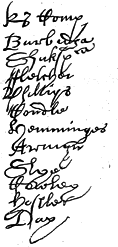
|
| [1596.] | Per Smyth. | ||
| Ric. Dixon. | Nicolas James. | ||
| Thomas More. | Thomas Bucke. | ||
| Willm Slater. | Thomas Sharpe. | ||
| Humffrey Cowper | Thomas Nycolls. | ||
| Humffrey Wheler | ffowlke Jonsons. | ||
| Roger Bragge. | George Mace. |
Yowre yssue ys to enquere whether that a woman's gowne of sadd tawnie, faced withe vellett, to the value of fyve pound; one other woman's gowne, of skattes color, pryced iijli., one kyrtle, pryce xxxs., one pettie-cote, pryce xxxs., one cloke, pryce liiis. iiijd., two daggers, pryce xvjs. viijd., one coverlett, pryce xls., and iij. thre prayer bokes, pryce xs., the xxth day of July, ao. xxxvijo. Elizabethe regine, dyd come to the handes and possession of Johane Parrett wydo or not: yf yow finde for the playntyffe, yow must assesse damages, and also for costes of the sute.
We fynd for the playntyf to be damnyfyd to the valeve of vli. ixs. iiijd. Costes, vjd.
Jury betwen Margryt Younge, plantyv, and Jane Perat, defendant.
| Phyllyp Gren | oRoger Bragg, jur. | |
| Nycolas Tybates | Rychard Tayller | |
| Robert Bydell | Edward Walt | |
| oRychard Dyxson, jur. | Henge Piggan | |
| John Whood | oNycollas James, jur. | |
| Rychard Hornbye | oThomas Bucke, jur. | |
| Robert Wylson | John Strayne | |
| Robert Janson | Laurens Holmes | |
| oThomas More, jur. | oThomas Sharpe, jur. | |
| oWyllyame Slater, jur. | oThomas Nycolles, jur. | |
| oHumfrey Couper, jur. | oFoulke Jansones, jur. | |
| oHumfrey Wheeller, jur. | oGeorge Mase, jur. |
[To this list of jurymen the following curious memorandum is attached.]
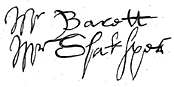
Mr. Shaxpere, one boke.
Mr. Barber, a coverlett, ij. daggars, the 3 bokes.
Ursula ffylld the apparell and the bedding clothes at Whytsontyd was twelmonth.
Emily Blacke. Dettes due to the partie ded.
/ p.55 /
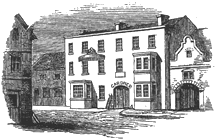
 |
---------------------------
* "This chair shall be my state, this dagger my sceptre, and this cushion my crown".—1 Henry IV, act ii, sc. 4.
---------------------------
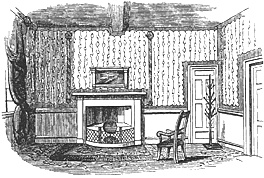
It is a morsel of certainty, snatched from the midst of the uncertainties of life; it is a sunny moment gleaming out kindly on a cloudy day; and he who has advanced some way on the pilgrimage / p.56 / of existence, knows the importance of husbanding even morsels and moments of enjoyment. "Shall I not take mine ease in mine inn?" thought I, as I gave the fire a stir, lolled back in my elbow-chair, and cast a complacent look about the little parlour of the Red Horse at Stratford-upon-Avon.*
---------------------------
* The little parlour here immortalized is the first room on the left entering the gateway of the inn, and immediately opposite Bridge Street.
---------------------------
---------------------------
† It is not an agreeable, perhaps not a wise, task to disturb a poet's thoughts. Truth will destroy the poetry of this passage. The clock was that at the Old Market Cross, not at the church, which did not contain one.
---------------------------
There was a gentle tap at the door, and a pretty chambermaid, putting in her smiling face, inquired, with a hesitating air, whether I had rung.‡
---------------------------
‡ "Sally Gardiner, the zealous housekeeper of the establishment, regrets that she did not shew herself on this occasion to our author, for she it was who actually / p.57 / rapped at the door, and by subsequently allowing pretty Hannah Cuppage to attend him with the bed-candle and warming-pan to No. 15 (immediately over the little parlour), lost an immortality from his pen. On a future visit, however, she still hopes to exclaim,—' 'Tis now midnight, and by eight o'clock to-morrow I may be made immortal.' Sally is in a state of single blessedness."—Captain Saunders' MSS. belonging to the Shaksperian Club, Stratford-on-Avon.
---------------------------
time to retire. My dream of absolute dominion was at an end; so abdicating my throne like a prudent potentate, to avoid being deposed, and putting the Stratford guide-book under my arm, as a pillow companion, I went to bed, and dreamt all night of Shakespeare, the jubilee, and David Garrick.
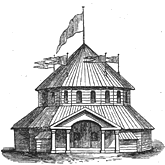
Enlargement
The next morning was one of those quickening mornings which we sometimes have in early spring; for it was about the middle of March. The chills of a long winter had suddenly given way; the north wind had spent its last gasp; and a mild air came stealing from the west, breathing the breath of life into nature, and wooing every bud and flower to burst into fragrance and beauty.
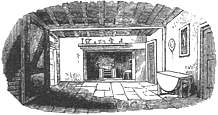
I had come to Stratford on a poetical pilgrimage. My first visit was to the house in which he was born, and where, according to tradition, he was brought up to his father's craft of wool-combing.
It is a small, mean-looking edifice of wood and plaster; / p.58 / a true nestling place of genius, which seems to delight in hatching its offspring in by-corners.
The walls of its squalid chambers are covered with
names and inscriptions, in every language, by pilgrims of all nations, ranks, and conditions, from the prince to the peasant, and present a simple, but striking instance of the spontaneous and universal homage of mankind to the great poet of nature.
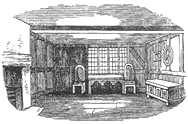
Enlargement
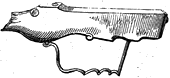
The house is shown by a garrulous old lady, in a frosty red face, lighted up by a cold blue anxious eye, and garnished with artificial locks of flaxen hair, curling from under an exceedingly dirty cap. She was peculiarly assiduous in exhibiting the relics with which this, like all other celebrated shrines, abounds. There was the shattered
|
---------------------------
* It is somewhat singular that no allusion to tobacco in any way should be found in Shakespeare. Ben Jonson and his contemporaries are constantly alluding to it.
---------------------------
smoker / p.59 / of Sir Walter Raleigh; the sword, also, with which he
![[Picture of a sword]](nwbkimg/newb_59a.gif)
![[Picture of a wooden lantern with a key in its small door]](nwbkimg/newb_59b.gif)
|
![[Picture of a chair with a broken bottom rung in front]](nwbkimg/newb_59c.gif)
|
---------------------------
* As might be anticipated, this prophecy has long ere this been fulfilled. John Ange died on October 11th, 1824. The name of Ange has belonged to Stratford for many generations, and some of his ancestors were known, no doubt, to Shakespeare.
---------------------------
It is not often that we see two streams of / p.64 / existence running thus evenly and tranquilly side by side; it is only in such quiet "bosom scenes" of life that they are to be met with. I had hoped to gather some traditionary anecdotes of the bard from these chroniclers, but they had nothing new to impart. The long interval during which Shakespeare's writings lay in comparative neglect has spread its shadow over his history, and it is his good, or evil lot, that scarcely anything remains to his biographers but a scanty handful of conjectures.
The sexton, and his companion, had been employed as carpenters on the preparations for the celebrated Stratford Jubilee; and they remembered Garrick the prime mover of the fête, who superintended the arrangements, and who, according to the sexton, was a "short, punch man, very lively, and bustling".
John Ange had assisted, also, in cutting down Shakespeare's mulberry-tree, of which he had a morsel in his pocket for sale; no doubt a sovereign quickener of literary conception. I was grieved to hear these two worthy wights speak very dubiously of the eloquent dame who shows the Shakespeare house. John Ange shook his head when I mentioned her valuable and inexhaustible collection of relics, particularly her remains of the mulberry-tree; and the old sexton even expressed a doubt as to Shakespeare having been born in her house.
I soon discovered that he looked upon her mansion with an evil eye, as a rival to the poet's tomb; the latter having, comparatively, but few visitors. Thus it is that historians differ at the very outset, and mere pebbles make / p.65 / the stream of truth diverge into different channels, even at the fountain head.
We approached the church through the avenue of limes, and entered by a gothic porch, highly ornamented, with carved doors of massive oak. The interior is spacious, and the architecture and embellishments superior to those of most country churches. There are several ancient monuments of nobility and gentry; over some of which hang funeral escutcheons, and banners dropping piecemeal from the walls. The tomb of Shakespeare is in the chancel. The place is solemn and sepulchral. Tall elms wave before the painted windows, and the Avon, which runs at a short distance from the walls, keeps up a low perpetual murmur. A flat stone marks the spot where the bard is buried. There are four lines inscribed on it, said to have been written by himself, and which have in them something extremely awful. If they are indeed his own, they show that solicitude about the quiet of the grave which seems natural to fine sensibilities, and thoughtful minds.
|
Good friend, for Jesus' sake, forbeare To dig the dust enclosed here. Blessed be he that spares these stones, And curst be he that moves my bones. |
---------------------------
/ p.68 /
This flagitious attack upon the dignity of the knight so incensed him, that he applied to a lawyer at Warwick to put the severity of the laws in force against the rhyming deer-stalker. Shakespeare did wait to brave the united puissance of a knight of the shire, and a country attorney. He forthwith abandoned the pleasant banks of the Avon and his paternal trade; wandered away to London; became a hanger-on to the theatres, then an actor, and finally wrote for the stage; and thus,through the persecution of Sir Thomas Lucy, Stratford lost an indifferent woolcomber, and the world gained an immortal poet. He retained, however, for a long time, a sense of the harsh treatment of the lord of Charlecote, and revenged himself in his writings, but in the sportive way of a good-natured mind. Sir Thomas is said to be the original of Justice Shallow, and the satire is slily fixed upon him by the justice's armorial bearings, which, like those of the knight, had white luces in the quarterings.
---------------------------
Shakespeare, when young, had, doubtless, all the wildness and irregularity of an ardent, undisciplined, and undirected genius. The poetic temperament has naturally something in it of the vagabond. When left to itself, it runs loosely and wildly, and delights in everything eccentric and licentious. It is often the turn up of a die, in the gambling freaks of fate, whether a natural genius shall turn out a great rogue, or a great poet, and had not Shakespeare's mind fortunately taken a literary bias, he might have as daringly transcended all civil, as he has all dramatic laws.
* Washington Irving is right; but can any one trace them in the cooked / p.66 / Chandos portrait, which, though probably the representation of some old Dutchman, has been palmed on the world by well-meaning but too credulous judges as a genuine likeness of the poet.
---------------------------
The inscription on the tomb-stone has not been without its effect. It has prevented the removal of his remains from the bosom of his native place to Westminster Abbey, which was at one time contemplated. A few years since, also, as some labourers were digging to make an adjoining vault, the earth caved in, so as to leave a vacant space almost like an arch, through which one might have reached into his grave. No one, however, presumed to meddle with his remains, so awfully guarded by a malediction; and lest any of the idle, or curious, or any collector of relics, should be tempted to commit depredations, the old sexton kept watch over the place for two days, until the vault was finished, and the aperture closed again. He told me that he had made bold to look in at the hole, but could see neither coffin nor bones, nothing but dust. It was something I thought to have seen the dust of Shakespeare.
Next to this grave are those of his wife, his favourite / p.67 / daughter, Mrs. Hall, and others of his family. On a tomb close by, also, is a full length effigy of his friend, John Combe, of usurious memory: on whom he is said to have written a ludicrous epitaph. There are other monuments around, but the mind refuses to dwell on anything that is not connected with Shakespeare. His idea pervades the place; the whole pile seems but as his mausoleum. The feelings, no longer checked and thwarted by doubt, here indulge in perfect confidence: other traces of him may be false and dubious, but here is palpable evidence and absolute certainty. As I trod the sounding pavement, there was something intense and thrilling in the idea, that, in very truth, the remains of Shakespeare were mouldering beneath my feet. It was a long time before I could prevail upon myself to leave the place; and, as I passed through the churchyard, I plucked a branch from one of the yew-trees, the only relic that I have brought from Stratford.
I had now visited the usual objects of a pilgrim's devotion, but I had a desire to see the old family seat of the Lucys, at Charlecote, and to ramble through the park, where Shakespeare, in company with some of the roysters of Stratford, committed the youthful offence of deer-stealing. In this hair-brained exploit we are told that he was taken prisoner, and carried to the keeper's lodge, where he remained all night in doleful captivity. When brought into the presence of Sir Thomas Lucy, his treatment must have been most galling and humiliating, for it so wrought upon his spirit as to produce a rough pasquinade, which was affixed to the park-gate at Charlecote.
Various attempts have been made by his biographers to soften, and explain away, this early transgression of the poet; but I look upon it as one of those thoughtless / p.69 / exploits, natural to his situation and turn of mind.*
* The direct evidence afforded by the Merry Wives of Windsor, that a misunderstanding of some kind had taken place between Sir T. Lucy and Shakespeare, gives this tradition a greater appearance of authenticity than any other relating to the great dramatist.
---------------------------
I have little doubt that, in early life, when running, like an unbroken colt, about the neighbourhood of Stratford, he was to be found in the company of all kinds of anomalous characters, that he associated with all the madcaps of the place, and was one of those unlucky urchins at mention of whom old men shake their heads, and predict that they will come one day to the gallows. To him the poaching in Sir Thomas Lucy's park was, doubtless, like a foray to a Scottish knight, and struck his eager, and as yet untamed imagination, as something delightfully adventurous.
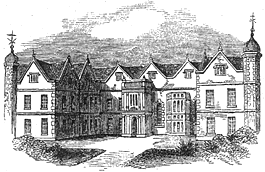
The old mansion of Charlecote, and its surrounding park, still remain in the possession of the Lucy family, and are particularly interesting from being connected with / p.70 / this whimsical but eventful circumstance in the scanty history of the bard. As the house stood at little more than three miles distance from Stratford I resolved to pay it a pedestrian visit, that I might stroll leisurely through some of those scenes from which Shakespeare must have derived his earliest ideas of rural imagery.
|
Hark ! hark ! the lark at heaven's gate sings, And Phœbus 'gins arise, His steeds to water at those springs On chaliced flowers that lies.
And winking Mary-buds begin |
/ p.72 /
My route for a part of the way lay in sight of the Avon, which made a variety of the most fanciful doublings and windings through a wide and fertile valley; sometimes glittering from among willows, which fringed its borders; sometimes disappearing among groves, or beneath green banks, and sometimes rambling out into full view, and making an azure sweep round a slope of meadow land. This beautiful bosom of country is called the Vale of the Red Horse. A distant line of undulating blue hills seems to be its boundary, whilst all the soft intervening landscape lies in a manner enchained in the silver links of the Avon.
After pursuing the road for about three miles I turned off into a foot-path, which led along the borders of fields, and under hedge-rows, to a private gate of the park; there was a stile, however, for the benefit of the pedestrian, there being a public right of way through the grounds. I delight in these hospitable estates, in which every one has a kind of property—at least as far as the foot-path is concerned. It in some measure reconciles a poor man to his lot, and what is more, to the better lot of his neighbour, thus to have parks and pleasure grounds thrown open for his recreation. He breathes the pure air as freely, and lolls as luxuriously under the shade, as the lord of the soil; and if he has not the privilege of calling all he sees his own, he has not, at the same time, the trouble of paying for it, and keeping it in order.
I now found myself among noble avenues of oaks and elms, whose vast size bespoke the growth of centuries. / p.73 / The wind sounded solemnly among their branches, and the rooks cawed from their hereditary nests in the tree-tops. The eye ranged through a long lessening vista, with nothing but a distant statue, and a vagrant deer stalking like a shadow across the opening.
There is something about these stately old avenues that has the effect of gothic architecture, not merely from the pretended similarity of form, but from their bearing the evidence of long duration, and of having had their origin in a period of time with which we associate ideas of romantic grandeur. They betoken also the long-settled dignity, and proudly concentrated independence of an ancient family; and I have heard a worthy, but aristocratic old friend observe, when speaking of the sumptuous palaces of modern gentry, that "money could do much with stone and mortar; but, thank Heaven ! there was no such thing as suddenly building up an avenue of oaks."
It was from wandering in early life among this rich scenery, and about the romantic solitudes of the adjoining park of Fullbroke, which then formed a part of the Lucy estate, that some of Shakespeare's commentators have supposed he derived his noble forest meditations of Jaques, and the enchanting woodland pictures in As you like it. It is in lonely wanderings through such scenes that the mind drinks deep, but quiet, draughts of inspiration, and becomes intensely sensible of the beauty and majesty of nature. The imagination kindles into reverie and rapture; vague, but exquisite images and ideas keep breaking upon it, and we revel in a mute and almost incommunicable luxury of / p.74 / thought. It was in some such mood, and perhaps under one of those very trees before me, which threw their broad shades over the grassy banks and quivering waters of the Avon, that the poet's fancy may have sallied forth into that little song, which breathes the very soul of a rural voluptuary:—
|
Under the greenwood tree, Who loves to lie with me, And tune his merry throat Unto the sweet bird's note? Come hither, come hither, come hither. Here shall he see No enemy, But winter and rough weather. |
I had now come in sight of the house. It is a large building of brick with stone quoins, and is in the gothic style of Queen Elizabeth's day, having been built in the first year of her reign. The exterior remains very nearly in its original state, and may be considered a fair specimen of the residence of a wealthy country gentleman of those days. A great gateway opens from the park into a kind of court-yard, in front of the house, ornamented with a grass plot, shrubs, and flower beds. The gateway is in imitation of the ancient barbican; being a kind of outpost, and flanked by towers, though evidently for mere ornament instead of defence.
The front of the house is completely in the old style; with stone-shafted casements, a great bow-window of heavy stone work, and a portal with armorial bearings over it, / p.75 / carved in stone. At each corner of the building is an octagon tower surmounted by a gilt ball and weathercock.
The Avon, which winds through the park, makes a bend just at the foot of a gently sloping bank, which sweeps down from the rear of the house. Large herds of deer were feeding or reposing upon its borders, and swans were sailing majestically upon its bosom. As I contemplated the venerable old mansion, I called to mind Falstaff's encomium on Justice Shallow's abode, and the affected indifference and real vanity of the latter:—
| Falstaff.— | You have here a goodly dwelling, and a rich. |
| Shallow.— | Barren, barren, barren; beggars all, beggars all, Sir John:—marry, good sir. |
/ p.76 /
After prowling about for some time, I at length found my way to a lateral portal, which was the every day entrance to the mansion.
I was courteously received by a worthy old housekeeper, who, with the civility and communicativeness of her order, showed me the interior of the house. The greater part has undergone alterations, and been adapted to modern tastes, and modes of living: there is a fine old oaken staircase, and the great hall, that noble feature in an ancient manor-house, still retains much of the appearance it must have had in the days of Shakespeare. The ceiling is arched and lofty, and at one end is a gallery, in which stands an organ. The weapons and trophies of the chase, which formerly adorned the hall of a country gentleman, have made way for family portraits. There is a wide hospitable fire-place, calculated for an ample old-fashioned wood-fire, formerly the rallying place of winter festivity. On the opposite side of the hall is the huge gothic bow-window, with stone-shafts, which looks out upon the court-yard. Here are emblazoned, in stained-glass, the armorial bearings for many generations, some being dated in 1558. I was delighted to observe in the quarterings the three white luces, by which the character of Sir Thomas was first identified with that of Justice Shallow. They are mentioned in the first scene of the Merry Wives of Windsor, where the justice is in a rage with Falstaff, for having "beaten his men, killed his deer, and broken into his lodge". The poet had, no doubt, the offences of himself and his comrades in mind at the time, and we may suppose the family pride and vindictive threats / p.77 / of the puissant Shallow to be a caricature of the pompous indignation of Sir Thomas.
Shallow. Sir Hugh, persuade me not; I will make a star-chamber matter of it; if he were twenty Sir John Falstaffs, he shall not abuse Robert Shallow, esquire.
Near the window thus emblazoned hung a portrait, by Sir Peter Lely, of one of the Lucy family, a great beauty of the time of Charles the Second: the old housekeeper shook her head as she pointed to the picture, and informed me that this lady had been sadly addicted to cards, and had gambled away a great portion of the family estate, among which was that part of the park where Shakespeare and his comrades had killed the deer. The lands thus lost had not been entirely regained by the family even at the present day. It is but justice to this recreant dame to confess that she had a surpassingly fine hand and arm.
By cock and pye, sir, you shall not away to night. . . . I will not excuse you; / p.80 / you shall not be excused; excuses shall not be admitted; there is no excuse shall serve; you shall not be excused. . . . . Some pigeons, Davy; a couple of short-legged hens; a joint of mutton; and any pretty little tiny kick-shaws, tell William Cook.
I now bade a reluctant farewell to the old hall. My mind had become so completely possessed by the imaginary scenes and characters connected with it, that I seemed to be actually living among them. Everything brought them, as it were, before my eyes, and as the door of the dining-room opened I almost expected to hear the feeble voice of Master Silence quavering forth his favourite sally:—
|
'Tis merry in the hall, when beards wag all, And welcome merry Shrove-tide. |
|
To shallow Rifers to whose Falls Melotious Birts sing Matricalls: There will me make our Peds of Roses, And a thousand fragrant posies. |
|
Melotious Birds sing Matrigalls: When as I sat in Pabilon: And a thousand vagram Poses. To shallow, &c.
|
/ p.85 /
Evan. Pray you gife me my Town, or else keep it in your Arms.
/ p.86 /
Evan. He has no more knowledge in Hibocrates and Galen, and he is a knafe besides: a cowardly knave as you woult tesire to be acquaint with all.
Page. I warrant you he's ye man yt should fight with him.
Slender. O sweet Anne Page.
/ p.87 /
Host. Peace, I say, Gallia and Wallia, French and Welch, Soul-Curer and Body-Curer.
Caius. I, dat is very good, excellaunt.
Host. Peace, I say; hear mine Host of the Garter; am I politick? am I subtle ? am I machivell? shall I loose my Doctor? No. He gives me the potions and ye motions. Shall I loose my Parson ? my Priest ? my Sr. Hugh ? No, he gives me the Proverbs and the No-verbs. Give me thy hand (celestiall) so; Boys of Art, I have deceiv'd you both; I have directed you to wrong places; your hearts are mighty, your skins are whole, and let burnt-sack be the issue. Come, lay their Swords to pawne; Follow me, lad of peace, follow, follow.
Shallow. Trust me, a mad host: follow, Gent.
Slender. O sweet Ann Page.
Caius. Ha' do perceive dat? Have you make-a-desott of vs, ha ha?
Evan. This is well, he has made vs his vlowting-stog; I desire yt we may be Friends, and let vs knog our prains together to be revenge on this scurvy cogging companion the Host of the Garter.
Caius. By gar, with all my heart; he promise me where is Ann Page; by gar, he deceive a-me too.
Evan. Well, I will smite noddles. Pray follow.
|
idolatrous fancy Would consecrate his relics, |
is pardonable in all enthusiastic admirers of the bard. But in spite of the sanctity which should invest such things, and which gives to his natal town an interest and an importance to which it could never otherwise lay claim; and attractive enough to induce visitors from the farthest regions of the civilized world; the spirit of renovation and change has altered or obliterated much that would gratify such earnest pilgrims. It is exactly eleven years ago since I first visited Stratford, and made some few sketches there;
Believe me, your's most sincerely, | |
| 21 Feb. 1850. | F. W. FAIRHOLT. |

|
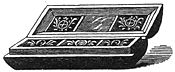
|
/ p.92 /
The real history of the lantern is, that Hart, the glazier, a descendant from the poet's sister, formed it out of the broken glass of the birth-place; which he inherited, and dwelt in. The following extract from a pamphlet by Mrs. Hornby, containing her account of the relics, may amuse the reader:—
"William Shakspeare, the immortal poet, was born April 23rd, 1564; baptized, 26th; died, April 23rd, and buried, 26th, 1616, in the chancel of Stratford church. Joan Shakspeare, sister to William Shakspeare, married to William Hart, a hatter, in Stratford, he died in 1616. William Hart, their son, was a player, in London. He was instructed by William Shakspeare, his uncle. Buried March 22nd, 1639. Left issue Charles Hart, the celebrated comedian in the reign of Charles II. Shakspeare gave, by will, to his sister's descendant, his birth-place and other property, after the death of his grand-daughter.
"To the memory of Thomas Hart, who was the fifth descendant in a direct line from Joan, eldest daughter of Joan Shakspeare, and sister to the immortal William Shakspeare. He died, May 23rd, 1793, aged 64. There is now surviving one daughter of Thomas Hart, Jane Iliff. And also four children of Mary, sister of Thomas Hart, viz., Joseph Mallison Smith, William Joan Smith, George and Sarah Smith. William Shakspeare Hart, John Hart, Sarah Hart, sons and daughter of John Hart.
"Thomas Hart, son of Thomas Hart, was married September 15th, 1791, he had one daughter baptized, January 18th, 1793, who died young. Thomas Hart lived / p.93 / in the house where Shakspeare was born, which was given him, and tied on his wife and her heirs. He requested Thomas Hornby, a relation by marriage, to take to the remains of the relics belonging to Shakspeare, and rent the house where Shakspeare was born, and take the things by valuation. The articles were valued by Thomas Taylor, auctioneer, of Stratford, May 20th, 1793; he lived there till his death, and his widow lived there till October, 1820, when she was compelled to leave by an extraordinary charge of rent. She now occupies a house nearly opposite.
1. Shakspeare's Chair.
|
"Goliah comes with sword and spear, And David with his sling; Altho' Goliah rage and swear, Down David doth him bring". |
/ p.95 /
21. A Goblet, with the arms of Shakspeare engraved upon it; made out of the highly-famed mulberry-tree.
[ p.96 ]
Vicesimo Quinto Die  Mtij Anno Regni Dni nri Jacobi unice Rx Anglie &c. Decimo Quarto & Sextie xlixo Annoq3 Dni 1616 Mtij Anno Regni Dni nri Jacobi unice Rx Anglie &c. Decimo Quarto & Sextie xlixo Annoq3 Dni 1616 | |
T. Wmj Shackspeare | |
| In the name of god Amen I Willim Shackspeare of Stratford upon Avon in the countie of warr gent in pfect health & memorie god be praysed doe make & Ordayne this my last will & testamt in manñ & forme followeing That ys to saye ffirst I Comend my Soule into the hands of god my Creator hoping & assuredlie beleeving through th onelie meritts of Jesus Christe my Saviour to be made ptaker of lyfe everlastinge And my bodye to the Earth whereof yt ys made Itm I Gyve & bequeath unto my in discharge of her marriage porcon wthin one yeare after my deceas wth consideracon after the Rate of twoe Shillings in the pound for soe long tyme as the same shalbe unpaied unto her after my Deceas & the ffyftie pounds Residewe thereof upon her Surrendring of or gyving of such sufficient securitie as the overseers of this my Will shall like of to Surrender or grante All her estate and Right that shall discend or come unto her after my deceas or that shee nowe hath of in or to one Copiehold teñte wth thapptenncs lyeing and being in Stratford upon Avon aforesaied in the saied countie of warr being pcell or holden of the mannor of Rowington unto my Daughter Susanna Hall & her heires for ever Itm I Gyve & bequeath unto my saied Daughter Judith One hundred & ffyftie pounds more if she or Anie issue of her bodie be Lyvinge att thend of three yeares next ensueing the Daie of the Date of this my Will during wch tyme my executors to paie her consideracon from my deceas according to the Rate aforesaied And if she Dye wthin the saied terme wthout issue of her bodye then my Will ys & I Doe gyve & bequeath One Hundred Pounds thereof to my neece Elizabeth Hall & the ffiftie Pounds to be sett fourth by my executors during the lief of my Sister Johane Harte & the use & pffitt thereof cominge shalbe payed to my saied Sister Ione & after her deceas the saied Ili shall Remaine Amongst the children of my saied Sister Equallie to be Devided Amongst them But if my said Daughter Judith be lyving att thend of the saied three yeares or anye yssue of her bodye then my will ys & soe I Devise & bequeath the saied Hundred & ffiftie pounds to be sett out by my executors & overseers for the best benefitt of her & her issue & the Stock not to be paied unto her soe long as She shalbe marryed & covert Baron the house wth thapptenncs in Stratford wherein she dwelleth for her naturall lief under the yearlie Rent of xiid Itm I gyve & bequeath [ p.97 ] unto her three sonns Willim Harte Hart & Michaell Harte ffyve pounds A peece to be payed wthin one yeare after my deceas (except my brod silver & gilt bole) that I now have att the date of this my will Itm I gyve & bequeath unto the Poore of Stratford aforesaied tenn pounds to Mr. Thomas Combe my Sword to Thomas Russell Esquier ffyve pounds & to ffrauncis Collins of the Borough of warr in the countie of warr gent thirteene pounds Sixe shillings and Eight pence to be paied wthin one Yeare after my deceas Itm I gyve & bequeath to to Willim Raynolds gent xxvj viij to buy him A Ringe to my godson Willm Walker xxs in gold to Anthonye Nashe gent xxvjs viiid & to Mr. John Nashe xxvjs viijd & to my ffellowes John Hemyngs Richard Burbage & Henry Cundell xxvj viij Apeece to buy them Ringes Itm I Gyve will bequeath & devise unto my Daughter Susanna Hall for better enabling of her to pforme this my will & towards the pformans thereof All that Capitall messuage or teñte wth thapptenncs in Stratford aforesaid called the newe place wherein I nowe Dwell & twoe Messuags or teñtes wth Messuags or teñtes wth thapptenncs scitvat lyeing & being in Henley Streete wthin the borough of Stratford aforesaied And all my barnes stables Orchards gardens lands teñts & hereditamts whatsoev scituat lyeing & being or to be had Receyved pceyved or taken wthin the towns Hamletts Villags ffields & grounds of Stratford upon Avon Oldstratford Bushopton & Welcombe or in anie of them in the saied countie of warr And alsoe All that Messuage or teñte wth thapptenncs wherein One John Robinson dwelleth scituat lyeing & being in the blackfriers in London nere the Wardrobe & all othr my lands teñts & hereditamts whatsoev To have & to hold All & singler the saied pmiffs wth their App
rtenntcs unto the saied Susanna Hall for & during the terme of her naturall lief & after her deceas to the first sonne of her bodie lawfullie yssueing & to the heires Males of the bodie of the saied first Sonne lawfullie issueinge & for defalt of such issue to the Second Sonne of her bodie lawfullie yfsuinge and to the heires Males of the bodie of the saied Second Sonne lawfullie yfsuinge and for defalt of such heires to the third Sonne of the bodie of the said Susanna Lawfullie yssueing & of the heires males of the bodie of the saied third sonne lawfullie yssueing And for defalt of such yssue the same soe to be & Remaine to the ffourth Itm I gyve unto my wief my second best bed wth the furniture Itm I gyve & bequeath to my saied Daughter Judith my broad silver gilt bole All the Rest of my goods Chattels Leases plate Jewels & household stuffe whatsoev after my Detts and Legasies paied & my funerall expences discharged I gyve devise & bequeath to my Sonne in Lawe John Hall gent & my Daughter Susanna his wief whom I ordaine & make executors of this my Last will & testamt And I doe intreat & Appoint the saied Thomas Russell Esquier & ffrauncis Collins gent to be overseers hereof And doe Revoke All form wills & publishe this to be my last will & testamt In Witness whereof I have hereunto put my [signed:] William Shakespeare | |
|
Witness to the publishing hereof, Fra: Collyns Julyus Shawe John Robinson Hamnet Sadler Robert Whattcott |
Probatum cora Magri Willimi Byrde legum Dcore Comisson &c. xxiido die menss Junij Anno Dni 1616 Juramto Johannis Hall unius ex &c. Cui &c. De bene &c. Jurat.—Resvat ptate &c. Susanne Hall alt ex &c. cu? venit &c. petitur. (Invt ext)
|

|